011 min
Where flow shows up
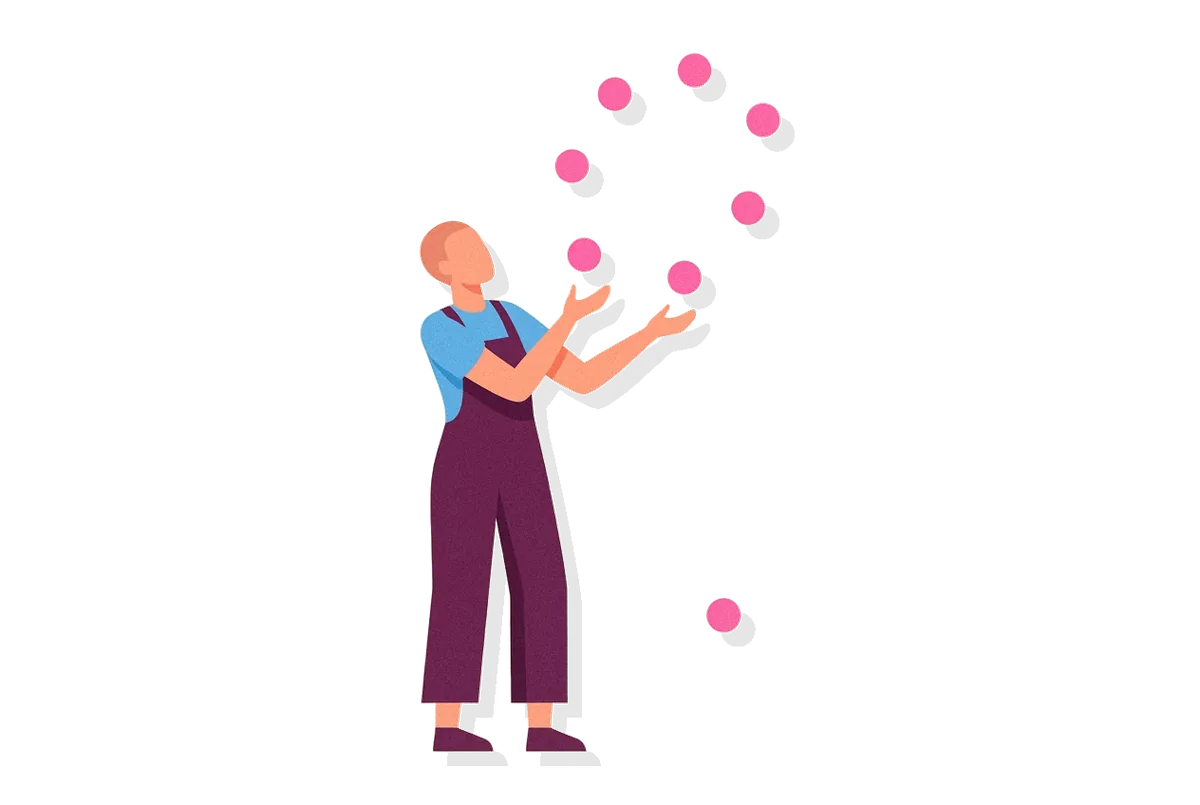
An engineer sits down to fix a tricky bug at the start of the afternoon. The problem is hard enough to demand full attention but not so hard that it feels hopeless. They start tracing, and the next thing they notice is that two hours have passed, a mug of coffee has gone cold, and they never once thought about their phone. They were not forcing concentration; the task pulled it out of them. Afterward they describe the session as the best part of the day, even though it was also the hardest.
That is flow: the state where attention, action, and the task fuse, and the effort of concentrating disappears into the doing. It is not the same as merely enjoying something or relaxing. Flow shows up specifically in demanding activities, at the point where a person's ability is stretched to meet a challenge that is real but achievable. Drop the challenge and the same person gets bored; raise it past their skill and they get anxious. Flow lives in the narrow band between the two, which is why it feels both effortful and effortless at once.
022 min
Why flow happens
Csikszentmihalyi's model says flow depends on a balance between the challenge of a task and the skill a person brings to it. When challenge and skill are both high and roughly matched, attention narrows onto the task and the constant background chatter of self-monitoring goes quiet. The mind has just enough to do that there is no spare capacity left for distraction or self-consciousness — a demand that lines up neatly with how limited working memory actually is.
The balance is not enough on its own. Flow theory holds that three conditions must be met. The activity needs clear goals, so attention has a direction. It needs immediate feedback, so the person can adjust moment to moment and knows whether they are on track. And it needs that challenge-skill match, so the task is within reach but not trivial. Remove any one and flow tends to collapse: a goal with no feedback leaves a person guessing; feedback with no clear goal has nothing to steer toward.
This is why flow is fragile in ordinary work. An interruption resets attention and breaks the feedback loop. A vague objective removes the clear goal. And a task pitched wrong for the person's skill — a senior engineer on trivial tickets, a beginner on an impossible one — never enters the band where flow is possible. The state is less a mood a person can summon than a byproduct of getting those conditions right.
031 min
Where flow comes from
Mihaly Csikszentmihalyi, a Hungarian-American psychologist, first presented the concept in his 1975 book Beyond Boredom and Anxiety. He had become fascinated by artists — painters especially — who would get so lost in their work that they pushed through hunger, fatigue, and discomfort to keep going, and who then lost interest in the finished painting almost immediately. The reward was clearly in the doing, not the result.
The term itself came from his interviews. Several people described the experience using the metaphor of being carried along by a current of water — "It was like floating," "I was carried on by the flow" — and Csikszentmihalyi kept their word. He went on to develop the experience sampling method to study it rigorously: participants carried a pager that beeped at random times, and each time it went off they recorded what they were doing and how they felt. This let him catch flow as it happened in real life rather than relying on people's memories of it, and the data behind flow theory comes largely from these real-time samples.
041 min
Examples of flow
The most-cited real finding about flow at work comes from a 1989 study by Csikszentmihalyi and Judith LeFevre, published in the Journal of Personality and Social Psychology. Using the experience sampling method with adult workers, they found that the great majority of flow experiences were reported while people were working, not during leisure — even though the same people said they were more motivated during leisure and often wished they were doing something else while at work. People were having their best, most absorbed experiences at their jobs and misremembering their jobs as the part of life they wanted to escape.
A second, illustrative case shows the challenge-skill balance failing in a normal workplace. A designer is put on a run of small, well-understood tickets for a week. They are fully skilled for the work, so nothing stretches them, and they spend the week restless, checking messages, unable to get absorbed. The following week they are handed an ambiguous, hard redesign that matches their ability, and they lose whole afternoons to it happily. Nothing about the designer changed between the two weeks. Only the match between the task's difficulty and their skill did.
052 min
How flow shows up in product, design, and teams
For a product designer, the three conditions of flow are a design brief for engagement. A well-made tool gives its user a clear goal at each step, immediate feedback on every action, and a difficulty curve that keeps pace with growing skill. Games do this deliberately — levels get harder as players get better — but the same logic applies to any product a person uses repeatedly. A tool that gives no feedback, or that stays trivially easy after the user has mastered it, will not hold attention, whatever else it does well.
For a manager, flow is a lens on how work is assigned. Someone stuck on tasks far below their skill will be bored and disengaged; someone thrown far past their skill will be anxious and stalled. Matching a person's assignments to just above their current ability is what keeps them both learning and absorbed, and it is a more precise instruction than "keep people challenged."
For an engineer, flow explains why interruptions cost more than the minutes they take. Flow depends on an unbroken feedback loop and sustained attention, so a single interruption does not just cost the interruption's length — it drops the person out of a state that took time to build and has to be rebuilt from scratch. Protecting blocks of uninterrupted time is protecting the conditions flow needs, which is also why sustained attention and demanding creative work both suffer badly under constant context-switching.
061 min
How to set up the conditions for flow
Flow cannot be willed directly, but its three conditions can be arranged, so the practical move is always to build the conditions and let the state follow. Start by making the goal of a work session concrete before beginning — "fix this specific bug," not "work on the codebase" — so attention has somewhere to point.
Next, shorten the feedback loop. Anything that lets a person see the result of each action quickly — a fast test suite, a live preview, a visible progress marker — keeps them able to adjust and stay absorbed. Long gaps between action and result are where attention leaks out.
The three levers, in order of what breaks flow fastest: protect unbroken time (attention), tighten the feedback loop, and pitch the task just above current skill.
Finally, tune the difficulty. If a task feels boring, the fix is usually to add a constraint that raises the challenge — a tighter deadline, a higher quality bar, a harder version of the same problem. If it feels overwhelming, break it into a piece that sits just inside current skill. One honest limit: flow is a good state for absorbed execution, but it is not the goal of all work. Some tasks — reviewing, planning, coordinating — are meant to be interrupted, and forcing flow onto them is a mistake.
071 min
Common misunderstandings about flow
The most common error is treating flow as a synonym for concentration or hard work. It is narrower than that. Flow specifically requires the challenge-skill balance, clear goals, and immediate feedback; grinding through a boring task with great focus is concentration, but it is not flow, and it does not feel the same.
A second misunderstanding is that flow is always good and more of it is always better. Flow is a state of deep, narrow absorption, which is exactly wrong for work that needs breadth — noticing a colleague's blocker, questioning whether the task is worth doing at all, stepping back to check direction. A person in flow on the wrong task will happily build the wrong thing for hours. The state does not judge whether the task deserves the attention; it only supplies the attention.
A third: flow is often sold as a productivity trick you can switch on. It cannot be summoned on demand. It is a byproduct of conditions — matched difficulty, a clear goal, tight feedback, and protected attention — and the honest advice is to build those conditions, not to try to force the feeling itself.
081 min
Flow vs. nearby concepts
Flow is easy to confuse with hyperfocus, and they overlap, but the two are described differently. Flow is defined by the challenge-skill balance and is characterized as a positive, enjoyable, optimal experience. Hyperfocus is simply intense, prolonged concentration on one thing, and it is not always described in a positive light — it can lock a person onto an unimportant task or make them lose necessary awareness of their surroundings. Flow implies the task was well matched and worthwhile; hyperfocus makes no such claim.
It is also distinct from "deep work," a popular term for long, distraction-free blocks of cognitively demanding effort. Deep work is a practice you schedule — a way of arranging time and attention; flow is a psychological state that such practice is trying to create but cannot guarantee. You can do deep work all afternoon and never enter flow if the task is pitched wrong. And flow differs from ordinary motivation: motivation is the drive to start or continue a task, while flow is a quality of the experience once you are absorbed in it. The 1989 work study showed the two can even pull apart — people in flow at work still reported wanting to be somewhere else.
091 min
Where the evidence on flow is contested
The challenge-skill model is intuitive, but it has drawn measured criticism. The sharpest objection is about the balance claim itself: some studies find that a high challenge-skill match does not reliably produce flow, and that the original quadrant model — flow when both are high, anxiety when challenge exceeds skill, boredom when skill exceeds challenge, apathy when both are low — oversimplifies what actually predicts the state. Critics point out that two people with the same challenge-skill ratio can have very different experiences, so the ratio alone cannot be the whole story.
A second, methodological caution concerns how flow is measured. Much of the evidence rests on self-reports gathered through the experience sampling method, which is a genuine advance over relying on memory but still depends on people accurately naming a fleeting internal state, sometimes after the fact. That leaves room for the concept to be stretched: nearly any pleasant, absorbed moment can get labeled "flow," which makes the theory hard to falsify. The reasonable practitioner position is that flow names something real and useful about matched-difficulty absorption, while treating the tidy quadrant diagram as a teaching aid rather than a precise law.
?8 questions
Questions people ask
What is a flow state in simple terms?
Who came up with the concept of flow?
What conditions are needed to enter flow?
What is the difference between flow and hyperfocus?
Can you force yourself into flow?
Is flow the same as being productive?
Do people experience flow more at work or at leisure?
Is flow theory scientifically proven?
§5 sources
Sources and further reading
Csikszentmihalyi, M. (1975). Beyond Boredom and Anxiety. San Francisco: Jossey-Bass. The first presentation of the flow concept.
Csikszentmihalyi, M., & LeFevre, J. (1989). "Optimal experience in work and leisure." Journal of Personality and Social Psychology, 56(5), 815–822. DOI 10.1037/0022-3514.56.5.815. The experience-sampling study of flow at work.
Csikszentmihalyi, M. (1990). Flow: The Psychology of Optimal Experience. New York: Harper & Row. The book-length treatment.
Flow (psychology)) — Wikipedia's overview of the definition, the three conditions, and the model's critics.
Show all 5 sourcesShow fewer sources
What Is Flow in Positive Psychology? — a plain-language summary of the conditions and characteristics of flow.