012 min
Where the endowment effect shows up
An illustrative case, using a role rather than a person. A product manager is looking at a feature used by 1.8 percent of accounts, costing two engineering days a month to maintain. Their team designed and shipped it two years ago. The proposal to remove it comes up in a planning meeting, and they argue to keep it. The reasons they give are real: some of those accounts are large, removal needs a migration path, the data might be wrong.
Now change one input and run it again. Everything is the same except that the feature arrived through an acquisition eighteen months ago, and nobody in the room built it. Same usage figure, same maintenance cost, same customers. This time the meeting agrees to remove it in about four minutes.
The decision reversed, and no fact about the feature changed. What changed was who held it.
The moment the effect starts is observable, and it is worth learning to hear. It is the point where the question silently shifts from is this worth having to am I willing to give this up. Those are different questions, and people answer them with different numbers. Kahneman, Knetsch and Thaler showed in 1990 that the gap between them is large, stable, and does not close when people are given repeated chances to learn.
The pattern generalises well past feature removal. Anything you already hold — a headcount slot, a contract, a URL, a paragraph in a document you wrote — is priced by a different mental operation from the one that would price it if you did not hold it yet.
022 min
Why the endowment effect happens
The standard account is loss aversion. Kahneman, Knetsch and Thaler state it directly in the 1990 paper: the endowment effect "is a manifestation of 'loss aversion,' the generalization that losses are weighted substantially more than objectively commensurate gains."
Unpack that sentence, because it carries the whole mechanism. People do not evaluate an outcome against zero. They evaluate it against a reference point, which is usually where they currently are. Owning the object moves the reference point. Before you own it, acquiring it is a gain of one object. After you own it, parting with it is a loss of one object. The object did not change. Its position relative to your reference point did, and losses are counted at a steeper rate than gains of the same size.
A competing account
Loss aversion is not the only explanation on the table, and honest writing about this concept has to say so.
Ziv Carmon and Dan Ariely proposed in 2000 that buyers and sellers are simply attending to different things. A buyer thinks mostly about the money they are about to part with, because that is what the transaction costs them. A seller thinks mostly about the thing they are about to part with. Each side focuses on what they forgo, and each therefore prices the trade using whichever side of it feels more vivid.
The two accounts predict the same gap in the standard experiment and differ elsewhere. Loss aversion says the gap comes from ownership. Focusing on the forgone says it comes from which side of the exchange holds attention, which can be manipulated without changing who owns anything.
Why the effect is adaptive
The usual argument is that a stronger weight on losses is a reasonable default for an organism that can be ruined by one bad loss but rarely transformed by one good gain. That argument is plausible and is not settled evidence, so treat it as a hypothesis rather than a finding.
031 min
Where the endowment effect comes from
Richard Thaler named it in 1980. Kahneman, Knetsch and Thaler credit him precisely: Thaler "labeled the increased value of a good to an individual when the good becomes part of the individual's endowment the 'endowment effect.'" His original evidence was a question about risk. The compensation people demanded to accept a 0.001 chance of sudden death was one or two orders of magnitude larger than what they would pay to remove the same risk they already faced.
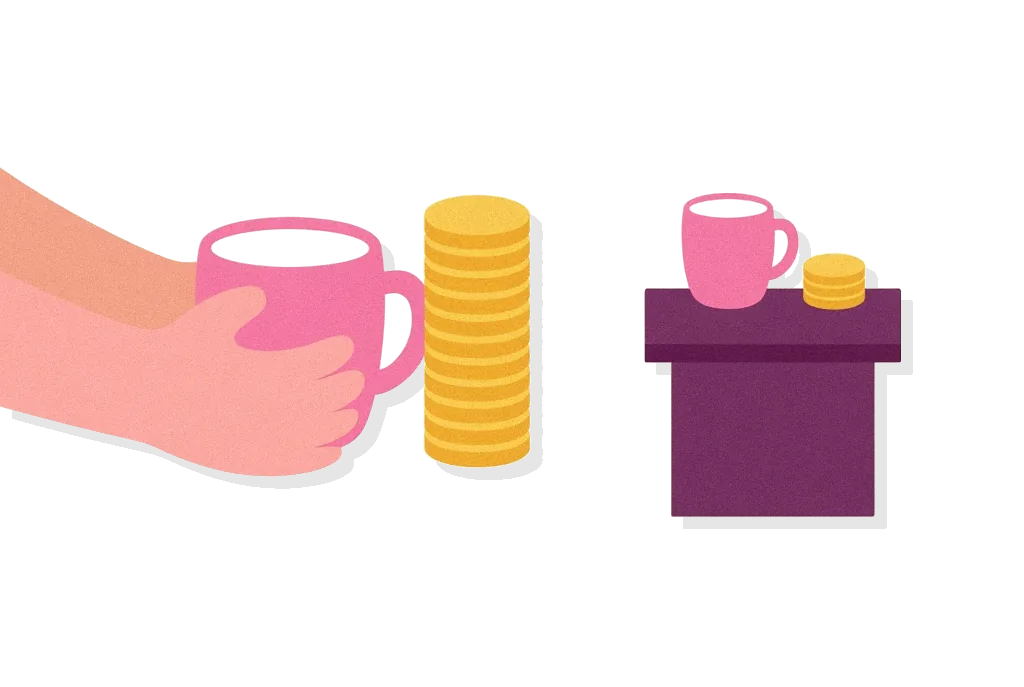
The experiment everyone cites came a decade later. In the 1990 Journal of Political Economy paper, Kahneman, Knetsch and Thaler handed coffee mugs to half the participants in a classroom and ran an open market between mug owners and non-owners. If ownership does not change value, roughly half the mugs should change hands. Over four trading rounds, the median seller would not go below $5.25 and the median buyer would not go above $2.25. Eleven trades were expected each round. Four, one, two and two occurred.
The result held up over repeated rounds, which is the detail that rules out inexperience as the explanation.
041 min
Individual effects
For one person, the cost is a specific class of transaction that never happens.
The direction of the error is consistent and predictable: you overprice what you hold and therefore keep it too long. An engineer keeps a service they wrote running past the point where deleting it would be cheaper. A founder holds equity through a down round at a valuation nobody will pay. A designer defends a pattern in the system they authored against a replacement they would have accepted from anyone else.
The loss is not the object. It is the better use of the same resources that the trade would have released. That is why the damage is hard to notice from inside: there is no moment where anything visibly goes wrong, only a series of reasonable-sounding decisions to hold.
The second-order cost is that the reasons feel like analysis. In the 1990 experiments nobody reported feeling attached to a mug. They reported a price. Ownership changes the number before it reaches conscious justification, and the justification arrives afterwards sounding like judgement.
051 min
Systemic effects
Across a group, the effect compounds through a specific mechanism: trades that would benefit both sides do not clear, and the shortfall is measurable.
Kahneman, Knetsch and Thaler built the measurement into the 1990 design. They recorded the ratio of trades that occurred to trades that were predicted. In the mug markets that ratio was 0.20. Four fifths of the mutually beneficial exchanges available in the room simply did not take place. In the pen markets it was 0.41. In a later run at the University of British Columbia with 117 students, nineteen trades were expected and one occurred, a ratio of 0.05.
That is the shape of the systemic cost in any organisation that allocates by negotiation between holders. A team will not release a headcount slot to a team that needs it more. A department will not hand over a system it maintains badly. Each holder prices their own position using the selling question and prices the alternative using the buying question, so the two numbers rarely meet.
The compounding happens because the shortfall is invisible in the records. An organisation can measure the reallocations it made. It has no log of the ones that were worth making and did not happen.
062 min
Examples
A real case, with a price tag. The day before their university's team played in the NCAA Final Four basketball tournament, Ziv Carmon and Dan Ariely had research assistants phone 93 Duke students who had entered a lottery for the right to buy a ticket. Some had won a ticket; some had not. The researchers asked winners for the lowest price they would sell at, and non-winners for the highest price they would pay.
| Selling price | Buying price | |
|---|---|---|
| Trimmed mean | $2,411 | $166 |
| Median | $1,500 | $150 |
The two groups were separated by a lottery draw and nothing else. Every winner had been a plausible loser a few days earlier. The published gap in the trimmed means is roughly fifteen to one.
The study appeared in the Journal of Consumer Research in 2000 under the title Focusing on the Forgone, and the authors used it to argue for the attention-based mechanism rather than loss aversion. It is worth citing carefully for that reason: the numbers are not in dispute, the interpretation of them is.
An illustrative contrast. A subscription product offers a free trial with every paid feature switched on. At the end of the trial, a user is not deciding whether to buy those features. They are deciding whether to give up features they have been using for fourteen days. The decision point the company designed is a purchase. The decision the user experiences is a loss. That gap is the whole reason the pattern exists, and a team that does not name it will keep mistaking trial conversion for demand.
072 min
How the endowment effect shows up in product, design, and AI
Deliberately used. Free trials with everything enabled, sample allocations of credits, and "your workspace" framing all hand the user provisional ownership before asking for money. So does a downgrade flow that lists what the user will lose rather than what the cheaper plan includes. None of this is deception, and all of it works on the mechanism above.
The line worth holding is between creating ownership and making its removal hard. Enabling a feature during a trial is the first. Requiring a phone call to cancel is the second, and it borrows the language of the first to excuse itself.
Accidentally suffered: deprecation. Every team that has tried to remove an endpoint, a setting, or a pricing tier has met users whose stated valuation of it exceeds anything they ever paid. Both sides of that conversation are inside the effect: the users hold the feature, and the team holds the replacement they built.
Accidentally suffered: migration. The effect is a large part of why switching costs are higher than feature comparisons predict. A customer evaluating your product against their current one is not comparing two products. They are comparing a gain against a loss, and weighting the loss more heavily. This is why trials, imports and reversible migrations move deals that feature tables do not.
For teams building with models. The same asymmetry appears in evaluation. A team that has spent a quarter on a prompt, a retrieval index, or a fine-tune will hold on to it against a simpler alternative that scores the same. The guard is procedural: fix the evaluation set before you build, and compare against the simplest baseline every time, not only at the start.
082 min
How to guard against the endowment effect
Awareness is not a technique, and the evidence is unusually blunt about it. In the 1990 experiments the gap survived four rounds of trading with full information about prices. What reduces it is changing the question or changing the procedure.
Use the chooser question. This comes directly out of the original research, which makes it the best-evidenced option on the list. Kahneman, Knetsch and Thaler ran a third group alongside buyers and sellers: choosers, who did not own a mug but picked, at each price, between the mug and the cash. A chooser is in exactly the same economic position as a seller. Their median valuation was $3.12. The sellers' was $7.12.
Do not ask "what would we accept to give this up?" Ask "if we held the cash instead, at what price would we buy this back?"
Because the two framings are economically identical, any gap between your answers is the effect, measured on your own decision.
Run the reverse test. Before defending something you hold, state the case for acquiring it today at its current cost. If you would not buy it, you are holding it for reasons that are not about its value.
Separate the decider from the owner. Have the review of a feature, a system or a contract led by somebody who did not build or sign it, and give them the data rather than the history.
Buy experience where you can. John List's 2003 field study found that traders converged toward the economically predicted behaviour as their market experience increased, and that experience rather than selection was doing the work. Inside a company this translates to a real if slow remedy: people who make the same kind of divestment decision repeatedly, and see the outcomes, get better at it.
091 min
Common misunderstandings
"People value anything they own more." Not anything. Kahneman, Knetsch and Thaler predicted in advance that goods held purely for resale would show no effect, and tested it in the same paper. In markets for tokens redeemable for cash, trading volumes matched the prediction almost exactly: 12, 11 and 10 trades against 11 expected. If the thing is held only to be exchanged, ownership does not move its value. The distinction is not price; it is whether the holder ever intended to use it.
"It is the same as sunk cost." The mug owners had spent nothing. They were handed the mugs. An effect that appears with zero investment cannot be an effect of investment.
"It is irrational, so remove it." Sometimes the higher selling price is correct. A holder often knows things a buyer does not: how much a system really costs to replace, which customers depend on it, what broke last time. The question to ask is whether the premium tracks private information or only possession. If you cannot name the private information, it is possession.
Where guarding against it would be a mistake. In a negotiation, the counterparty's endowment effect is real information about what they will actually accept. Treating their number as irrational and refusing to move is a good way to not close.
101 min
Endowment effect vs. nearby concepts
| Compared with | The axis that separates them |
|---|---|
| PsychologyLoss aversion | |
| PsychologySunk cost fallacy | |
| Not in the library yetStatus quo bias | |
| PsychologyIKEA effect |
The fastest way to tell endowment from sunk cost in a live meeting: ask what was spent. If the answer is nothing, and the reluctance is still there, it is the endowment effect.
112 min
Where the evidence is contested
This is one of the better-attacked findings in behavioural economics, and the attacks are worth knowing because they are specific rather than general scepticism.
Charles Plott and Kathryn Zeiler published the strongest objection in the American Economic Review in 2005. Their argument is that the gap may be an artefact of how the experiments were run rather than a fact about preferences. Participants in a valuation experiment face an unfamiliar elicitation procedure, and if they misunderstand it, their stated prices will be distorted in ways that look like an endowment effect. They rebuilt the procedure with anonymity, an incentive-compatible mechanism and extensive training on the mechanism before any valuation was asked for. Under those conditions, using both lotteries and mugs, they report no gap between willingness to accept and willingness to pay.
Stated at its strongest, that is a serious claim: not that the effect is small, but that the standard demonstration may be measuring subject confusion.
John List's 2003 field study in the Quarterly Journal of Economics comes at it from the other side. Studying behaviour in functioning marketplaces, he found that individual behaviour converged toward the standard economic prediction as market experience increased, and that experience rather than selection was responsible.
Where this leaves a practitioner is more useful than a verdict. The disagreement is about whether the effect is a stable property of human preference or a feature of inexperience and unfamiliar procedures. For a product decision, that distinction barely matters, because your users and your colleagues are inexperienced at exactly the decisions you are asking them to make. The place it does matter is inside your own company, where repeated decisions and explicit procedure are available to you, and where the critics' results suggest both are worth more than awareness is.
?8 questions
Questions people ask
What causes the endowment effect?
What is an example of the endowment effect?
How do you overcome the endowment effect?
What is the difference between the endowment effect and sunk cost?
Is the endowment effect real?
Does the endowment effect apply to everything you own?
Why do free trials work so well?
How large is the endowment effect?
§6 sources
Sources
Kahneman, D., Knetsch, J. L. and Thaler, R. H. (1990). Experimental Tests of the Endowment Effect and the Coase Theorem. Journal of Political Economy 98(6), 1325-1348
Carmon, Z. and Ariely, D. (2000). Focusing on the Forgone: How Value Can Appear So Different to Buyers and Sellers. Journal of Consumer Research 27(3), 360-370
Plott, C. R. and Zeiler, K. (2005). The Willingness to Pay-Willingness to Accept Gap, the "Endowment Effect," Subject Misconceptions, and Experimental Procedures for Eliciting Valuations. American Economic Review 95(3), 530-545
List, J. A. (2003). Does Market Experience Eliminate Market Anomalies? Quarterly Journal of Economics 118(1), 41-71
Show all 6 sourcesShow fewer sources
The Decision Lab. Endowment Effect
Thaler's 1980 paper, Toward a Positive Theory of Consumer Choice (Journal of Economic Behavior and Organization 1(1), 39-60), is where the term was coined. It sits behind a publisher paywall that blocks automated access, so it is cited here through the 1990 paper, which quotes and attributes it directly.