012 min
The blizzard ticket and the sunk cost fallacy
In 1980 the economist Richard Thaler told a short story about a football ticket to show how a cost you can't recover affects a choice. Hal Arkes and Catherine Blumer retold it in 1985, and their version goes like this.
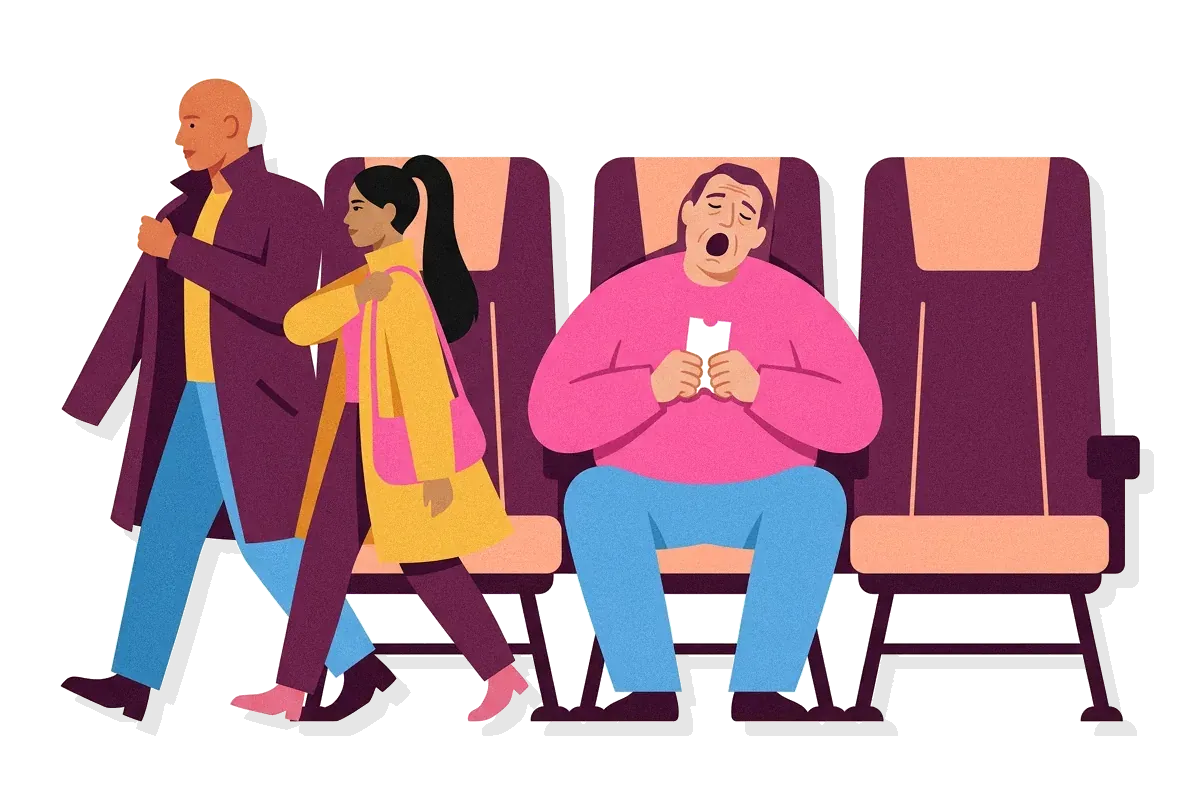
A man wins a free football ticket in a radio station's contest. He doesn't want to go alone, so he talks a friend into buying a ticket and coming along. The friend pays $12. As the two get ready to leave, a terrible blizzard begins. The winner looks out of the window and decides to stay home, because enduring the storm would cost him more than the game would give him. The friend disagrees. He doesn't want to waste the $12 he paid, so he insists on going.
Look at the friend's reasoning. His $12 is gone whether he sits in the stands or stays on the sofa, so it can't be a reason to go. The only question left is whether an evening in the blizzard is worth more to him than an evening at home. If it isn't, going means he pays twice, once with the $12 and again with a cold, unpleasant night.
Economists call money, time or effort that you can't get back a sunk cost. The friend lets his sunk cost steer his choice, and that is the sunk cost fallacy. You've probably made his choice yourself, sitting through a film you disliked because you'd already bought the ticket.
021 min
Sunk costs versus costs you can still avoid
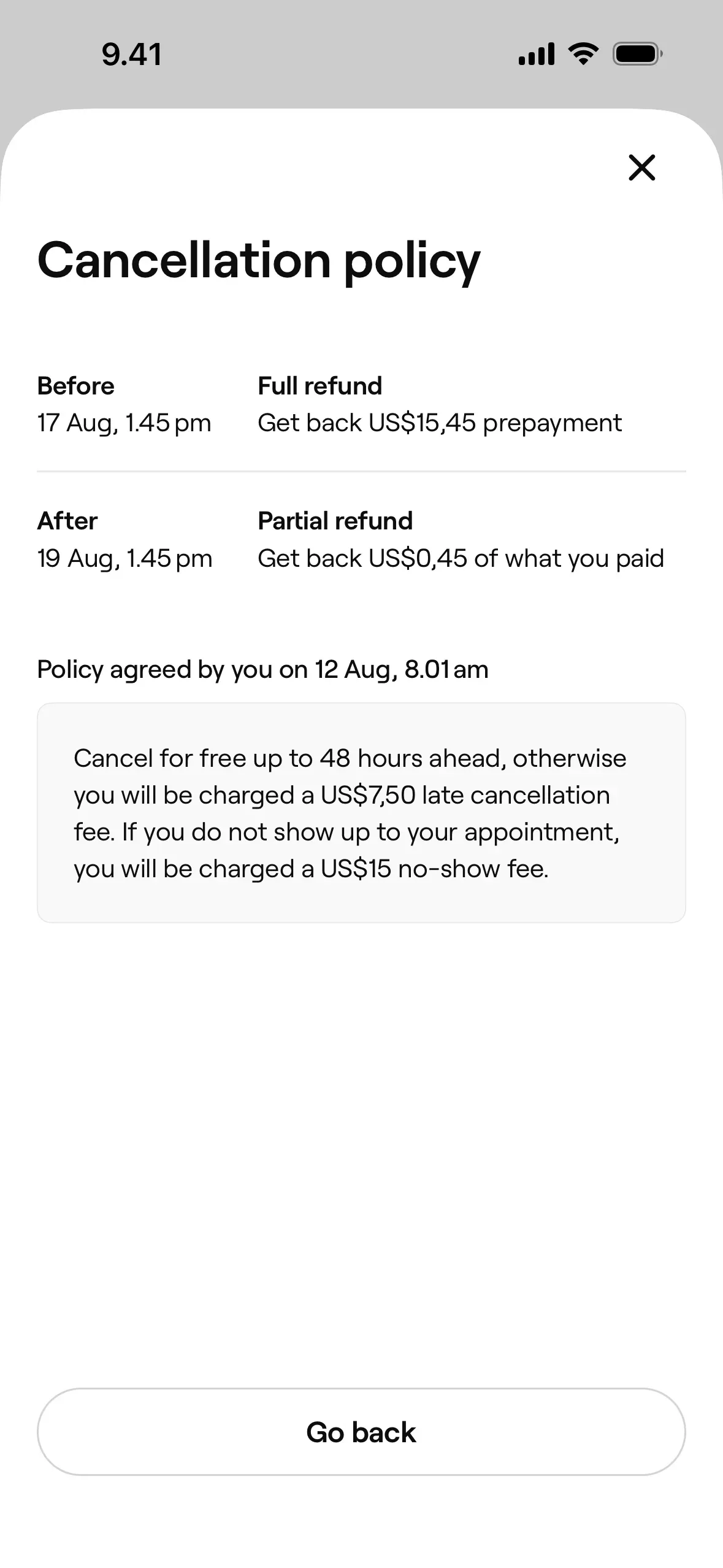
Fresha, a booking app, shows the moment a refundable cost becomes sunk. Its cancellation policy sheet has two rows. Before a set time, the sheet promises a full refund of the US$15.45 prepayment. After a later time, you get back only US$0.45 of what you paid. While the refund window is open, your choice still changes the outcome. Once it closes, nothing you choose will return the money.
Economists call this the bygones principle: only costs that are still in the future should count when you choose. The prepayment that's already gone belongs to the past. What you would pay next belongs to the future. So does what else you could do with that money. Economists call this opportunity cost, the value of the option you give up.
A cost is sunk only if nothing you do from here on can bring it back. So before you weigh a past cost, ask one plain question: can any choice I make now return it? If the answer is no, it's sunk, and it shouldn't change what you do next.
031 min
The theater study that named the sunk cost effect
In 1985 the psychologists Hal Arkes and Catherine Blumer named the sunk cost effect, a greater tendency to carry on with something once you've put money, effort or time into it. Then they tested it at a university theater.
The theater sold booklets of tickets for a season of plays. Each of 54 customers paid one of three prices: full price (18 customers), $2 off (19) or $7 off (17). The tickets had color-coded stubs. After each play, the researchers collected the stubs and counted how many people in each price group had come.
On the first five plays, people who paid full price used the most tickets, 4.11 on average. People with $2 off used 3.32, and people with $7 off used 3.29. Paying more went with turning up more, which is what the sunk cost effect predicts. On the last five plays, the three groups did not differ reliably. Everyone used fewer tickets in the second half, 3.57 per person on average in the first five plays against 2.09 in the last five.
So the pull of the money faded within one season. The $2 and $7 groups were almost identical, so a bigger discount did not bring a bigger drop. The study also doesn't show that people who pay more always go to more shows.
042 min
How the amount spent changes the sunk cost fallacy
Does it matter how much you've already spent? In 1991 the researchers Garland and Newport tested that with two questionnaire studies. The first used 88 undergraduate business students. The second used 36 students on a master of business administration (MBA) course. Each student read four short scenarios: finishing a radar-evading plane, remodeling an office, a vacation trip and building a retirement home. In every scenario some money was already spent, and the rest of the budget would finish the job. The students gave the chance, from 0 to 100, that they would put in the remaining money.
The researchers changed two things independently. One was the dollars already spent. The other was what share of the whole budget those dollars were, either a low share (10 to 20 percent) or a high share (80 to 90 percent). On the vacation, for example, $320 spent was a fifth of a $1,600 budget in one version and four fifths of a $400 budget in another.
Only the share of the budget already spent moved the answers. In the first study the average chance of carrying on was about 36 at a low share and about 61 at a high share. In the MBA study it was about 28 and 67. The dollar amount made no reliable difference. These were answers to imagined cases, not real spending.
So the useful question is less how many dollars you've put in and more how far along the plan you are. Spending more doesn't always make you more likely to keep going. Petroleum geologists showed the opposite. The more dry wells a geologist had drilled, and the more money had gone in, the less willing they were to keep drilling. That finding comes from a 1990 survey, reported in a 2011 economics paper. For those geologists, a growing bill may have signaled that the project was going badly.
052 min
Why the sunk cost fallacy happens
Several things can make your past spending affect your next choice, and researchers have proposed more than one.
You feel the loss
Quitting makes a loss real, and a loss feels worse than an equal gain feels good. Psychologists call this loss aversion. The Decision Lab, a behavioral-science site, says it may explain part of the sunk cost fallacy. A 2019 study adds detail. In four experiments, people judged investment scenarios. The worse a scenario made them feel, the more likely they were to keep investing. People who first had to justify their decision felt less of that bad feeling and resisted the urge to keep investing better. When people were kept busy with a memory task, which uses up the mental effort they'd need for careful thinking, the link between feeling and pull got stronger. So when you're tired or distracted, the feeling decides more.
You can't remember why you started
In 2011 the economists Baliga and Ely suggested that the pull can be a sensible reaction to a limited memory. Say you can't recall all your reasons for starting a project. How much you've spent then tells you something about how good the project looked when you began. In their experiment, people first showed the opposite pull, becoming less eager to finish as more was spent. Once the researchers made remembering harder, the usual pull appeared.
Other reasons on the list
Reviews of the research also name feeling personally responsible for the first decision. They name not wanting to look wasteful, too. Another cause is being too hopeful about how a plan will turn out. A closely related bias is the planning fallacy, too much optimism about how long and how costly a plan will be.
061 min
Personal responsibility and the sunk cost fallacy
In 1976 the researcher Staw asked 240 business students at the University of Illinois to play a company executive. The company, a made-up firm called Adams & Smith, had falling earnings. First the students chose which of two divisions, Consumer Products or Industrial Products, should get $10 million of research money. Then they read what happened over the next five years. Some were told they had made the first choice, and others that an earlier officer had. Some read that the choice paid off, and others that it did not. Finally every student split $20 million between the two divisions and wrote a paragraph defending the split.
The students who had made the first choice themselves and then read that it failed put the most money into their original choice. Staw concluded that feeling personally responsible for a bad result pushed people to commit more.
That result has not held up cleanly. The FORRT replication atlas, a public list of repeated psychology studies, records two attempts to repeat Staw's study. One failed and one gave mixed results. Personal responsibility is a plausible reason to keep investing, but it is not a proven one. If you chose the project yourself, it's worth asking whether that is what's keeping you in.
071 min
Who is most affected by the sunk cost fallacy
Not everyone reacts to a sunk cost the same way. In 2010 Van Putten, Zeelenberg and Van Dijk tested 75 students at Tilburg University. A questionnaire first sorted the students into two types. State-oriented students keep dwelling on past setbacks, and action-oriented students move on quickly. A week later each student read a scenario about an airline building a radar-evading plane. In one version $10 million had already been spent. In the other, the students were choosing whether to spend $1 million on the same plane.
Among the state-oriented students, 16 of 20 (80 percent) would invest when the $10 million was already spent, against 4 of 20 (20 percent) when it was not. Among the action-oriented students the gap was 9 of 17 against 6 of 18, too small to count as reliable. People who let go of past events easily did not show the sunk cost effect. So if you tend to dwell on setbacks, expect the sunk cost fallacy to affect you more.
081 min
The sunk cost fallacy in relationships
Does the sunk cost fallacy happen in relationships? In 2016 the researchers Rego, Arantes and Magalhães ran two experiments on unhappy romantic relationships. In the first, 902 people read about an unhappy relationship and chose whether to stay or to end it. They were more likely to stay when money and effort had been invested in the relationship earlier, but not when time had.
In the second experiment, 275 people chose how much more time they were willing to put into the relationship. They offered more time when more time had already gone in, an effect the researchers called a sunk time effect.
So the time, money and effort you've put into a relationship can pull on whether you stay, much as they do for a purchase. The two experiments found it for different kinds of investment, so it's safer to say that money, effort and time can all play a part than to say which matters most.
091 min
The Concorde and the sunk cost fallacy in government
In 1962 the British and French governments signed a treaty to build a supersonic airliner, the Concorde, at an estimated cost of £70 million. The UK government had asked for a clause in the treaty that set heavy penalties for cancelling. That made stopping costly from the start. Costs rose and delays piled up. The first flight was on 2 March 1969, and the programme eventually cost between £1.5 billion and £2.1 billion in 1976 money. The two governments kept funding the plane even after it became clear that it could not be justified on economic grounds. The last aircraft were retired in 2003.
That history gave the sunk cost fallacy a second name, the Concorde fallacy.
101 min
The sunk cost fallacy in business: Swoopo’s penny auctions
In a penny auction, every bid costs a fixed fee that is never refunded, and the item goes to whoever bids last, once nobody bids for a short time. At Swoopo, an online auction company, each bid cost $0.75. So every bidder pays for every bid, and only one bidder wins.
The economist Augenblick studied more than 160,000 Swoopo auctions run over four years and published the result in 2016. He found that the company's profit margins were above 50 percent, far above what theory predicts. He also found that the pattern of when auctions ended fits one kind of bidder. That bidder keeps going because of the fees already paid. If you were that bidder, each extra bid would add another cost you can't get back, and the total would grow with every round.
Players slowly learned to quit earlier, though activity in the market kept rising. Swoopo itself declared bankruptcy in 2011.

111 min
The sunk cost fallacy on cancel screens
You open the cancel page of MasterClass, a site that sells video classes by subscription. It starts with a red headline and the line "You still have 363 days of learning from the world’s best." As you scroll, you find a row headed "Finish what you started." On the right, a panel offers a button to keep the membership, one to set a reminder before it renews and one to cancel now.
The headline and the row both point at things that are already settled: the days you've paid for and the classes you've begun. The page says cancelling takes effect at the end of the current billing period. So those days stay the same whichever button you press. What should decide is whether you expect to keep watching. If you design screens like this, ask whether a screen is asking about the person's future or reminding them of what they've already spent.

121 min
Is the sunk cost fallacy always bad?
Counting what you've already spent is not always a mistake. Economists have a rule that only future costs count. Wikipedia's article on sunk costs notes cases where breaking that rule is rational.
A penalty that's still to come counts too. The 1962 treaty between Britain and France to build a supersonic airliner carried a penalty for cancelling. That penalty was a cost the two governments would have faced from then on. The fallacy is only about counting money already paid.
The mistake can also run the other way. Some research finds people who seem too eager to write off earlier investments so they can start something new.
132 min
How to avoid the sunk cost fallacy
Keeping your past spending out of your next choice takes a few habits.
Start with a question that has no past in it: if you were starting today with nothing spent, would you choose this? The Decision Lab suggests setting clear goals and looking only at current and future costs and benefits. A goal written down before you're deep in the work gives you something to measure the next hour or dollar against. Write why you started and what would make you stop.
Then explain your reasoning. In a 2019 study of investment choices, people who had to justify their decision resisted the sunk cost fallacy better. So try writing a few sentences on why you'll continue. If every reason is about what you've already spent, that tells you something.
What a bank learned about stopping rules
Rules and outside review can help, but people can find a way around them. McNamara, Moon and Bromiley studied a large bank in the midwestern United States in 2002. The bank gave each small-business borrower a risk rating from 1, the safest, to 7. When a rating reached the early-warning level of 4 or 5, the loan went on a watch list and the lending officer was watched more closely. At 6 or 7, the loan was taken from the officer and given to a specialist loan support team. The rules did what they were meant to. Escalation of commitment means putting more into a failing course of action. More monitoring reduced it, and so did handing the decision to someone else. They also produced effects the bank had not intended.
But the officers who rated the borrowers also decided when the rules took effect. Some officers resisted downgrading their borrowers' risk ratings, which the authors call intervention avoidance, meaning dodging the downgrade that brings more oversight. Officers whose borrowers were close to a threshold were more likely to keep rating them too safe, so the bank's response came late. The study doesn't say how much the bank lost or saved overall. What it shows is that a stopping rule works only when the people it applies to can't change the number that sets it off.
Before you put in more time, money or effort, check your own case:
?7 questions
Questions people ask
Is the sunk cost fallacy a cognitive bias or a logical fallacy?
What is the opposite of the sunk cost fallacy?
How is the sunk cost fallacy different from escalation of commitment?
How is the sunk cost fallacy different from loss aversion?
How is the sunk cost fallacy different from opportunity cost?
Why is the sunk cost fallacy bad?
Does the sunk cost fallacy only apply to money?
§13 sources
Sources
Show all 13 sourcesHide sources
Branwen, Are Sunk Costs Fallacies?, Gwern.net, which reproduces Arkes and Blumer (1985), The Psychology of Sunk Cost, Organizational Behavior and Human Decision Processes 35, and their retelling of Thaler's (1980) ticket story.
Garland and Newport (1991), Effects of Absolute and Relative Sunk Costs on the Decision to Persist with a Course of Action, Organizational Behavior and Human Decision Processes 48.
Baliga and Ely (2011), Mnemonomics: The Sunk Cost Fallacy as a Memory Kludge, American Economic Journal: Microeconomics 3(4).
Dijkstra and Hong (2019), The feeling of throwing good money after bad: The role of affective reaction in the sunk-cost fallacy, PLOS ONE 14(1).
Staw (1976), Knee-Deep in the Big Muddy: A Study of Escalating Commitment to a Chosen Course of Action, Organizational Behavior and Human Performance 16.
FORRT (Framework for Open and Reproducible Research Training), FLoRA Replication Atlas, entry for Staw (1976). (76)90005-2/
Van Putten, Zeelenberg and Van Dijk (2010), Who throws good money after bad? Action vs. state orientation moderates the sunk cost fallacy, Judgment and Decision Making 5(1).
Rego, Arantes and Magalhães (2016), Is there a Sunk Cost Effect in Committed Relationships?, Current Psychology.
Wikipedia, Concorde.
Augenblick (2016), The Sunk-Cost Fallacy in Penny Auctions, Review of Economic Studies 83(1).
McNamara, Moon and Bromiley (2002), Banking on Commitment: Intended and Unintended Consequences of an Organization's Attempt to Attenuate Escalation of Commitment, Academy of Management Journal 45(2).
Wikipedia, Sunk cost.
The Decision Lab, The Sunk Cost Fallacy.