011 min
Where the framing effect shows up
A product manager is presenting a quarterly retention update to the leadership team. The dashboard shows that 80% of new users are still active 30 days after signing up. The room reads this as solid news, and the conversation moves on to which channel to invest in next.
The same PM presents the identical underlying number a month later. This time the slide says the product loses 20% of new users within 30 days. Nothing about the product changed between the two meetings — only the wording did. The room now reads the number as a problem, and the conversation shifts to a rescue plan for onboarding.
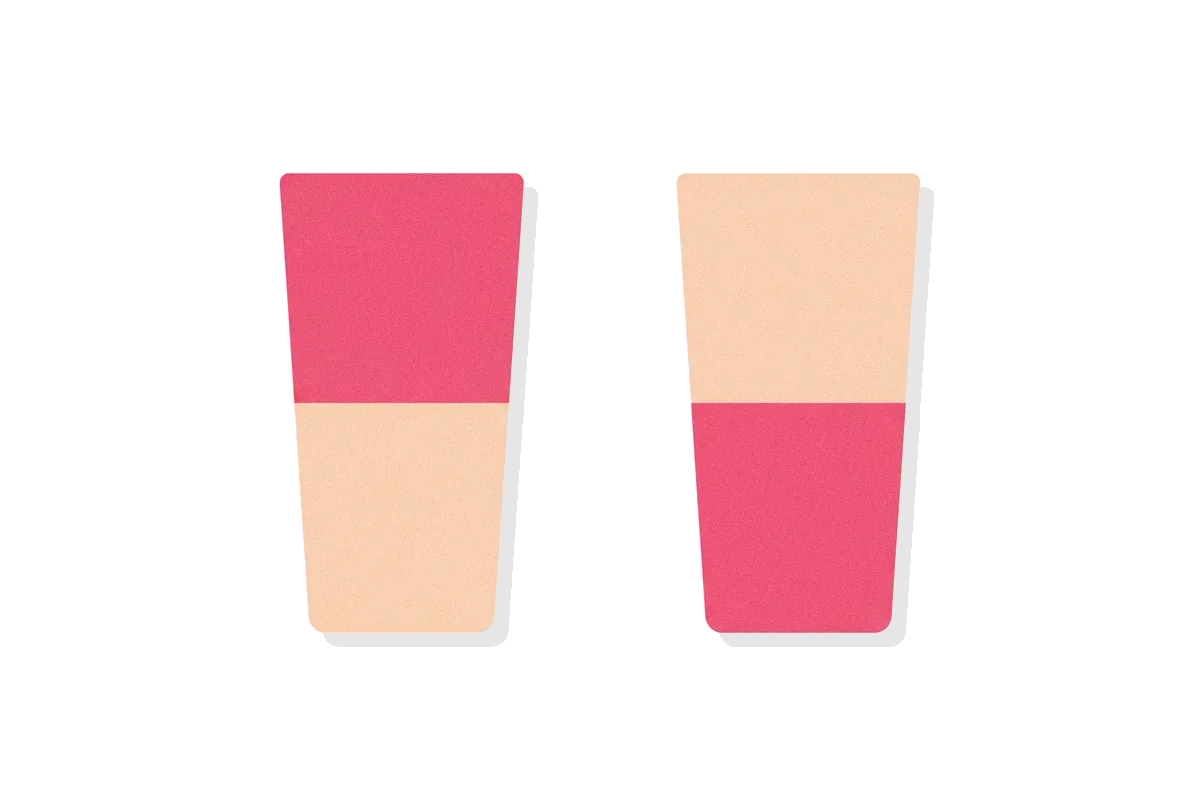
The two slides describe exactly one number, seen from two sides of the same reference point. What differs is not the data but whether the figure is framed as what was kept or what was lost.
That is the framing effect: a shift in preference or judgment caused by how equivalent information is worded, not by any change in the underlying facts.
022 min
Why the framing effect happens
The framing effect follows from prospect theory, the model of decision-making under risk that Daniel Kahneman and Amos Tversky introduced in 1979. Standard economic theory assumes people judge options by their effect on final wealth. Prospect theory assumes something different: people evaluate a change relative to a reference point, usually the status quo, and treat gains and losses on either side of that point differently.
The value function in prospect theory is, in the authors' own words, "normally concave for gains, commonly convex for losses, and is generally steeper for losses than for gains." The last part of that sentence is loss aversion: a loss subtracts more value than an equally sized gain adds. When a choice is worded so that one option reads as a loss, that option is weighted more heavily than the identical option worded as a gain, even though the two descriptions refer to the same outcome.
A second mechanism sits alongside loss aversion: the certainty effect, the tendency to overweight outcomes that are certain compared with outcomes that are merely probable. In their account of the Asian disease results below, Tversky and Kahneman describe choices involving gains as risk averse — people preferred the sure thing — and choices involving losses as risk taking, because a gamble that might avoid the loss altogether felt worth taking. Certainty pulls harder in one direction depending on which side of the reference point a person is standing on.
Why the mind works this way at all is debated. The common adaptive account is that an organism that suffers one large loss can be ruined, while one that misses an equivalent gain usually gets another chance, so weighting losses more heavily is a reasonable long-run policy. That explanation is plausible rather than settled, and the framing effect itself does not depend on it being true.
031 min
Where the framing effect comes from
Amos Tversky and Daniel Kahneman introduced the framing effect in The Framing of Decisions and the Psychology of Choice, published in Science in 1981. Their best-known demonstration is the Asian disease problem.
One group of 152 respondents was told that a disease was expected to kill 600 people, and asked to choose between two programs: "If Program A is adopted, 200 people will be saved" or "If Program B is adopted, there is 1/3 probability that 600 people will be saved, and 2/3 probability that no people will be saved." Seventy-two percent chose Program A, the certain option.
A second group of 155 respondents saw the identical scenario worded differently: "If Program C is adopted, 400 people will die" or "If Program D is adopted, there is 1/3 probability that nobody will die, and 2/3 probability that 600 people will die." This time only 22% chose Program C, the certain option, and 78% chose the gamble.
Program A and Program C describe the same outcome — 200 survivors, 400 deaths — and so do B and D. Only the wording changed, from lives saved to lives lost, and the majority choice reversed.
041 min
Individual effects
For one person, the distorted decision is any choice where the two options can be described from either side of a reference point, which covers most choices involving risk or trade-offs.
The direction of the error is predictable from the gain/loss split: framed as a gain, people choose too safely and pass up a bet with a better expected outcome; framed as a loss, people take on too much risk chasing a chance to avoid the loss altogether. A hiring manager told a candidate has an "80% success rate in similar roles" reads the file differently than a manager told the same candidate has a "20% failure rate," even though both are looking at one number.
The cost rarely shows up on a single decision — the framed choice is often defensible in isolation. It shows up across many decisions, when the same underlying risk tolerance produces safe calls under one description and risky calls under the other, with no consistent policy governing either.
051 min
Systemic effects
Across an industry, framing compounds through interface copy that many teams write the same way because it measurably works.
Arunesh Mathur and colleagues crawled roughly 11,000 shopping websites in 2019 and catalogued a dark pattern they call "Confirmshaming": a pop-up that asks for an email address in exchange for a discount, where declining is worded as a shameful choice rather than a neutral one. Real examples they recorded include "No thanks, I like paying full price" and "No thanks, I hate saving money." The researchers found 169 such instances across 244 of the sites they crawled, and concluded that "the Confirmshaming dark pattern exploits the framing effect cognitive bias in users."
The compounding mechanism is imitation rather than coordination. No single team decided that a whole category of e-commerce sites should word its opt-outs this way. Each site copied a pattern that increases opt-ins, and the framing effect is why it works: the same declining choice reads as a loss of savings rather than a neutral pass, and enough visitors respond to the loss framing to make the pattern spread.
061 min
Examples
A real case: a $5 discount that only matters on one item. In a second study from the same 1981 paper, Tversky and Kahneman gave 181 people a scenario about buying a $15 item and a $125 item, with the chance to drive to another branch of the store to save $5 on one of them. The total saving was $5 either way. When the $5 discount applied to the cheap item, 68% of respondents said they would make the trip. When the identical $5 discount applied to the expensive item, only 29% said they would. The saving was framed as large relative to $15 and small relative to $125, and the choice followed the frame rather than the flat $5.
An illustrative case. A designer is testing copy for a plan-downgrade screen. One version reads: keep 50GB of storage by staying on the current plan. The other reads: lose 40GB of storage if you downgrade. Both describe the same two plans and the same 10GB difference. The team is not deciding what the plans offer — that was fixed before the copy was written. They are deciding which side of the reference point to describe the difference from, and that choice alone will move how many people downgrade.
071 min
A second case
One demonstration proves the effect exists. A second, done differently, shows how far it travels.
In 2018, Richard Klein and dozens of co-authors repeated the $15/$125 discount study as part of the Many Labs 2 project, an attempt to replicate 28 classic findings with far larger and more varied samples than the originals. Their version ran online rather than on paper, adjusted the dollar amounts for 2014 prices, and swapped in a ceramic vase and a wall hanging as the items. The sample was 7,228 people.
The pattern held: 49% of respondents said they would travel for the discount on the cheap item, against 32% for the same discount on the costly item — the same direction as the 1981 result. But the size of the gap shrank. The original odds ratio was 4.96; the replication's was 2.06, which the authors describe as less than half the size of the original.
What the contrast teaches: the framing effect is not a fragile artefact that only shows up in a small classroom study. But the exact magnitude reported in 1981 was itself larger than the effect turns out to be at scale, which is closer to the normal pattern for a replicated finding than the exception.
081 min
How the framing effect shows up in product, design, and AI
Deliberately used, and sometimes exploited. The dark-pattern research covered above is the clearest case: an opt-out worded as a loss converts better than a neutral one, which is precisely why it spread across thousands of sites. The same mechanism sits behind subscription cancellation screens that describe what a user gives up rather than what they keep, and behind billing pages that frame an annual plan as "save $48" rather than as "pay $348 today instead of $29 a month," a choice that also leans on hyperbolic discounting, since the larger number is due sooner in the annual framing.
Accidentally suffered, in reporting rather than interface copy. An analyst evaluating a new model writes that it reaches "92% accuracy on the validation set." A colleague, looking at the same run, describes it as an "8% error rate." Neither number is wrong, and neither person is trying to persuade anyone, but a team deciding whether 8% is acceptable will react differently than a team deciding whether 92% is good enough, and the decision can come out differently depending on which sentence made it onto the slide first.
The fix in both cases is the same: fix which frame is the default before the meeting, in writing, rather than letting whoever speaks first choose it.
092 min
How to guard against the framing effect
Knowing the term does not make anyone immune to it. The 1981 study itself found the same reversal among university faculty and physicians, not only students, and the 2018 replication above still found the effect in a sample of over 7,000 people recruited specifically to test whether it would hold up. Guarding against it takes a change in process, not a warning label.
Write the decision in both frames before deciding. State the option as a gain and as a loss, on paper, before the discussion starts. If the two versions produce different intuitions about the same numbers, the difference is the bias, and it is now visible rather than silently steering the room.
Fix the reference point in advance. Most framing disputes are really disputes about where zero sits. Agree in advance whether a metric is measured against last quarter, a target, or a competitor, and hold that reference point steady across the whole conversation rather than letting each speaker pick their own.
Ask for the raw numbers, not the framed summary. "92% accuracy" and "8% error" both compress the same confusion matrix. Requesting the underlying counts forces the decision onto the numbers rather than onto whichever description was written down first — the same practice that guards against confirmation bias: check the original evidence rather than a summary of it.
This does not remove the pull of a well-chosen frame. It gives a decision process one more checkpoint than reading the slide and reacting to it.
102 min
Common misunderstandings
"The framing effect just means people can be talked into anything with vague language." The 1981 demonstrations do not use vague language. Program A and Program C were both precise, numerically identical descriptions of the same policy. Framing does not depend on ambiguity; it survives translation into exact numbers.
"Positive framing is always the persuasive choice." The Asian disease result runs the opposite way for the loss case: describing a certain option as an avoided loss (Program C) made it less popular, not more, because a certain loss is exactly what people gamble to escape. There is no single frame that wins independent of what decision it is attached to.
"A contested effect size means the effect probably is not real." The size shrank under replication — the discount study's odds ratio dropped from 4.96 to 2.06 — but the direction held at a sample nearly forty times larger than the original. A smaller true effect is a different finding from no effect.
Where a loss frame is the honest one, not a manipulation. A safety warning that says a procedure carries a real chance of a bad outcome should be worded as a loss, because the loss is real and the reader needs to weigh it as one. The mistake this section is about is treating every loss-worded sentence as a dark pattern — sometimes the accurate description is the one that sounds like a loss.
111 min
Framing effect vs. nearby concepts
| Compared with | The axis that separates them |
|---|---|
| PsychologyAnchoring | |
| PsychologyLoss aversion | |
| PsychologyAvailability heuristic |
The question that untangles them in a meeting: did the wording change which number was mentioned (anchoring), did it change which side of zero an identical number sits on (framing), or did it change how easy it was to recall a comparable case (availability)?
?5 questions
Questions people ask
What causes the framing effect?
What is an example of the framing effect in product or marketing?
How do you avoid or overcome the framing effect?
What is the difference between the framing effect and anchoring?
Is the framing effect real? Does it hold up under replication?
▶1 video
Watch
Understanding Framing Effect
§5 sources
Sources
Tversky, A. and Kahneman, D. (1981). The Framing of Decisions and the Psychology of Choice. Science 211(4481), 453-458
Kahneman, D. and Tversky, A. (1979). Prospect Theory: An Analysis of Decision under Risk. Econometrica 47(2), 263-291
Klein, R. A. et al. (2018). Many Labs 2: Investigating Variation in Replicability Across Samples and Settings. Advances in Methods and Practices in Psychological Science 1(4), 443-490
Mathur, A., Acar, G., Friedman, M. J., Lucherini, E., Mayer, J., Chetty, M. and Narayanan, A. (2019). Dark Patterns at Scale: Findings from a Crawl of 11K Shopping Websites. Proc. ACM Hum.-Comput. Interact. 3(CSCW), Article 81
Show all 5 sourcesShow fewer sources
The Decision Lab. Framing Effect