011 min
Curse of Knowledge at a glance
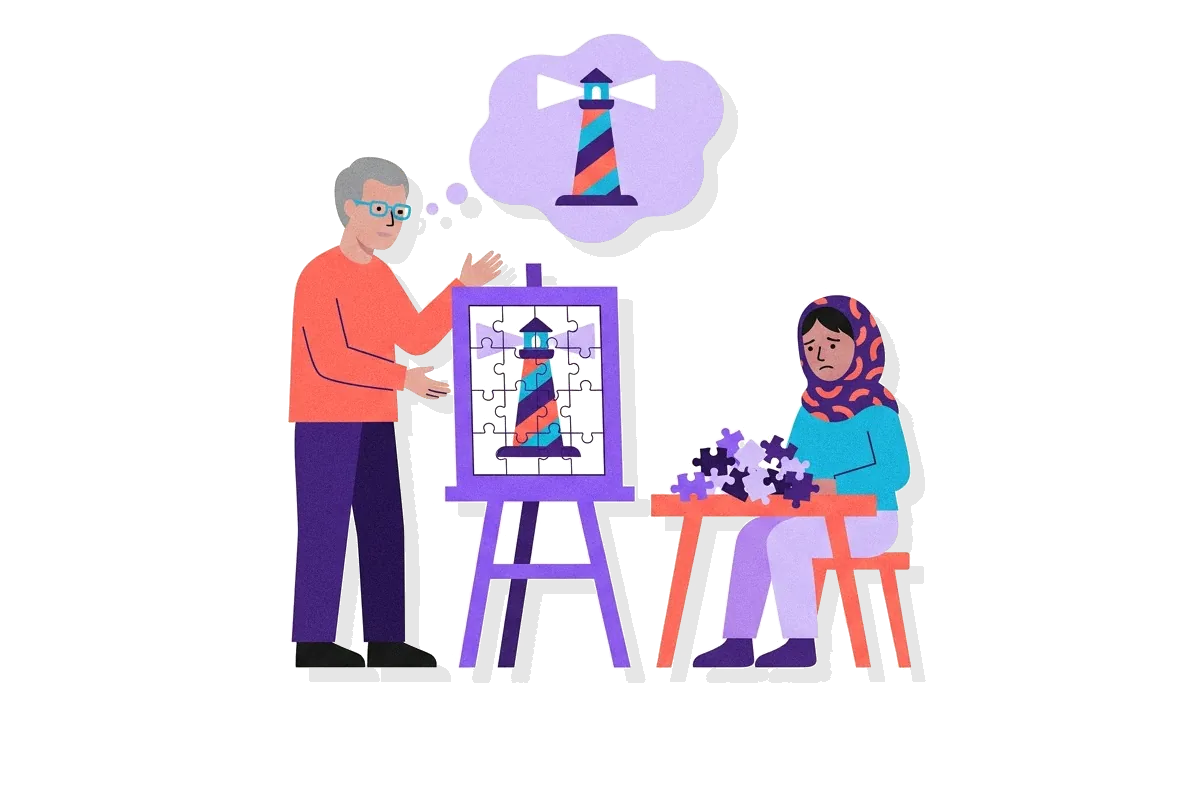
- What it is: An informed person cannot easily picture what an uninformed listener still does not know.
- Origin: Camerer, Loewenstein, and Weber named it in a 1989 economics paper.
- Use it when: Writing docs, onboarding new hires, or reviewing a design with a non-specialist.
- Watch for: Over-correcting into explaining basics to people who already know them.
021 min
The problem Curse of Knowledge solves
A senior engineer writes a setup guide for a new hire. Every step feels self-evident to the engineer, so the guide skips the part where a config file has to be renamed before the app will start. The new hire, who does not yet know that detail, follows the guide exactly, and the app fails to start. The engineer was not careless. The step is missing because, to someone who already knows it, that step does not read like a step at all.
This is the specific failure curse of knowledge names: a person who holds information cannot fully picture the state of someone who does not hold it, so instructions, explanations, and warnings leave out exactly the part that made the information hard to get in the first place. The gap shows up first for the receiver — the new hire stuck on a config file, the customer confused by a product term, the student lost after a professor skips a step that used to be hard for the professor too. The sender rarely notices, because from where they stand, nothing is missing. The same message that reads as complete to its writer reads as incomplete to everyone who has not yet done the work the writer already did.
032 min
How Curse of Knowledge works
Camerer, Loewenstein, and Weber tested the effect with real money, not a survey. In the first stage of their 1989 experiment, 51 Wharton students each read a public report on one of eight real companies and wrote down their own prediction of that company's 1980 earnings. Two months later, a second group of students was told the companies' actual 1980 earnings and then traded assets whose payout depended on the first group's predictions, not on the true earnings. The second group knew the real numbers. Their task was to price the asset based only on what the first, uninformed group had guessed.
If the second group had been able to set aside what they knew, their trading prices would have tracked the first group's forecasts and nothing else. Instead, prices drifted toward the real earnings the second group had been told — information that, by the design of the task, was supposed to stay out of the price entirely. "We discuss a systematic violation of this assumption that we call the 'curse of knowledge.' Better-informed agents are unable to ignore private information even when it is in their interest to do so." The traders were not confused about the rules. Ignoring what they knew was simply harder than the task assumed it would be.
The same gap separates curse of knowledge from a related but different problem: the empathy gap, where a person fails to predict their own future feelings — how hungry, angry, or tired they will be later, or how a decision made calmly will feel once they are under pressure. Curse of knowledge is not about predicting a feeling, in yourself or anyone else. It is about a specific fact, term, or skill one person currently has and another person currently does not — a gap in what two people know, not in what either of them feels.
041 min
Where Curse of Knowledge comes from
Colin Camerer, George Loewenstein, and Martin Weber introduced the term in "The Curse of Knowledge in Economic Settings: An Experimental Analysis," published in the Journal of Political Economy in 1989. The name itself came from a colleague, economist Robin Hogarth, who suggested it while the paper was being written. Earlier psychologists had observed pieces of the same tendency; this paper was the first to test it with real financial stakes in an actual trading market, not a survey question.
051 min
Before and after
A product designer hands a checkout redesign to the engineering team with a one-line note: "Move the error state above the fold." The designer knows exactly what that means — they spent three weeks looking at the failed-payment screen, so "the error state" has one obvious meaning in their head. The engineer reading the note has never seen that screen and has to guess which of four error messages it refers to.
Before:
Move the error state above the fold.
The note assumes the reader already pictures the same screen, the same error message, and the same current position on the page that the designer is picturing. None of those three things are written down anywhere.
After:
On the checkout page, when a card is declined, move the red "Payment failed" banner from the bottom of the form to directly under the card number field, so it is visible without scrolling.
The rewritten note names the specific screen, the specific message, and the specific place it needs to move to. Nothing about the underlying design decision changed between the two versions — only how much of the designer's own mental picture made it onto the page. That is the entire fix curse of knowledge calls for: writing down the parts of the picture that exist only in the writer's head.
062 min
A second case
A single trading experiment shows curse of knowledge holds even with money on the line. A very different study shows how large the gap between the informed and the uninformed person can feel from the inside.
In 1990, Elizabeth Newton, then a psychology graduate student at Stanford University, ran an experiment for her doctoral dissertation using a simple game. She assigned each participant one of two roles: "tapper" or "listener." A tapper picked one of twenty-five well-known songs, such as "Happy Birthday to You," and tapped out its rhythm on a table with a finger — no humming, no words. The listener's only job was to name the song from the taps alone.
Before any listener guessed, Newton asked each tapper to estimate the odds that the listener would get the song right. Tappers predicted 50 percent — they expected to get their message across roughly one time in two. Over the course of the experiment, 120 songs were tapped out, and listeners correctly named only 3 of them: 2.5 percent, or about one time in 40.
The gap between the tappers' prediction and the real result is curse of knowledge doing its work at the extreme. While a tapper taps, the melody plays in their own head alongside every tap — the rhythm and the tune arrive together, and pulling them apart takes real effort. A tapper who has just heard "Happy Birthday to You" complete in their own mind finds it almost impossible to imagine a listener hearing nothing but a disconnected series of knocks. What is obviously a song to the tapper is, to the listener, a pattern with no attached meaning at all.
The trading experiment and the tapping study measure the same failure two different ways: one shows it moves real prices when people are paid to predict correctly, the other shows how badly a person estimates their own success at it. Between the two, the tapping study is the one most often repeated in writing and communication training, because unlike a market price, a wrong guess at a song is something a reader can immediately feel for themselves.
071 min
A script to use tomorrow
The next time you write instructions, a status update, or feedback for someone with less context than you, add one line that states what you are assuming they already know, and check whether that is actually true for them:
Quick context in case it's not obvious: I'm assuming you already know [the specific fact, term, or screen this depends on]. Tell me if that's not the case and I'll back up.
Paste it above the message once, then delete the parts that do not apply. The bracket forces you to name your own assumption in writing, instead of leaving it unstated — which is the exact step curse of knowledge causes a writer to skip without noticing.
081 min
The overuse trap
Trying to fix curse of knowledge can tip into a different failure: explaining a detail the audience already has, at length, to a person who does not need it. A senior engineer who has been burned by skipping a step before might start every code review comment with a full restatement of how the system works, even to a teammate who wrote half of it. The tell is not how much gets explained. It is whether the explanation answers a question nobody in the room is actually asking.
This overcorrection often comes from the same instinct as the spotlight effect: assuming other people are paying closer attention to your explanation, and noticing its gaps, than they actually are. The fix for curse of knowledge is naming your own assumption once. It is not re-explaining everything, every time, to every audience, regardless of what they already know.
092 min
Curse of Knowledge vs. nearby concepts
| Concept | What changes | How it differs from curse of knowledge |
|---|---|---|
| Hindsight Bias | How predictable a past event feels, looking back | Compares your present self to your past self, not to another person |
| Illusion of Transparency | How visible your thoughts or feelings seem to an observer | About whether others read your inner state now, not whether they share a fact you know |
| False Consensus Effect | How common your own opinions or habits seem | About shared beliefs, not shared factual knowledge |
Curse of knowledge is most often confused with hindsight bias, and the paper that named curse of knowledge treats them as one mechanism pointed in two directions. Camerer, Loewenstein, and Weber described hindsight bias as the same tendency read backward in time: a tendency to exaggerate what one knew before, when one was less informed. Curse of knowledge compares you to another person at the same moment; hindsight bias compares your present self to your own past self.
The illusion of transparency gets confused with curse of knowledge because both involve misjudging another person's mind. It is a different bias: overestimating how visible your own current thoughts or feelings are to somebody watching you, not overestimating what somebody else already knows. A nervous presenter overestimating how visibly their hands are shaking has the illusion of transparency. An expert who forgets a beginner does not know what an acronym stands for has curse of knowledge.
The false consensus effect is the easiest of the three to tell apart: it is about opinions feeling more widely shared than they really are, not about a fact, term, or skill one person has and another does not.
102 min
Where the evidence is contested
A natural assumption is that curse of knowledge only shows up when nothing is at stake — no real cost for guessing wrong, and no market pressure to correct it. Economists studying asymmetric information had reason to expect exactly that: if informed traders were paid to predict what less-informed traders would guess, and given a real market to do it in, competition should push out any trader too cursed by their own knowledge to price correctly.
Camerer, Loewenstein, and Weber built their experiment specifically to test that expectation, using real financial incentives and an actual trading market with 51 Wharton students, instead of a paper survey. Comparing judgments made in individual-level and market experiments, they found that market forces reduce the curse by approximately 50 percent but do not eliminate it. The market discipline economists expected to erase the bias only cut it in half.
For a working professional, the honest reading sits between the two extremes. Real stakes and real feedback do make the bias smaller — this is not a bias that ignores incentives entirely, and it is not a fixed trait some people simply have and others do not. But halving it is not the same as removing it, and nothing in the data supports waiting for enough practice, enough feedback, or enough market pressure to make the problem go away on its own. A trader with years of experience in that same market would still be expected to carry roughly half the bias into the next trade. The one step shown to help — stating your own assumption before someone else has to guess it — still has to be done deliberately, on purpose, every time, by people who already know they are prone to the mistake.
112 min
Frequently asked questions about Curse of Knowledge
What is the curse of knowledge?
Curse of knowledge is a cognitive bias where a person who already knows something cannot easily imagine what it is like not to know it, so their explanations, instructions, and messages leave out details that only feel obvious because they already have the missing knowledge. Camerer, Loewenstein, and Weber named it in a 1989 economics paper.
What is an example of the curse of knowledge?
In 1990, Elizabeth Newton had "tappers" tap out well-known songs and "listeners" try to name them from the taps alone. Tappers predicted listeners would guess correctly 50 percent of the time; listeners actually guessed only 2.5 percent of 120 songs, because tappers could hear the melody in their own head and could not imagine a listener hearing only disconnected taps.
How is curse of knowledge different from hindsight bias?
Curse of knowledge compares what you know to what another person knows, at the same moment. Hindsight bias compares what you believe now to what your own past self actually believed, before an outcome was known. The 1989 paper that named curse of knowledge treats hindsight bias as the same mechanism applied to your own past self instead of to someone else.
How is curse of knowledge different from the illusion of transparency?
The illusion of transparency is overestimating how visible your current thoughts or feelings are to someone watching you, like a nervous speaker assuming their nerves are obvious. Curse of knowledge is overestimating whether someone else already has a fact, term, or skill you have. One is about your visible state; the other is about shared knowledge.
How do you avoid the curse of knowledge at work?
State the assumption you are making about what the reader already knows, in one sentence, before the main message. Camerer, Loewenstein, and Weber found real financial incentives only cut the effect by about half, so naming the assumption on purpose works better than expecting practice to remove it.
When does trying to fix the curse of knowledge backfire?
It backfires when someone over-corrects by explaining details the audience already has, at length, to people who do not need it. The tell is whether the explanation answers a question nobody in the room is actually asking, not how much detail gets included.
Does experience make the curse of knowledge go away?
No. Camerer, Loewenstein, and Weber tested this directly with real financial incentives and an actual trading market, and found market forces reduce the curse by about 50 percent but do not eliminate it, even among motivated, paid participants.
?7 questions
Questions people ask
What is the curse of knowledge?
What is an example of the curse of knowledge?
How is curse of knowledge different from hindsight bias?
How is curse of knowledge different from the illusion of transparency?
How do you avoid the curse of knowledge at work?
When does trying to fix the curse of knowledge backfire?
Does experience make the curse of knowledge go away?
§5 sources
Sources
Camerer, C., Loewenstein, G., & Weber, M. (1989). The Curse of Knowledge in Economic Settings: An Experimental Analysis. Journal of Political Economy, 97(5), 1232-1254.
Heath, C., & Heath, D. Made to Stick: Why Some Ideas Survive and Others Die — Introduction (Tappers and Listeners). Heath Brothers.
Wikipedia contributors. Illusion of Transparency. Wikipedia, The Free Encyclopedia.
Wikipedia contributors. Hindsight Bias. Wikipedia, The Free Encyclopedia.
Show all 5 sourcesShow fewer sources
Wikipedia contributors. Curse of Knowledge. Wikipedia, The Free Encyclopedia.