011 min
Spotlight Effect at a glance
- What it is: A mistake feels broadcast to the whole room; it almost never is.
- Origin: Gilovich, Medvec, and Savitsky (2000): T-shirt wearers guessed 46% noticed; only 23% had.
- Where it bites: A presenter assumes a stumble ruined the talk; most of the room missed it entirely.
- Guard against it: Awareness alone barely helps — ask someone who was actually in the room.
021 min
Where the Spotlight Effect shows up
A junior designer walks into a client review with a coffee stain on their shirt. For the next thirty minutes they are certain everyone in the room keeps glancing at it, and they half-listen to the feedback while tracking how obvious the stain must look. Afterward, nobody mentions it, because almost nobody saw it.
This is the spotlight effect: the designer judged their own visibility from how loudly the stain registered in their own attention, and barely adjusted for how little of that attention anyone else was actually spending on them. The same bias shows up without any mistake at all. Run the scene again with the stain removed: the designer still assumes their nervousness, their slightly-too-fast speech, or an awkward pause is as noticeable to the client as it feels to them. Only the content of the self-consciousness changes; the overestimate does not.
The pattern generalizes past clothing and nerves. A new hire who uses the wrong tool name in a stand-up, or an engineer who stumbles over a word in a postmortem, both tend to assume the room is still thinking about it minutes later. The room has usually moved on.
031 min
Why the Spotlight Effect happens
Gilovich, Medvec, and Savitsky traced the spotlight effect to anchoring and adjustment, the same general process behind anchoring, where a person starts from a number or impression that is easy to reach and then corrects away from it by too little. Here the easy-to-reach anchor is the person's own experience: how large the stain, the stumble, or the mistake looms in their own mind. People do try to adjust downward for the fact that nobody else was inside their head, but the adjustment falls short, so the final estimate still sits closer to "everyone noticed" than to the truth.
In the original study's own test of this mechanism, participants who were asked what number they had considered before settling on their final estimate were far more likely to report having considered a higher number than a lower one — exactly the pattern anchoring-and-adjustment predicts, since the starting point sits above the adjusted answer, not below it.
The bias likely persists because the correction has no good feedback loop. Nobody circulates after a meeting to report how little they noticed, so the one piece of information that would shrink the gap, other people's actual, boring indifference, almost never arrives. Treat anchoring-and-adjustment as the leading explanation rather than a fully settled one: it is the mechanism the original researchers proposed, not one they tested against every rival account.
041 min
Where the Spotlight Effect comes from
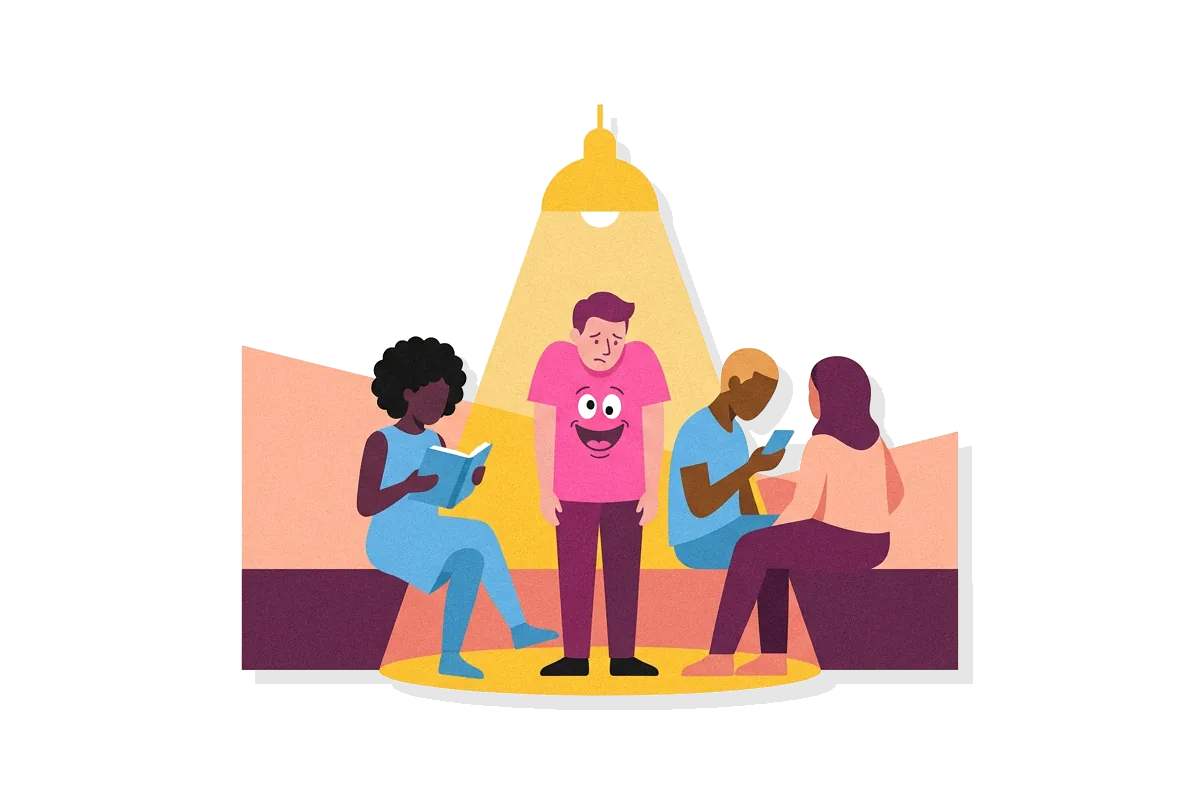
Thomas Gilovich, Victoria Medvec, and Kenneth Savitsky named the spotlight effect in a 2000 study in the Journal of Personality and Social Psychology. In the best-known experiment, a participant put on a T-shirt printed with a large image of Barry Manilow, chosen because college-age participants in the mid-1990s found him deeply unfashionable, and walked into a room of several already-seated students. The wearer then guessed how many of those students had noticed the shirt. On average, wearers guessed that 46% of the room had noticed the shirt, but the researchers found that only 23% actually had. The researchers reported that the targets' average estimate was exactly twice as high as the observers' average accuracy.
051 min
Individual effects
The clearest individual cost shows up before the moment ever happens. People over-prepare for, or avoid outright, situations where the attention on them is actually low: rehearsing an explanation for a wardrobe mishap nobody will register, or declining to raise a question in a meeting for fear that stumbling over the phrasing will be remembered, when in practice a stumble is usually forgotten within the hour.
A candidate in a job interview who flubs one answer often assumes the interviewer is still weighing that single stumble at the end of the call, and over-explains or apologizes for it rather than moving on to make their actual case. The error runs in one direction, toward overestimating exposure, so the usual effect is more self-monitoring than the situation calls for, not less.
061 min
Examples
The clearest real-world extension of the spotlight effect is public speaking. Savitsky and Gilovich (2003) had participants deliver impromptu speeches in pairs, then rate their own anxiety, how nervous they thought they looked, and how nervous their partner actually looked to them. Speakers consistently rated their own visible nervousness higher than their partner did, and a related study by MacInnis, Mackinnon, and MacIntyre (2010) found that 36% of speakers expected the audience to rate them as more anxious than the audience actually did.
For an illustrative case: a product manager presenting a roadmap update loses their place mid-sentence for a few seconds. They spend the rest of the meeting certain the pause has signaled that they are unprepared, replaying it instead of listening to the questions that follow. Nobody in the room brings it up afterward, because for everyone else the pause was a few seconds of normal silence, not a moment worth remembering, exactly the gap the research measures, just moved from a stage to a conference room.
072 min
How the Spotlight Effect shows up in product, design, and AI
In design critiques, a designer who made one visibly rushed screen in an otherwise solid flow often assumes the whole group is quietly judging that one frame, and spends review time defending it instead of using the time for feedback that matters. The room's actual attention is usually spread evenly across the deck, not fixed on the one weak slide the designer cannot stop looking at.
Engineers see the same pattern in incident postmortems: the engineer who pushed the change that triggered an outage often assumes their name is the thing everyone remembers about the incident, long after the team has moved on to the actual fix. That lingering sense of exposure, more than the incident itself, is kept alive by the availability heuristic: the engineer's own memory of the mistake stays vivid and easy to recall, so it feels like it must be equally vivid to everyone else, even once the postmortem has closed.
Data and AI teams run into a quieter version during evaluation reviews: an analyst presenting a model's failure cases assumes the one embarrassing example in the slide deck will dominate how stakeholders judge the whole system, when in practice a single bad output usually registers as one line item among many, not as the headline. None of this is a dark pattern anyone designs on purpose; it is a bias the audience brings to the room on its own, not one a product exploits.
081 min
How to guard against the Spotlight Effect
Two techniques actually change the estimate rather than just naming the bias. The first is to ask someone who was actually in the room a specific question, such as what they remember from the meeting, rather than a vague one like whether it was fine, since a specific question forces a real answer instead of a polite one. The second is reference-class thinking: before a presentation, recall how little you remember of other people's small stumbles in meetings you have personally sat through, then apply that same base rate to yourself instead of to everyone else.
Knowing the spotlight effect exists does little on its own. The two techniques above work because they substitute a different, more accurate number for the one you would otherwise anchor on; naming the bias does not, by itself, change what your attention is anchored to.
091 min
Common misunderstandings about the Spotlight Effect
The most common misreading treats the spotlight effect as proof that nobody is ever paying attention to you, a comforting overstatement the original research does not support. Observers in these studies still noticed the shirt, the stumble, or the mistake some of the time; the finding is that the target's estimate runs about twice as high as that real, nonzero rate, not that the real rate is zero.
The bias is also not always worth fighting. Genuine social feedback, such as a visibly late arrival, a typo in a shared document, or a comment that actually did land badly, is sometimes exactly as noticeable as it feels, and treating every such signal as an overestimate risks ignoring feedback that was accurate the first time.
101 min
Spotlight Effect vs. nearby concepts
The spotlight effect is often confused with the illusion of transparency: the belief that your own hidden feelings, like nervousness or dishonesty, are more visible on your face than they really are. The spotlight effect is about actions and appearance, such as a stain or a stumble; the illusion of transparency is about internal states. Gilovich and his coauthors traced both biases to the same anchoring-and-adjustment process, which is why they are so often described together, but what gets over-projected differs: an event in one case, an emotion in the other.
It is also distinct from self-serving bias, which is about taking credit for successes and blaming circumstances for failures, not about how visible either one is to an audience. And it is not false consensus, which assumes other people think and feel the way you do rather than overestimating how visible you are to them.
111 min
A second case
A 2020 attempt to extend the spotlight effect pushed it into a new domain: judgments about where someone else is looking, rather than judgments about one's own visible appearance or nervousness. Bernique's study, a small university research project rather than a large preregistered replication, supported the basic prediction that being watched by a researcher made the spotlight effect stronger, especially for participants who scored higher on social anxiety. It found only weaker support for the idea that people's judgments of another person's eye-gaze direction showed the same bias.
That contrast matters more than any single number. The T-shirt and public-speaking studies both measure overestimating one's own visible mistakes or nervousness; gaze judgment measures something closer to reading someone else's behavior, not projecting your own. The bias travels reliably within "how noticeable am I," and travels less reliably once the question shifts to reading other people instead of yourself, a boundary the original anchoring explanation does not obviously predict on its own. The practical lesson carries over cleanly: the spotlight effect is strongest for your own visible slip-ups, and weaker evidence exists for it outside that narrow case.
121 min
Where the evidence is contested
The spotlight effect has not been through a large, preregistered replication of the kind psychology's replication movement has run on biases like ego depletion or power posing. Gilovich and his coauthors followed up their own finding in a 2002 paper, "The Spotlight Effect Revisited," narrowing the conditions under which the overestimate is largest, evidence that even the original research team treats the size of the gap as something that depends on context rather than as a fixed number. A 2020 attempt to extend the finding to eye-gaze judgments found only mixed support for that extension, which is itself evidence that the effect's reach is narrower than its popular retelling suggests.
Until a larger, modern replication exists, the safest practical stance is to trust the direction of the finding: people reliably overestimate how much others notice them, without treating any one study's exact percentage as a permanent constant.
132 min
Frequently asked questions
What causes the spotlight effect? People anchor on how vivid a mistake or moment feels to them, then adjust too little for how little others are actually attending. It is an anchoring-and-adjustment process, first described by Gilovich, Medvec, and Savitsky in 2000.
What is an example of the spotlight effect in design or product work? A designer assumes the one rushed screen in a review will dominate feedback, when attention is usually spread across the whole deck. The room rarely fixates on the single detail that feels glaring to the person who made it.
How do you avoid or overcome the spotlight effect? Ask someone who was actually in the room a specific question about what they remember, and compare a stumble to how little you remember of other people's small mistakes. Simply knowing the bias exists rarely shrinks it on its own.
What is the difference between the spotlight effect and the illusion of transparency? The spotlight effect overestimates how visible your actions and appearance are to others. The illusion of transparency overestimates how visible your hidden feelings are. Both share the same anchoring mechanism but project a different thing outward.
Is the spotlight effect real, or does it still hold up? The core direction, that people overestimate their own visibility, is well supported across several studies, including a 2020 extension. It has not had a large modern replication, so treat any one study's exact percentage as illustrative, not fixed.
Does the spotlight effect apply to public speaking? Yes. Savitsky and Gilovich's 2003 study found speakers rated their own nervousness as more visible to an audience than the audience actually reported seeing, and a 2010 follow-up found 36% of speakers expected to be seen as more anxious than they were.
Is the spotlight effect the same as social anxiety? No. Social anxiety is a broader fear of negative judgment. The spotlight effect is the narrower estimation bias that makes one specific moment feel more visible than it is, and it shows up even in people with no anxiety disorder at all.
?7 questions
Questions people ask
What causes the spotlight effect?
What is an example of the spotlight effect in design or product work?
How do you avoid or overcome the spotlight effect?
What is the difference between the spotlight effect and the illusion of transparency?
Is the spotlight effect real, or does it still hold up?
Does the spotlight effect apply to public speaking?
§5 sources
Sources
Gilovich, T., Medvec, V. H., & Savitsky, K. (2000). The Spotlight Effect in Social Judgment: An Egocentric Bias in Estimates of the Salience of One's Own Actions and Appearance. Journal of Personality and Social Psychology, 78(2), 211-222.
Gilovich, T., Kruger, J., & Medvec, V. H. (2002). The Spotlight Effect Revisited: Overestimating the Manifest Variability of Our Actions and Appearance. Journal of Experimental Social Psychology, 38(1), 93-99.
Savitsky, K., & Gilovich, T. (2003), as reported in MacInnis, C. C., Mackinnon, S. P., & MacIntyre, P. D. (2010). The Illusion of Transparency and Normative Beliefs About Anxiety During Public Speaking. Current Research in Social Psychology, 15(4), 42-55.
Bernique, A. S. (2020). Lights, Camera, Anxiety: The Spotlight Effect, Social Anxiety and the Perception of Gaze Direction. Bridgewater State Undergraduate Review, 15(1), Article 7.
Show all 5 sourcesShow fewer sources
The Decision Lab. The Spotlight Effect.