011 min
What breaks without an internal trigger
Suppose a product manager at a news-reading app opens the usage log and finds many sessions that start with no notification. The manager had believed that email and push alerts brought readers back. The log suggests that some readers return on their own.
That raises a practical question. An alert only works while the team keeps sending it, and each alert interrupts the reader. A reader who opens the app alone costs the team nothing at that moment. So the manager wants to know what makes a reader open the app when nothing has asked them to.
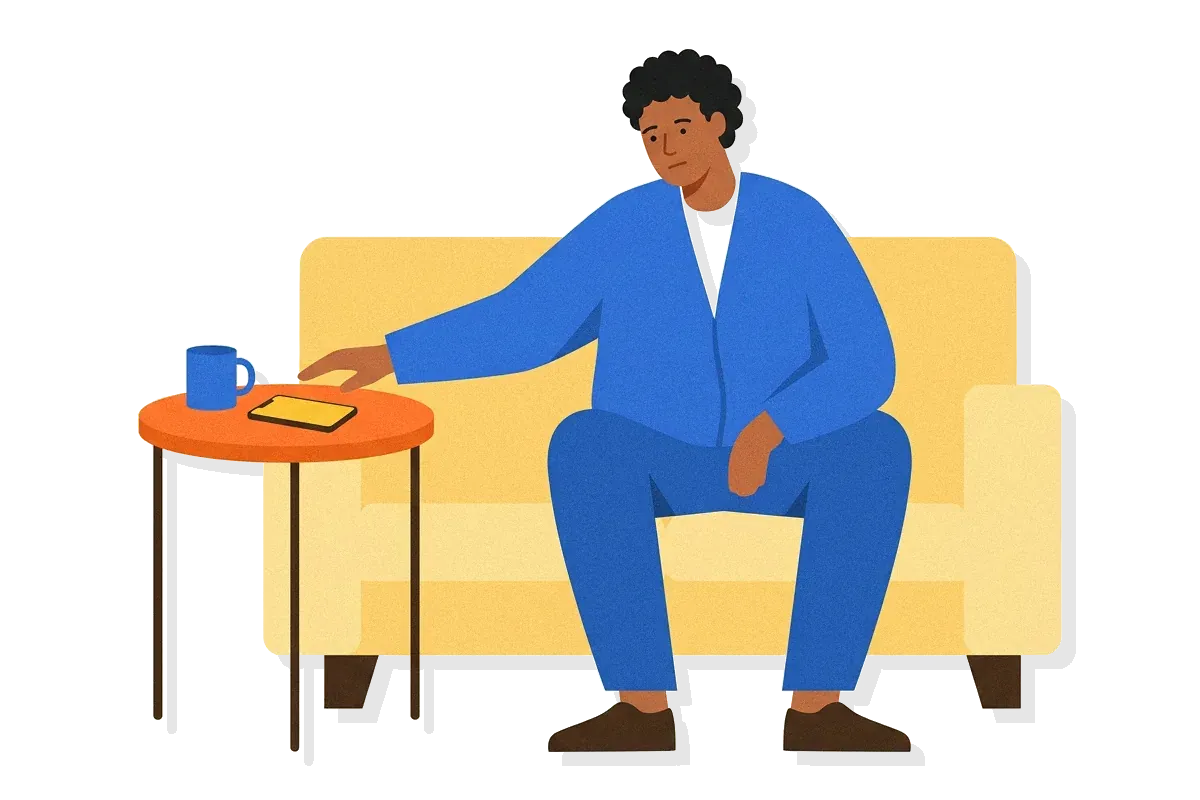
The answer is often a feeling. On a quiet evening, a reader feels bored and opens the app, and the product has sent no notification. The reader may have made no plan to read the news. A familiar feeling brought the app to mind, because the app has ended that feeling before. A feeling that does this work is called an internal trigger.
023 min
How an internal trigger forms
An internal trigger is learned, and learning it takes many repeats. The loop usually starts with an external trigger, such as a notification, which puts the information about what to do in the person's surroundings. If the reader opens the app and finds something that ends their boredom, the app and the feeling become linked in memory. Eyal's workbook for Hooked says an internal trigger works through an association that the user already holds in memory. An external trigger, by contrast, places that information in the user's surroundings.
The more often the pair meets, the stronger the link. The more often people meet external triggers, the more likely they are to develop an internal trigger of their own. After the link is strong, the feeling alone is enough. Once the habit has formed, boredom or loneliness alone is enough to send a person to the app, with no notification.
The first relief matters most. A new reader has to see what the app is good for before any link can form, which is the moment described in aha moment. After the trigger, the person acts, receives a variable reward whose content changes from visit to visit, and then puts something into the product, which the library covers as investment. Those later steps are what make the next visit more likely.
Where the link is stored
Researchers who study habits show why a link like this works. David Neal, Wendy Wood and colleagues published two experiments in 2012 on what sets off a habit. In both, the setting where a habit usually happens set it off, while current goals did not, yet people still described their habits as serving goals. Their team studied settings such as locations, not feelings. The study therefore supports the general idea of a stored link, but it does not test Eyal's claim about emotions.
Why discomfort makes a strong cue
According to LogRocket's guide, the strongest internal triggers are unpleasant feelings, among them anxiety, uncertainty and boredom. An unpleasant feeling gives a person a reason to act, and a product that has ended the feeling before is an easy action to choose.
One set of studies shows how strong the wish to escape an empty moment can be. Timothy Wilson and colleagues asked people to sit alone and think, with nothing else to do. In one study, each person sat alone for 15 minutes with a button that would give them a mild electric shock. Being alone with their thoughts for 15 minutes was unpleasant enough that many participants gave themselves a shock which they had earlier rated as worth paying to avoid.
Why that result is disputed
Kieran Fox, Evan Thompson, Jessica Andrews-Hanna and Kalina Christoff, at the University of British Columbia, replied to the Wilson study the same year. They pointed out that 57 percent of the participants in that part of the study never shocked themselves, and that only 17 percent gave themselves more than two shocks. They argued that thinking alone was not unpleasant in the strong sense Wilson's team claimed. For a product team, the safe reading is narrow: unpleasant states can push people to act, but this one study does not measure how strongly.
031 min
Where the internal trigger idea came from
Nir Eyal developed the idea on his blog and then set it out in the 2014 book Hooked: How to Build Habit-Forming Products. Eyal's hook model is a loop of four steps: a trigger, then an action, then a reward that varies, then an investment by the user. The model has two kinds of trigger. The external kind comes from the product or from other people. The internal kind comes from the person.
Eyal wrote for teams that build products people use many times a week. In that setting, a team that pays for every visit with an alert will always be paying. A team whose product has become the person's own answer to a feeling no longer has to ask. Eyal did not discover that habits depend on cues. Habit researchers already described habits as responses repeated in a recurring setting. His contribution was to describe how a product team can aim at that link on purpose.
041 min
Internal triggers in real products
The path from alert to feeling is easiest to see in a video site. LogRocket's guide to the hook model follows a person who watches a video that a friend shared, then watches more when friends send further links. After enough repeats, the person links watching videos with boredom. From then on, boredom alone sends them to the site.
Back in the news-reading app, the manager's next step is a question to readers, not a design. What was happening just before the last time you opened the app? One possible answer, which the manager would need to test, is uncertainty about a news story. Another is the wish for a short break.
Checking habits on phones
A 2012 paper by Antti Oulasvirta and colleagues gives data from phones. They drew on several sources of data and described checking habits: short, repeated looks at content that the phone can show at once. In a controlled field experiment, checking began and grew when a quick reward was available. The paper does not name a feeling behind the checks, so it shows the habit side of the idea and leaves the emotion side untested.
051 min
How to find the internal trigger of a product
Finding the internal trigger of a real product takes one working day and a small group of users. Follow these steps.
- Write down the one action you want people to repeat, such as opening the app.
- Ask five to eight current users what was happening just before they last did it, and write each answer in a spreadsheet, one row per person.
- Ask why after each answer, again and again, until you reach a feeling. Eyal's workbook calls this the five whys technique.
- Count how often the feeling occurs in a normal week. A product meant for daily use needs a feeling that comes daily.
- Finish this sentence for your product. It is the artifact the day produces.
Every time the user feels [feeling], they [repeat the action].
- Plan any reminder to arrive near the moment the feeling usually appears, not at a time that suits the team.
If step 3 ends on a task, such as "I needed the score", the feeling is not found yet. Keep asking until the answer is a state the person wants to leave.
062 min
Where an internal trigger fails
The sentence from the last section can be wrong in several ways. The simplest is that the feeling is real but rare. A habit builds gradually, from repeated responses in the same setting, so a feeling that appears once a month gives the product too few chances to form a link.
A trigger alone is not enough
Internal triggers are one part of a larger picture. BJ Fogg, who founded the Behavior Design Lab at Stanford University, states that behaviour happens only when motivation, ability and a prompt are all present at once. An internal trigger is a prompt. A reader who feels bored but is on a train with no signal has the prompt and no ability to act. A reader who finds the app slow has the prompt and loses motivation. The trigger can be perfect and the visit still does not happen.
Misreading: the habit feels like a choice
People often believe they open an app because they want something. Neal's team found that the setting set off strong habits, yet people still explained their habits by their goals. So a user's own answer to "why do you open the app?" is a weak guide to the trigger. Ask what was happening before the action, not what the person wanted.
Misreading: an internal trigger means addiction
A strong internal trigger can look like addiction from outside. The Oulasvirta team's qualitative data suggest that people experience frequent habitual phone use more as an annoyance than as an addiction. A habit is a repeated, quick response. It does not require the harm, loss of control or craving that the word addiction suggests.
071 min
Internal trigger compared with nearby concepts
Internal trigger and external trigger are the two halves of the same idea, and the difference is where the cue sits. The table compares them with two nearby ideas that readers often mix up with them.
| Idea | Where the cue comes from | Who starts it | Example |
|---|---|---|---|
| Internal trigger | A feeling or thought in the person | The person | Boredom brings the app to mind |
| External trigger | The product, an advertisement or another person | The sender | A push notification arrives |
| Prompt in Fogg's model | Either source | Either | Any cue that arrives while motivation and ability are present |
| Motivation | The person's wish to act | The person | A reader wants to know the score |
The deciding fact is that an internal trigger needs no sender. Motivation is also inside the person, but it is a level of wanting, while an internal trigger is a specific cue that brings one product to mind. A prompt is the wider word. It covers both kinds of trigger, so every internal trigger is a prompt and not every prompt is an internal trigger.
081 min
Where the evidence for internal triggers is contested
Yu-kai Chou, who writes on gamification, argues that the hook model describes the steps of habit formation without explaining why each step works in psychological terms. His objection fits the internal trigger well. The model says that boredom or loneliness can become a trigger, but it does not say how a feeling becomes tied to one product and not another.
The research above fills part of the gap and shows what is still open. Neal's team shows that a repeated setting can come to set off an action. Wilson's team, and the reply to it, shows that people disagree about how unpleasant an empty moment is. Neither study tested a product and an emotion together.
For a practitioner, the disagreement leaves a clear way to work. Treat the internal trigger you find as a hypothesis about your users. Check it with the interviews in the previous steps, and check it again with usage data before building a plan on it.
091 min
What to decide before building on an internal trigger
Before a team builds on an internal trigger, it has to answer three questions. First, does the product end the feeling, or only cover it for a moment? A product that ends the feeling gives the person something they would choose again. Second, does the person know the pattern? A reader who can name the feeling is able to decide whether the habit serves them. Third, can the team say what happens to the habit if the feeling goes away? A product that depends on one feeling for all of its visits is exposed when the feeling changes.
If the answers are weak, the safer plan is to improve the reward and leave the trigger alone.
?4 questions
Questions people ask
Is an internal trigger always a negative emotion?
How long does it take for an internal trigger to form?
Do internal triggers make notifications unnecessary?
How can a team tell an internal trigger from a goal?
§10 sources
Sources
Show all 10 sourcesHide sources
Nir Eyal, Wikipedia entry. Gives the 2014 book Hooked and the four steps of the hook model.
Nir Eyal, Hooked supplemental workbook. States that internal triggers work through stored associations and lists the five whys exercise.
LogRocket Blog, "What is the hook model? How to build habit-forming products". Explains how external triggers lead to internal ones, with a video-site example.
Amplitude, "The Hook Model: Retain Users by Creating Habit-Forming Products". Describes how emotions come to prompt opening an app without notifications.
Timothy D. Wilson and colleagues, "Just think: The challenges of the disengaged mind", Science, 2014. Eleven studies on time alone with one's thoughts.
David T. Neal, Wendy Wood, Jennifer S. Labrecque and Phillippa Lally, "How do habits guide behavior? Perceived and actual triggers of habits in daily life", Journal of Experimental Social Psychology, 2012.
Antti Oulasvirta, Tye Rattenbury, Lingyi Ma and Eeva Raita, "Habits make smartphone use more pervasive", Personal and Ubiquitous Computing, 2012. A summary page of the paper's abstract, hosted by Aalto University.
BJ Fogg, Fogg Behavior Model, Behavior Design Lab.
Kieran C. R. Fox, Evan Thompson, Jessica R. Andrews-Hanna and Kalina Christoff, "Is thinking really aversive? A commentary on Wilson et al.", Frontiers in Psychology, 2014.
Yu-kai Chou, "Hook Model: Why It Creates Addicts, Not Habits".