012 min
Where participatory design comes from
In the 1970s, computers were arriving in factories and offices across Scandinavia. Managers and suppliers chose the systems. The workers who would use them every day had almost no say in how they worked.
Trade unions in Norway, Sweden and Denmark began to push back. One early project paired the Norwegian Iron and Metal Workers' Union with researchers to study new workplace technology. It produced proposals for shop-floor planning systems, and a textbook that taught union members about planning and data processing.
The project that gave the method its shape, Utopia, started in 1981 at the request of the Nordic unions for graphic workers. Newspapers were about to move page make-up onto computer workstations. Page make-up is the skilled job of arranging the text and pictures on each newspaper page. The graphic workers knew this job better than anyone. They feared that software designed without them would take the skill out of it.
Utopia brought five union members together with computer scientists and social researchers in Stockholm and Aarhus. Their task was to write the requirements for a real newspaper system that a Swedish manufacturer was building. Later, the team studied a pilot of the image system in daily use at the Swedish newspaper Aftonbladet.
The workers were not there to answer questions. They were there to design. That raised a practical problem: how do you design with people who have never written a specification?
023 min
How participatory design works
The Utopia team's first discovery was that skilled people cannot easily put their skill into words. Ask a page make-up worker to describe a good layout and you get general answers. Put a page in front of them and their hands know what to do.
So the researchers built a technology laboratory. In it, the graphic workers did page make-up and image processing on simulated equipment. They set their requirements by doing the work, not by describing it.
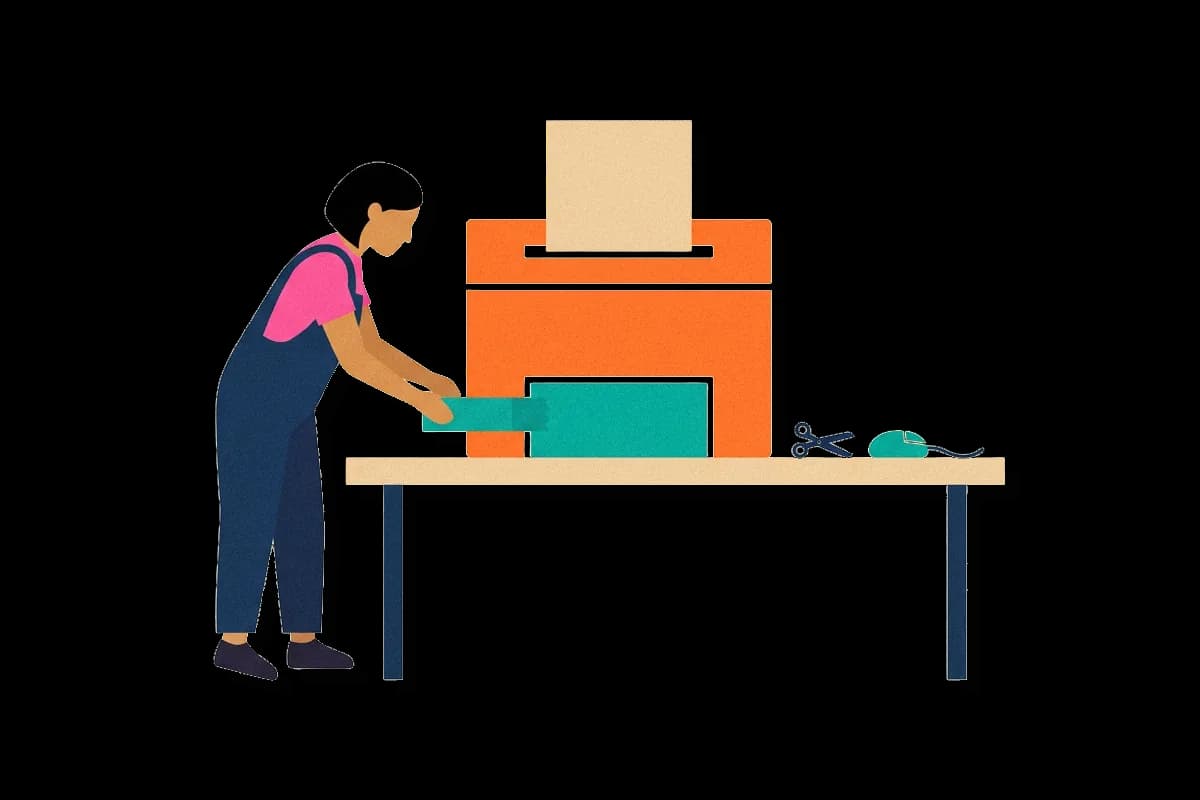
Much of the equipment in that laboratory was fake. The team made mock-ups: a laser printer out of cardboard, computer mice out of wood, and menus on paper. A mock-up is a rough physical model of a tool. It does not work, but people can pick it up, use it in pretend work and change it. A worker could move a paper menu and say it was in the wrong place, and everyone could see why. Changing cardboard cost nothing, so nobody defended a bad idea just because it had been expensive to build.
This gives the basic loop of participatory design:
- Designers and users meet around something both can handle: a sketch, a mock-up or a prototype.
- Users act out their real work with it.
- Problems and ideas show up in what users do, not only in what they say.
- The group changes the object together, and the loop starts again.
Two kinds of learning happen in that loop. The workers learn what the new technology can and cannot do. The designers learn what the work really involves. The field calls this mutual learning. When it works, the result fits the real work better, ideas appear that neither side had alone, and the people affected accept the new tool because they helped shape it.
Why talking about the work is not enough
The design researcher Elizabeth Sanders explained in 2002 why the hands-on step matters. Interviews give you only what people can put into words, and only what they choose to tell you. Watching people shows what they do, but not what they feel or hope for. Sanders added a third route: what people make when you give them simple materials to express an idea. Much of what people know is tacit knowledge, which means knowledge they cannot easily say in words. Sanders argued that a team understands people best when it studies what they say, what they do and what they make, all at once.
A shared object for groups who speak differently
Graphic workers and programmers used different words for the same job. A cardboard printer gave both groups one thing to point at. Looking back on Utopia in 2000, its authors named this as a condition for the whole method. The authors stated that every group in the room needs design objects that mean something to that group. A requirements document meant something to the programmers and very little to the workers. A mock-up meant something to both.
The three issues behind every participatory project
The loop above describes the method. It does not say who decides. In 1998, Finn Kensing and Jeanette Blomberg reviewed the research and found it kept returning to three issues: who holds power over the design, what it really means for people to take part, and which methods let them take part.
- Power: who gains and who loses control of the work when the new system arrives.
- Participation: who takes part, at which stages, and with how much influence on the result.
- Method: which tools and techniques let people without design training contribute as equals.
Utopia answered the first question openly: the project existed so that workers kept control of their craft. Most commercial projects today never ask it. That gap explains much of how the method is used now.
032 min
How participatory design shows up in real products
Utopia's methods outlived its union politics. They now appear in consumer hardware made by large companies.
The Xbox Adaptive Controller
Microsoft released the Xbox Adaptive Controller in 2018. It is a game controller for disabled players. Players plug in their own switches, large buttons and joysticks, so they can play with a foot or a chin if that suits their body. Microsoft's device design team worked with disabled players and with charities such as AbleGamers and SpecialEffect. The Microsoft team also built and tested controller prototypes with patients at Craig Hospital, a rehabilitation hospital in Colorado.
Working this way doubled the usual development time for a controller, from one year to two. That is the cost side of the method in a real number. The Victoria and Albert Museum in London added the controller to its collection when it was released.
How much decision power the players held is not public. What is documented is that disabled players and rehabilitation patients shaped the hardware through repeated rounds of prototypes. That is the Utopia loop applied to a mass-market product.
When participation is only a label
Many guides list fan idea platforms and user-edited maps as participatory design. Those let people send in ideas or data, but the company still decides alone. That is closer to crowdsourcing than to shared design.
The weaker cases are harder to spot. In 2020, Mona Sloane, Emanuel Moss, Olaitan Awomolo and Laura Forlano warned machine learning teams against participation-washing. The term means using the language of participation to make a project look fair, while the people involved have no real power over it. They warned that some forms of community involvement exploit the people involved and extract value from them. The tell is simple: participants give time and knowledge, and nothing in the result depends on what they said.
042 min
Participatory design vs. user-centred design and co-design
If users shape the product, how is that different from the user research most teams already do? The difference is who holds the pen. Sanders described the change as moving from designing for users to designing with them.
| Approach | What users do | Who decides |
|---|---|---|
| Not in the library yetUser-centred design | ||
| ResearchUsability testing | ||
| ResearchContextual inquiry | ||
| ProductDesign thinking | ||
| Not in the library yetParticipatory design |
The one line that separates participatory design from its neighbours is decision power. In the other approaches, users inform the design. In participatory design, they can change it.
A second neighbour comes from research rather than design. In participatory action research, people affected by a problem study it together with researchers and act on what they find. Participatory design borrowed that idea of shared inquiry and applied it to making tools and services.
Shared decisions do not remove the designer. Someone still has to turn many ideas into one coherent product, and that is still a design skill. Design by committee happens when a team adds every suggestion because nobody owns the synthesis. Participatory design asks the designer to build the synthesis in the open, with the participants.
Co-design and co-creation are not the same thing
Many guides use participatory design, co-design and co-creation as if they meant one thing. Sanders and Pieter Jan Stappers drew the line in 2008. Co-creation is any creative work shared by two or more people, so it includes a brainstorm between colleagues. Co-design is that shared creativity used across a whole design process, with designers and people without design training working together. Co-design is one form of co-creation, and participatory design is the older tradition that both terms grew from.
052 min
Where participatory design goes wrong
Inviting people into the room is the easy part. The hard part is making their input change the outcome, and most failures happen there.
Consulted but not heard
In 1969, Sherry Arnstein, writing about citizen participation in US city programmes, described participation as a ladder of eight rungs. The bottom rungs, manipulation and therapy, are not participation at all. The middle rungs, informing, consultation and placation, give people a voice but no power. Arnstein called the middle rungs tokenism: people may advise, but those in power keep the right to decide. The top rungs, partnership, delegated power and citizen control, give people real control over the result.
A design workshop can sit on any rung. A team that has already chosen the solution and runs a workshop to collect quotes for the slide deck is on a tokenism rung, whatever the invitation called it.
A friendly room can hide a power conflict
After Utopia, the same researchers ran a project with the local branch of the Danish labour inspection service. They worked with managers and ordinary staff together. Looking back, they admitted that a pleasant working atmosphere had sometimes kept them from seeing the power conflicts until those conflicts surfaced. Participants also had trouble getting time away from their normal work to take part. Good relations in a workshop say nothing about who will decide later.
Children and other unequal partners
Participation is hardest when one group is used to leading and the other to following. In the KidStory project, which ran from 1998 to 2001, schoolchildren in Sweden and England designed storytelling tools with adult researchers and teachers. The team found that equal footing took time and patience, because children expect to follow adults and adults expect to be in charge. The same problem appears with patients and doctors, junior staff and managers, or customers and a company. Methods have to be built for the weaker side, or that side goes quiet.
When the software is bought, not built
Utopia designed a new system from the start. In the labour inspection project, the team had to use standard software while still shaping a long-term plan for how the organisation would use computers. With bought software, users can only adjust settings, not change how the product works. The design space shrinks to configuration and to how the work around the software is organised. Participatory design still helps there, but a team should say plainly how little is open to change.
061 min
How participatory design changed since Utopia
Those failures did not stop the method from spreading. They changed what people mean by it.
Utopia's practical tools travelled further than its politics. Low-cost prototypes and early design sessions with users became normal in interaction design, and later methods such as Contextual Design and Cooperative Inquiry built on them. Participatory design is now used in software, architecture, city planning, health care and education.
In 2025, Peter Wacnik, Shanna Daly and Aditi Verma reviewed 88 research articles on participatory design published up to May 2022. Most described software or other non-physical systems rather than physical products. Most involved participants at several stages of the work, not just once. As more teams use the term, it has become less strictly defined, and participants take part to very different degrees.
Early involvement is not participation
The Utopia authors saw this drift coming. In 2000 they wrote that involving users early had become a standard that most developers at least claim to follow. When teams do not actually follow it, the usual reason is lack of time and understanding, not bad intent. Asking users early is now common. Giving them a share of the decisions is still rare, and it is the part that made Utopia different.
072 min
Running a participatory design project
Everything above turns into a short set of decisions a team makes before the first session.
Decide what participants can change, and tell them.
Write down which decisions are open. If none are, call it a feedback session instead.
Invite the people the change affects most,
not the ones who are easiest to reach. A few participants cannot speak for millions of users, so run several groups and say who was missing.
Pay people for their time,
or arrange time away from their normal work. Ask for consent on recordings and say who owns the ideas.
Bring things people can handle:
sketches, paper prototypes, cardboard models, journey maps or card sorts. Ask participants to act out real tasks with them.
Plan several rounds,
from framing the problem to testing late versions, so participants see the design change.
Report back.
Show participants which ideas changed the design, which did not, and why.
A skilled facilitator holds this together. Their job is to keep the loudest expert from taking over, and to make the quiet participants' work visible to the group.
Say a product team is redesigning the shift-scheduling tool that hospital nurses use. The team could interview nurses and test screens with them. A participatory version starts earlier. Nurses arrange paper versions of a week's rota, show where swaps go wrong, and vote on the trade-offs, such as speed of booking against fairness of night shifts. The product manager then states which of those choices the team will build.
Use participatory design when the people affected hold skills or interests the team cannot see from outside, and when you are ready to let them change the result. When neither is true, a lighter method is more honest than a workshop on a tokenism rung.
?4 questions
Questions people ask
How many participants does a participatory design session need?
Can participatory design be done remotely?
Who owns the ideas participants contribute?
Does participatory design work for a small startup?
§8 sources
Sources
Co-operative Design: perspectives on 20 years with the Scandinavian IT Design Model — Susanne Bødker, Pelle Ehn, Dan Sjögren and Yngve Sundblad, NordiCHI 2000
Participatory Design: Issues and Concerns — Finn Kensing and Jeanette Blomberg, Computer Supported Cooperative Work 7, 1998 (doi:10.1023/A:1008689307411)
From User-Centered to Participatory Design Approaches — Elizabeth B.-N. Sanders, in Design and the Social Sciences, Taylor & Francis, 2002
Co-creation and the new landscapes of design — Elizabeth B.-N. Sanders and Pieter Jan Stappers, CoDesign 4(1), 2008 (doi:10.1080/15710880701875068)
Show all 8 sourcesShow fewer sources
A Ladder of Citizen Participation — Sherry R. Arnstein, Journal of the American Institute of Planners 35(4), 1969, reprinted text
Participation is not a Design Fix for Machine Learning — Mona Sloane, Emanuel Moss, Olaitan Awomolo and Laura Forlano, 2020
Participatory design: a systematic review and insights for future practice — Peter Wacnik, Shanna Daly and Aditi Verma, Design Science 11, 2025
Xbox Adaptive Controller, object record — Victoria and Albert Museum, London