011 min
The meaning that pragmatics studies
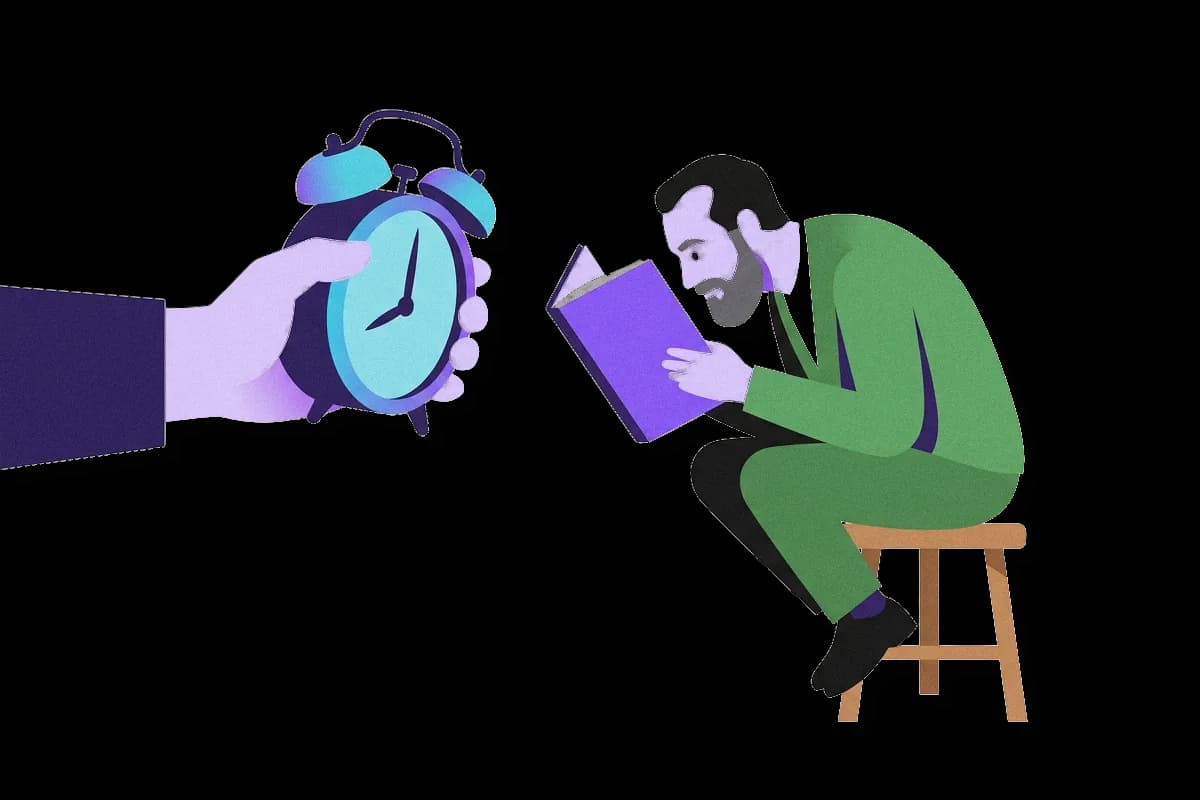
Picture a product manager who stops at an engineer's desk during standup and asks, Can you look at the checkout bug? The engineer answers, The migration is due Friday. The engineer did not say no. The engineer did not say yes, and did not mention the bug at all. Still, the product manager now knows that the bug will wait until after Friday.
The product manager reached that conclusion without any rule of grammar. The words of the reply say nothing about the bug. The conclusion comes from the situation. Both people know that an engineer with a deadline has no time for other work, and each knows that the other knows it. Pragmatics is the field that studies this gap between the words a person uses and the meaning the listener receives.
The gap works in the other direction too. The first question is not about ability. Nobody would answer Yes, I am able to and walk away. It is a request, and both people treat it as one. Most messages at work are built this way, and a message can be clear in its words and still be read as something the writer did not intend.
021 min
Where pragmatics comes from
The field got its name before it got its main ideas. In 1938 the philosopher Charles Morris defined pragmatics as the study of how signs relate to the people who interpret them. He set it beside syntax, which asks how signs relate to each other, and semantics, which asks how signs relate to the things they stand for. Linguists and philosophers still use the three-way split.
Two philosophers then turned the definition into a working field. J. L. Austin, whose lectures were published in 1962, showed that speaking is often a way of acting. H. P. Grice, in lectures given in 1967, proposed that people in a conversation expect each other to cooperate, and that listeners use this expectation to find implied meaning. Later theories asked how listeners reason. The best known, relevance theory, came from Dan Sperber and Deirdre Wilson in 1986.
032 min
How pragmatics separates what is said from what is meant
Pragmatics starts from a split. Semantics covers what an expression means by the rules of the language: the dictionary meaning of its words and how they combine. Pragmatics covers what the speaker means by using that expression on this occasion. The same sentence can mean different things on different occasions, so the second layer cannot be read from the sentence alone. Three kinds of context do most of the work.
Who, where and when
Some words follow a fixed rule but point to a different person or place each time they are used. I, you, here and now are the standard cases. Linguists call this deixis, from a Greek word for pointing. The rule for such a word is fixed, but what it points to is set by facts about each use, such as who spoke, when and where. A commit message that says fixed this yesterday means nothing until a reader knows who wrote it and when.
What both people already know
Speakers treat some facts as settled before they speak. The facts that both sides already accept are called the common ground. A statement that takes a fact for granted works only if that fact is already part of the common ground. In the standup case, The migration is due Friday answers the product manager only because both of them know that the engineer is the one doing the migration. When one person lacks the fact, the reply sounds like a change of subject.
What the speaker wants the listener to find
Reference is the act of choosing words so that the listener finds the thing the speaker has in mind. Calling something the bug works in one team and fails in another, because it depends on what each listener already knows and is looking at. This is why reference belongs to pragmatics and not only to semantics.
Tone and gesture belong to this layer as well. Stress, pauses and facial expression change what a sentence does, and they are lost when the same words are typed. The email section below returns to that loss.
041 min
Speech acts: how pragmatics treats speaking as doing
Speech acts are the part of pragmatics that treats a sentence as an action. Austin began from the observation that some sentences describe nothing. I promise to review it today and You are hired do not report a fact. They create a promise or a job. Austin called such sentences performatives, because saying them is a way of doing something.
He then split every utterance into three layers. The locutionary act is saying the words. The illocutionary act is what the speaker does by saying them: asking, promising, warning or ordering. The perlocutionary act is the effect on the listener, such as being persuaded or annoyed. John Searle later sorted illocutionary acts into five families: statements, requests, commitments, expressions of feeling, and declarations that change a situation.
The family that matters most at work is the request. A request can be direct (Please look at the checkout bug) or indirect (Can you look at the checkout bug?). An indirect speech act has the form of one act and the force of another. A question leaves the listener room to decline without a flat refusal, which is one reason speakers use it. The engineer's reply works the same way. It has the form of a statement about a deadline and the force of a refusal for now.
052 min
Implicature: how pragmatics explains implied meaning
Implicature is meaning that a speaker suggests without stating it. Grice's explanation starts from an assumption that people in a conversation share. Grice proposed that speakers are expected to make their contribution to a conversation what the exchange needs at that point. He called this the cooperative principle and spelled it out in four maxims. Quantity asks for as much information as the exchange needs, and no more. Quality asks for only what the speaker believes to be true. Relation asks for relevance. Manner asks for clarity and order.
Listeners use the maxims to guide inference. The product manager asked about the bug and received an answer about a migration. If the engineer is being relevant, the migration must matter to the question. The only link is time, because the migration uses the hours the bug would need. The product manager infers a refusal. Nobody stated it. The listener worked it out.
Grice noticed that the inference is strongest when a maxim seems to be broken. A speaker who openly breaks a maxim, which linguists call flouting it, signals that the listener should look for the reason. The engineer's reply seems to break the rule of relevance, and that is what starts the search.
Two tests separate implied meaning from stated meaning. An implicature can be cancelled: the engineer can add but I can look at it on Thursday morning without contradicting anything. A stated meaning cannot be cancelled this way. An implicature can also be calculated, which means a listener can write out the steps that lead to it, as above.
The same logic explains why some usually suggests not all. A manager who says Some of the tests passed is heard to mean that others failed. If the manager adds in fact, all of them passed, nothing false has been said, because the first sentence only suggested the other reading. Listeners also extend good faith to the speaker. The principle of charity is the habit of reading a speaker as making sense, and implicature depends on it.
061 min
A real case: the Bronston perjury trial
The line between what a person said and what a listener inferred reached the United States Supreme Court in 1973. Samuel Bronston, the owner of a film production company, testified at a bankruptcy hearing. A creditor's lawyer asked whether he had any bank accounts in Swiss banks, and Bronston said no. The lawyer then asked whether he had ever had one. Bronston answered that the company had had an account in Zurich for about six months.
The answer was true. It also left out that Bronston had held a personal account in Geneva for nearly five years. A listener who expects a relevant answer hears no, not me, and the government prosecuted him for perjury on exactly that reading. The Court took the case to decide whether a witness can be convicted of perjury for an answer that is literally true, yet off the point of the question and misleading through what it implies.
It decided that the federal perjury law does not reach such an answer, and it placed the burden on the questioner to ask precisely. For pragmatics the case is a clean test. The sworn words and the implied meaning came apart, and the law counted only the sworn words. Outside a courtroom the usual standard is different: colleagues and customers tend to judge a message by what it led them to believe.
071 min
Pragmatics in survey and form design
Pragmatics also explains why the design of a questionnaire changes the answers. People filling in a survey treat it as a conversation with a cooperative writer, so they assume that every detail is there for a reason. Ting Yan's 2005 dissertation at the University of Maryland reviewed earlier work on this and ran six new experiments.
Numbers on a scale are messages
In Ting Yan's 2005 dissertation, the strongest sign that survey respondents apply Grice's maxims came from an experiment that changed the numbers printed on a rating scale. When the labels included negative numbers, answers moved toward the right side of the scale. Respondents read each part of the scale as chosen on purpose, so a minus sign carried meaning. If you design a rating question in a product, each number and label is a message.
Two similar questions are read as two different questions
The same work found that people assume a second question is there to add something. When two almost identical questions were asked together, the answers to them were less strongly related. Respondents seem to reason that the writer would not ask the same thing twice, so the second question must mean something else. A form that repeats a question in different words can therefore change the data it collects.
081 min
Pragmatics in writing: why tone is lost
Writing removes most of what speakers use to signal intent: stress, pause, pitch, gesture and face. A reader must infer the writer's meaning from the words alone. Justin Kruger, Nicholas Epley and their colleagues tested whether writers notice this loss. In 2005 these researchers reported five experiments in which people believed they could convey tone over e-mail better than they actually could.
The authors explain the result with egocentrism. The writer hears the intended tone while typing and cannot easily set it aside when judging how the reader will hear the same words. The same pattern lies behind the curse of knowledge. For a team that works in chat and email this is an edge where pragmatics fails: a sarcastic remark, or a short reply that sounds neutral to the writer, can read as cold to the reader. When the tone matters, state it in words.
091 min
A formal model of pragmatic reasoning
Pragmatics also has a mathematical side. In 2012 Michael Frank and Noah Goodman, at Stanford, tested a model of how a listener finds what a word refers to. People saw several objects and bet on which one a given word named. The model assumes that speakers try to be informative, and that listeners use that assumption to work backwards from the word to the object. Frank and Goodman reported that a model built on informative speakers and reasoning listeners matched human judgments closely without any adjustable settings.
The result matters because Grice's maxims were informal. This work showed that part of the reasoning can be written as a calculation and checked against data. Later models of this family are called rational speech act models.
101 min
Pragmatics and language models
Language models read text only, so they are a clear test of how much pragmatics a system can learn from words alone. In 2024 a team led by Settaluri Lakshmi Sravanthi at IIT Bombay and partner institutions released the Pragmatics Understanding Benchmark, known as PUB. It holds about 28,000 questions in fourteen tasks on four phenomena: implicature, presupposition, reference and deixis. The team tested nine models. The team concluded that language models are strong on semantics and often weak on pragmatics.
The authors also report a gap between humans and the models. Humans were steady across tasks, while the models varied with the hints they were given and with the difficulty of the task.
111 min
Using the Gricean maxims to design for language models
If models struggle with implied meaning, a product team can design around the gap. In 2025 Yoonsu Kim, Juho Kim and colleagues ran design workshops with communication experts, designers and end users to apply Grice's maxims to chat with language models. They produced nine design considerations, grouped by stage of the interaction.
The maxims suggest a practical reading. A prompt or an interface should supply what the model cannot infer (quantity), avoid vague wording (manner) and keep to the task (relation).
121 min
How pragmatics varies across languages and people
Pragmatic norms differ between languages and communities. The same request can be direct in one language and blunt in another, and a phrase that works as a polite offer in one place can sound odd in another. Language learners often know the grammar and still choose the wrong tone, because dictionaries do not record these norms. A team that works across countries meets the same problem: a reply that is a firm no in one office can be a soft maybe in another.
People differ as well. Children learn to infer implied meaning gradually. Irony, for example, needs the listener to track what the speaker believes about what the listener believes. Clinicians study pragmatics because a person can have strong grammar and still find implied meaning hard. Tests of pragmatic ability need care, since what counts as an appropriate reply depends on local norms, and a test written in one culture can misjudge another.
131 min
Pragmatics vs. semantics and being pragmatic
Pragmatics is most often mixed up with semantics. The deciding test is substitution. Keep the sentence and change the speaker, the listener or the place. If the meaning changes, pragmatics is involved. If it stays the same, the meaning is semantic. The migration is due Friday has one semantic meaning and, in the standup, a different pragmatic one.
A second mix-up is with the ordinary adjective pragmatic, which means practical. A pragmatic manager picks what works. The field has no preference for the practical. It studies every use of language, including a joke, a hint and a statement that is true and misleading. The field is also wider than the cooperative principle, which is one theory inside it and has its own entry.
141 min
Where the scope of pragmatics is disputed
Researchers agree on the core topics but not on the borders. The first dispute is where semantics ends. Some philosophers hold that the sentence fixes most of what is said and that context adds little. Contextualists hold that context enters the meaning of nearly every sentence. The Stanford Encyclopedia of Philosophy entry on pragmatics sets out both views and several in between.
The second dispute is about method. Sperber and Wilson argued in 1986 that pragmatics cannot be a separate module of the mind, because it draws on everything a person knows and so makes loose predictions. Their relevance theory also replaces Grice's four maxims with one principle about relevance, and it treats understanding as inferring the speaker's intention.
Both camps agree that listeners infer. While the dispute stays open, a practitioner can write messages that stay clear under either reading: put the request, the deadline and the reason in the words.
151 min
A script to use tomorrow
Use this when you need something from a colleague and cannot afford a hint.
I need [the checkout bug looked at] by [Thursday]. If you cannot, tell me what you can do instead, and I will plan around it.
When you get a reply that does not answer the question, check your reading before you act on it. Say: I hear that as [not before Friday]. Is that right?
?4 questions
Questions people ask
Does pragmatics apply to writing as well as speech?
How can I test whether my message will be read as I intend?
What is the difference between an implicature and a presupposition?
Do I need to memorise Grice's four maxims to use pragmatics?
§8 sources
Sources
Kepa Korta and John Perry, "Pragmatics", Stanford Encyclopedia of Philosophy.
Laurence R. Horn and Gregory Ward, "Pragmatics", MIT Encyclopedia of the Cognitive Sciences, 1999.
Bronston v. United States, 409 U.S. 352 (1973), Supreme Court of the United States.
Ting Yan, "Gricean Effects in Self-Administered Surveys", doctoral dissertation, University of Maryland, 2005.
Show all 8 sourcesShow fewer sources
Justin Kruger, Nicholas Epley, Jason Parker and Zhi-Wen Ng, "Egocentrism Over E-Mail: Can We Communicate as Well as We Think?", Journal of Personality and Social Psychology 89(6), 2005.
Michael C. Frank and Noah D. Goodman, "Predicting Pragmatic Reasoning in Language Games", Science, 2012.
Settaluri Lakshmi Sravanthi and others, "PUB: A Pragmatics Understanding Benchmark for Assessing LLMs' Pragmatics Capabilities", arXiv, 2024.
Yoonsu Kim and others, "Applying the Gricean Maxims to a Human-LLM Interaction Cycle: Design Insights from a Participatory Approach", CHI 2025 late-breaking work.