012 min
Franklin's rival and the borrowed book
The named case comes from the Autobiography of Benjamin Franklin, which he wrote late in life. In 1736 Franklin was chosen clerk of the General Assembly of Pennsylvania, the colony's elected legislature. The next year a new member, whom Franklin describes as "a gentleman of fortune and education", made a long speech against him to favour another candidate. Franklin was chosen anyway, but he did not want an opponent who was likely to gain influence.
Franklin chose a method that still surprises readers. He did not flatter the member. He asked the member for a favour.
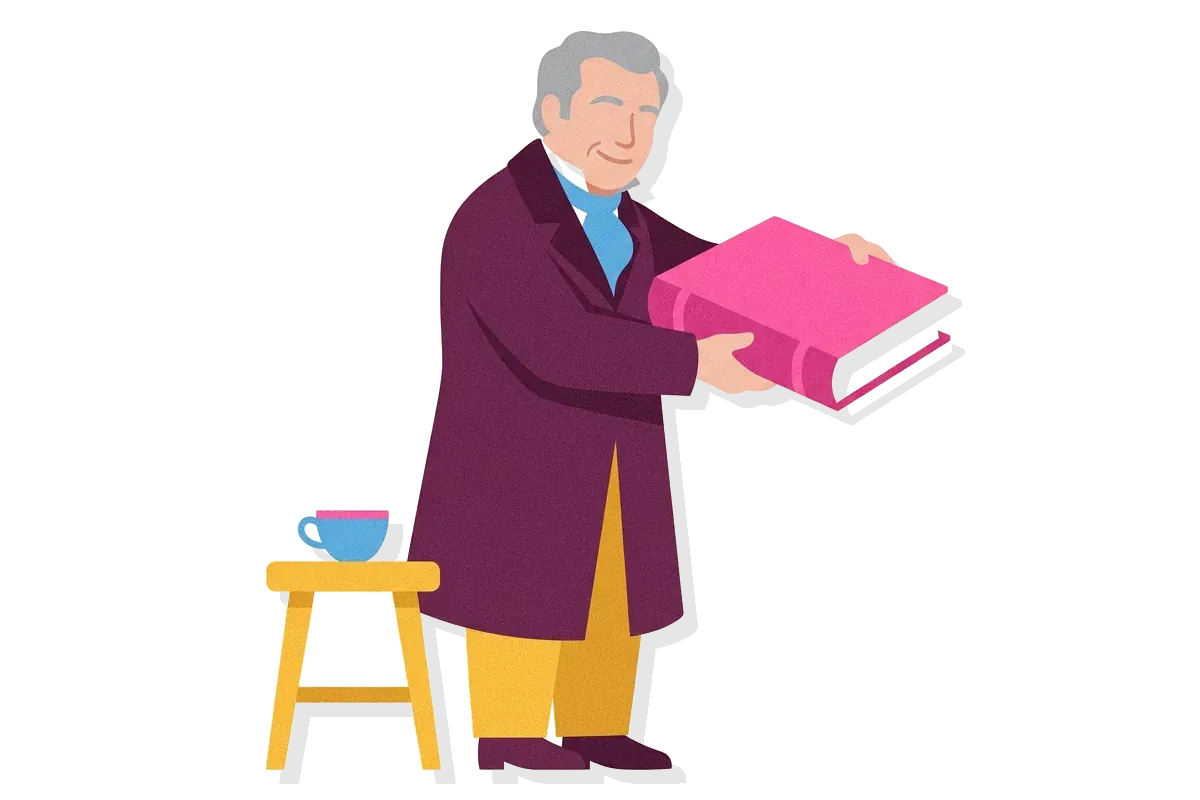
Having heard that he had in his library a certain very scarce and curious book, I wrote a note to him, expressing my desire of perusing that book, and requesting he would do me the favour of lending it to me for a few days.
The member sent the book at once. Franklin returned it about a week later with a second note that thanked him strongly. The next time they met in the House, the member spoke to Franklin for the first time, "with great civility". They became friends for life.
Look at who did what. The member was the one who lent the book. Franklin was the one who received it. The member's attitude changed, from open opposition to friendship. That direction is the whole effect, and it is the opposite of what most people expect. We usually assume that we win over a person by doing something for them. Franklin won over a person by letting them do something for him.
Franklin's own explanation was short. He called it an old maxim: the person who has once done you a kindness is more ready to do you another than the person you have yourself obliged. Franklin described what the helper later does. He did not give a psychological cause. The next sections cover the causes that researchers have proposed since.
022 min
Why the Ben Franklin effect happens
Researchers have offered three explanations. They are not exclusive, and the evidence does not fully separate them.
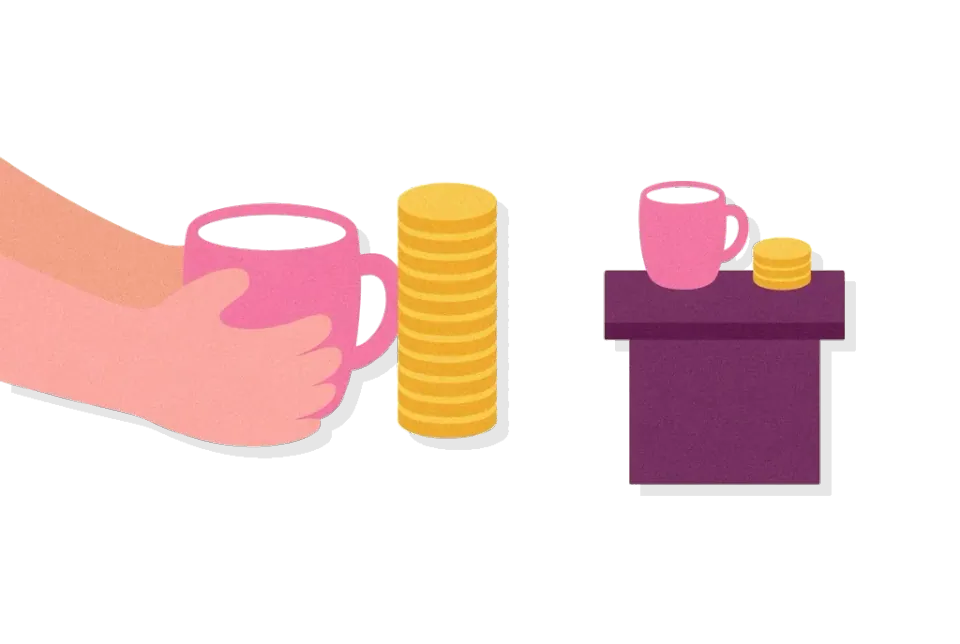
Cognitive dissonance. Cognitive dissonance is the discomfort of holding two ideas that do not fit together, or of acting against a belief. The theory says people reduce that discomfort by changing one of the ideas. Applied here, the two ideas are "I do not like this person" and "I just helped this person." The act is already done and cannot be undone. The easier thing to change is the attitude. This account is described on cognitive dissonance, and it is the version most often repeated.
Self-perception. Daryl Bem proposed in 1967 that people often learn what they think by watching what they do, the same way an outside observer would. This account needs no discomfort. A person who sees themselves lend a book, work late for someone, or answer a long question concludes that they must care about that person. The attitude is inferred from the behaviour after the fact.
A reply to a friendly signal. Yu Niiya, who ran a modern test of the effect, proposed a different account. In that view the person who is asked for help reads the request as an attempt to start a friendly relationship, and answers that signal with warmth. This account predicts something the other two do not. It says the request matters, and not only the act of helping.
| Explanation | What changes the liking | Needs the helper to feel discomfort | Predicts no effect when |
|---|---|---|---|
| Cognitive dissonance | The wish to make attitude match action | Yes | The helper has an outside reason for helping |
| Self-perception | The helper infers feelings from their own act | No | The helper sees the act as forced |
| Reply to a friendly signal | The helper answers a request for closeness | No | There is no direct request |
The three accounts agree in the usual case. They separate when a person helps without being asked, or helps because an intermediary asked. A later section reports experiments on exactly that point.
One more factor makes the effect plausible. People rarely help someone they dislike for no reason. When a person does help, they look for the reason, and "I like them" is the cheapest one available. The two sentences "I helped them" and "I dislike them" are hard to hold together. One of them usually changes, and it is not the one that has already happened.
032 min
Where the Ben Franklin effect comes from
The effect is named after Franklin, but the experiment came much later. Jon Jecker and David Landy published Liking a Person as a Function of Doing Him a Favour in the journal Human Relations in 1969.
In their experiment, students took part in a question-and-answer competition run by the researcher, and the students could win money. Afterwards the students were split into three groups. One group was approached by the researcher, who asked them to give the money back because he had paid the winners from his own funds and was now short of money. A second group was asked by a secretary to return the money, on the grounds that it belonged to the psychology department and the department's funds were low. A third group was not asked at all. Then every student was asked how much they liked the researcher.
The result had a clear order. The students who were asked directly by the researcher liked him the most. The students who were asked through the secretary liked him the least. The students who were not asked fell in between. The difference between the first two groups is the important part. Both groups gave back money. Only the group that was asked in person raised its liking.
Two limits of the sources should be said plainly. The page for the original paper blocks automated access, so the description above is taken from a published summary of it, and the figures in the paper itself were not checked for this article. The summary reports the order of the groups. It does not give the size of the differences, so this article does not give one either.
042 min
Later evidence: harm, and the request itself
Two later experiments extend the 1969 result in different directions.
Treating someone badly lowers liking. John Schopler and John Compere published Effects of Being Kind or Harsh to Another on Liking in 1971. Their participants played the role of teachers who tapped out patterns for a learner to repeat. With one learner the teacher encouraged correct answers. With another the teacher insulted and criticised mistakes. Afterwards, the learners who had been insulted were rated as less attractive. The finding is the mirror image of the Franklin case. It says that how you treat a person affects how you judge them, in both directions.
The request matters. Yu Niiya reported an experiment in the Journal of Social Psychology in 2016, with both Japanese and American participants. People who were asked for help by a confederate (a researcher's assistant playing a participant) liked the confederate more than they had at the start. People who helped the confederate without being directly asked showed no such increase. This is a second difference between the two lines of evidence. In Franklin's case and in Jecker and Landy's experiment, a direct request came first. Niiya's result suggests that the request is part of the cause and not only a way to get the favour.
Put the studies side by side and a pattern emerges.
| Study | What the helper did | Liking afterwards |
|---|---|---|
| Franklin's account | Lent a book after a direct note | Rival became a friend |
| Jecker and Landy, 1969 | Returned money after a direct request from the researcher | Highest of three groups |
| Jecker and Landy, 1969 | Returned money after a request from a secretary | Lowest of three groups |
| Niiya, 2016 | Helped after a direct request | Rose from the starting level |
| Niiya, 2016 | Helped without a direct request | No rise |
| Schopler and Compere, 1971 | Insulted the learner | Learner rated less attractive |
052 min
How the Ben Franklin effect shows up at work
The scenarios below follow the same pattern. A person with little reason to support someone is asked for a small, specific favour and given a way to say yes.
A product manager and a sceptical engineering lead
A product manager has proposed a roadmap that an engineering lead openly doubts. The usual response is a longer slide deck, which gives the lead more to argue against. The Franklin move is smaller. The product manager asks the lead to check one estimate, because the lead knows the codebase best. The lead spends ten minutes, gives a number, and has now contributed to the plan. The lead's later comments tend to move from "whether" to "how".
A designer and a stakeholder who dislikes the direction
A designer faces a director who keeps rejecting the visual direction. Rather than defend it again, the designer asks the director one question only that person can answer, such as which of the director's past campaigns they would point to as the right level of risk. The answer is a favour of knowledge. It also puts the director on record as helping to shape the work.
An engineer and a maintainer of a shared library
An engineer needs a maintainer's approval for a change to a library the maintainer owns. The maintainer has ignored two earlier requests. The engineer asks a narrow question about how the maintainer would structure the change, and then does it that way. The maintainer, having given an opinion that is now followed, has a stake in the change passing.
A founder and a possible advisor or early customer
A founder wants a busy person's time but cannot offer anything in return yet. Asking for ten minutes of advice on one concrete decision costs the other person little. Founders often assume they must first give value. The effect suggests that a small, well-chosen request can start the relationship, and a later report on what the advice led to gives the helper a result to feel good about.
062 min
How to use the Ben Franklin effect, and how to guard against it
To use it, follow the conditions the evidence supports.
Ask directly.
In both the 1969 experiment and Niiya's 2016 experiment, a direct request was part of the effect. A favour handled through someone else did not help in the first, and a favour with no direct request did not help in the second.
Keep the favour small and specific.
A question the person can answer in minutes is easier to do willingly than a task that takes days.
Make it a real need.
The person should be able to see that their help matters. A request made only to flatter is easy to spot and gives them no reason to feel they did something useful.
Thank them for the specific help.
Franklin returned the book with a note that expressed his sense of the favour. That tells the helper their act had value, which supports the reading "I helped because this was worth doing."
Do not try to cancel the favour at once.
Repaying immediately turns the exchange into a trade. No experiment cited here tests this, so treat it as a judgement and not a finding.
To guard against it, separate the help from the verdict.
- Before you decide whether you like a colleague's proposal, ask whether you only feel warm toward them because you did something for them lately.
- When you review a request for a favour you granted, judge the next request on its merits. The warmth from the first one can make you say yes more easily to the second.
- Notice the conditions in which you were asked. A request made in person, for something you could do willingly, is the condition that moves liking the most.
Franklin's maxim points the same way. A person who has helped is more ready to help again. That is useful when you are the one asking and costly when you are the one being asked.
072 min
When the Ben Franklin effect does not work
The sources above give some limits and the research literature suggests others. The first two below are supported by the experiments cited. The rest are reasonable inferences, and each is marked as such.
- The request goes through an intermediary. In the 1969 experiment, the students who were asked by a secretary liked the researcher the least of the three groups.
- There is no direct request. In Niiya's 2016 experiment, helping without being asked did not raise liking.
- The person did not choose to help. This is an inference from the dissonance and self-perception accounts. Both depend on the helper seeing the act as their own choice. If a rule or a boss forced the favour, "I had to" explains the act and the attitude has no reason to change.
- The favour is large or repeated. This is also an inference. A person who loses real time or money may start to feel used, and resentment is then a more natural explanation for their act than friendship.
- The favour is a one-sided demand. A request that reads as an order, or that arrives with a threat, does not signal a wish for friendliness. Niiya's account predicts no warmth in that case.
- The helper has an outside reason. A person who helped for pay, for credit, or because it is their job has an explanation that does not involve liking.
The tell for a failed attempt is simple. The person helps, and their manner stays the same or gets colder. At that point, stop asking.
There is also an ethical limit. The effect should not be used to manipulate a person into giving more than they would freely give. A request that is honest about its size, and that the person can decline, keeps the interaction fair.
082 min
The Ben Franklin effect compared with nearby concepts
The Ben Franklin effect is easy to confuse with three other ideas about helping and consistency. The axis that separates them is who changes, and why.
| Concept | Who changes | Why |
|---|---|---|
| This pageBen Franklin effect | ||
| PsychologyReciprocity | ||
| PsychologyCommitment and consistency | ||
| PsychologyIKEA effect |
The nearest confusion is with reciprocity, because both involve favours. They run in opposite directions. Under reciprocity, you do something for a person and they feel they owe you. Under the Ben Franklin effect, the person does something for you and they come to like you. Advice that mixes them up is common. "Give first" is a reciprocity strategy. "Ask first" is a Ben Franklin strategy. They can work in the same relationship, but they are different mechanisms.
The IKEA effect is the closest in structure. Both effects raise liking for something a person put effort into. In the IKEA effect the object is a thing the person made. In the Ben Franklin effect the object is another person the helper assisted.
092 min
Where the evidence is contested
The honest summary is that the effect rests on a small set of experiments, and the explanation is not settled.
The evidence base is thin. This article cites one experiment from 1969 that tested a favour request directly, and one from 2016. Franklin's story is an anecdote that he wrote himself, years later. It is not a controlled result. A reader should hold the claim that favours make people like you as likely, in the right conditions, and not as a law.
The mechanism is disputed. Dissonance theory is the usual explanation in popular writing. Bem's self-perception account says the same outcome needs no discomfort. Niiya argues that the person being asked is answering a friendly signal, and links this to the Japanese idea of amae, a kind of acceptable dependence that invites care. Each account predicts the data in the usual case, as the mechanism section shows.
The original paper was not read for this article. The direct page blocks automated access, and the numeric results in the paper were not checked here. The order of the three groups is consistent across the secondary summaries that were read.
What a practitioner should do while this is unsettled. Use the effect in low-stakes settings where a small request costs the other person nothing. Do not build a strategy that depends on it. Treat any rise in warmth as a hint and not as agreement.
?7 questions
Questions people ask
What is the Ben Franklin effect?
What did Benjamin Franklin actually do?
Why does doing a favour make you like someone?
Does asking for a favour always make people like you?
How is the Ben Franklin effect different from reciprocity?
Can I use it to win over a hostile colleague?
Is the Ben Franklin effect well established?
§6 sources
Sources
Show all 6 sourcesHide sources
Franklin, B. Autobiography of Benjamin Franklin, ed. F. W. Pine (Project Gutenberg edition). The borrowed-book passage and the maxim.
Jecker, J. and Landy, D. (1969). Liking a Person as a Function of Doing Him a Favour. Human Relations 22(4), 371-378. (the publisher blocks automated access, so the record was confirmed through Crossref and the experiment is described from the summary below)
Wikipedia. Benjamin Franklin effect, the summary of the Jecker and Landy and the Schopler and Compere experiments, and of Niiya's alternative account.
Niiya, Y. (2016). Does a Favor Request Increase Liking Toward the Requester? Journal of Social Psychology 156(2), 211-221.
Schopler, J. and Compere, J. S. (1971). Effects of being kind or harsh to another on liking. Journal of Personality and Social Psychology. (the publisher blocks automated access, so the record was confirmed through Crossref)
Bem, D. J. (1967). Self-perception: An alternative interpretation of cognitive dissonance phenomena. Psychological Review 74(3), 183-200. (the publisher blocks automated access, so the record was confirmed through Crossref)