011 min
The Law of Common Fate in a drag-and-drop photo grid
Picture a designer building a photo manager. A person ticks twelve photos that sit in different corners of a large grid. The twelve look nothing alike, and they are not next to each other. The only thing they share is a tick mark.
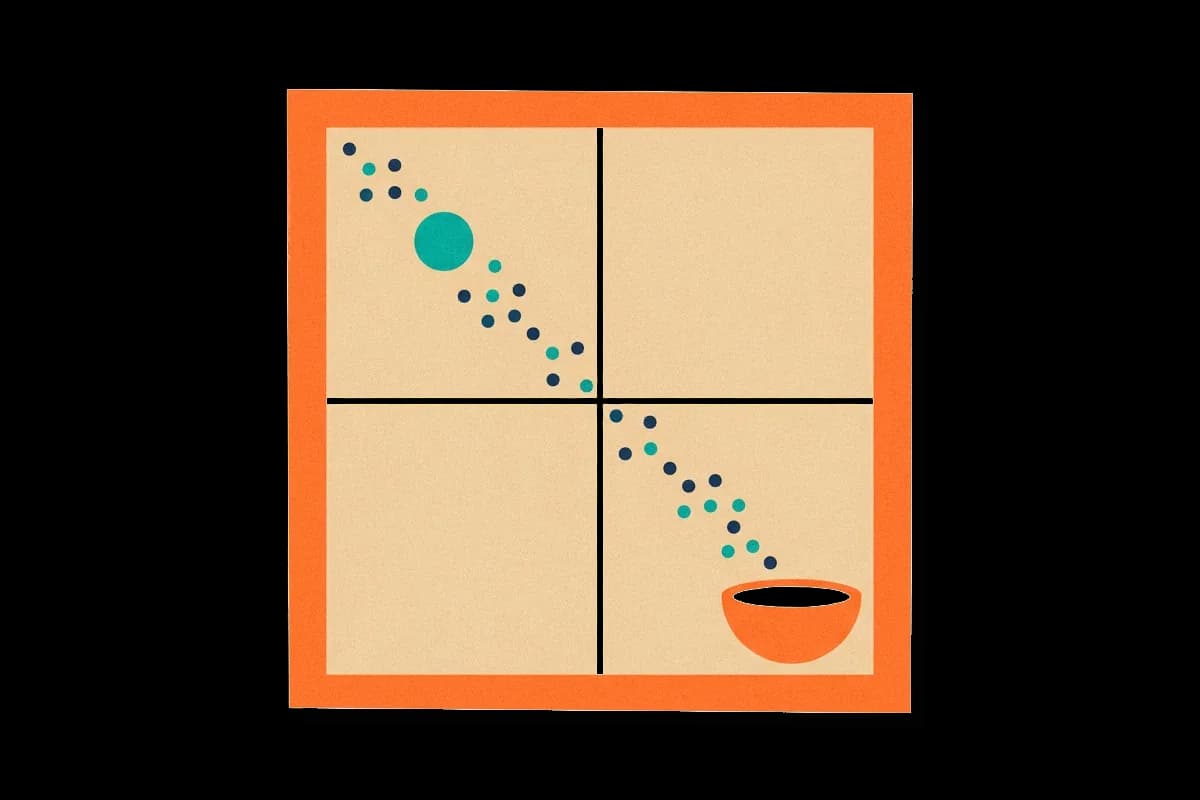
Then the person drags one of the ticked photos. All twelve leave the grid and slide toward an album, in the same direction and at the same speed. The photos that were not ticked stay where they are.
For that moment, the twelve photos stop being twelve separate pictures. They look like one bundle, and nobody has to explain which photos are in it. The grid did not make that bundle. The movement did.
Psychologists call this the Law of Common Fate. The next sections follow the photo manager and check each step against the research behind it.
022 min
What the Law of Common Fate actually says
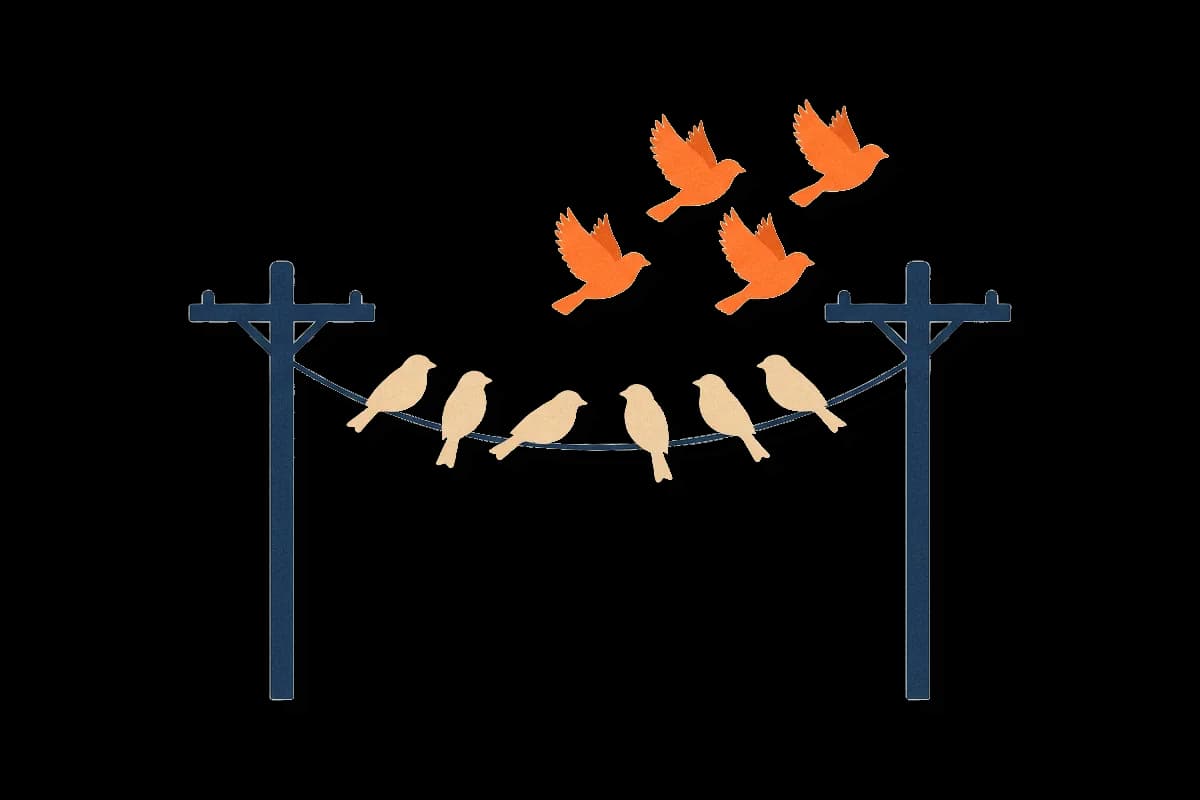
The first careful description of the effect used a row of dots instead of photos. Max Wertheimer, a German psychologist, asked readers to picture a row of dots that the eye already splits into groups because of the gaps between them. Then, in front of the viewer, some of the dots shift slightly upward.
What the viewer feels depends on which dots moved:
- If the shifted dots are a whole group that the eye had already formed, the change looks smooth. The viewer barely does more than notice that something changed.
- If the shifted dots cut across two groups, the change feels confusing and uncomfortable. Wertheimer described a feeling of opposition to the change.
The second case matters most for design. Sometimes the shifted dots formed a new group of their own, and that group overrode the spacing that had grouped them before. Spacing is the subject of proximity, the tendency to see things that sit close together as related. In Wertheimer's dots, movement beat spacing.
He named the factor after what the shifted dots share. The shift is their common fate, and he also called it uniform destiny.
Why would movement group things at all? The 2012 review of Gestalt research by Johan Wagemans and colleagues gives a plain answer. Common fate can be read as a form of similarity grouping, where the property that matches is velocity, meaning speed and direction, instead of colour or shape. That ties it to the Law of Similarity: two shapes that move the same way are similar in velocity.
No formula comes with the principle. It describes what viewers tend to see when other conditions are equal, and Wertheimer showed it with displays, not with an equation.
031 min
Where the Law of Common Fate comes from
Wertheimer was one of the founders of Gestalt psychology, a school that studied how people see wholes instead of lists of parts. His 1912 paper on apparent motion is widely seen as the start of the school.
In 1923 he published the paper that set out the grouping factors of the Gestalt principles, among them proximity, similarity and common fate. It appeared in the journal Psychologische Forschung, volume 4, pages 301 to 350. Most English readers know it through a 1938 translation in Ellis's source book of Gestalt psychology, titled "Laws of Organization in Perceptual Forms".
That translation left out one sentence that later turned out to matter. In the German original, Wertheimer wrote that the principle holds in a wide range of conditions, and that he had not yet studied how wide. Many readers of the English version took common fate to mean one thing only: shapes sliding at the same speed in the same direction.
The question he left open is the subject of the next section.
041 min
How far the Law of Common Fate reaches
Wertheimer left the range open, so later researchers tested it. Four findings show how far the idea stretches.
Movement other than a slide
Common fate does not need a straight slide. Experiments described in a 2025 paper in Scientific Reports found that viewers can also pick out points that rotate together, or that expand or contract together, and not only points that slide in one direction.
Brightening and dimming together
Sekuler and Bennett showed in 2001 that motion is only one case. When parts of a scene get brighter or darker at the same time, viewers group those parts, even when the parts started at different brightness levels. Wagemans and colleagues call this generalized common fate.
Changing together in any direction
A related finding drops direction altogether. A field of dots that flip between black and white at random times splits into two regions as soon as the dots in one area flip together. Researchers call this synchrony: elements that change at the same moment group together, even when their changes differ.
Appearing and disappearing together
The newest extension covers things that appear or vanish together. In a 2025 study, thirty younger and older adults could tell horizontal rectangles from vertical ones even though the rectangle was not visible in either picture. Only the texture elements on its surface appeared or disappeared together.
051 min
Why the Law of Common Fate exists
All four findings raise one question: why would the visual system group by shared change at all? A leopard shows the answer most clearly.
Picture a leopard lying on mottled, leafy ground. Its coat breaks up its outline, and a viewer who is standing still sees only spots and leaves. The moment it steps forward, every patch on its body travels in one direction while the leaves stay put. Those moving patches join into one animal.
Camouflage that works perfectly on a still animal stops working when the animal moves. Wagemans and colleagues treat this as the natural reason grouping principles exist: the same grouping that makes an animal stand out can hide it, and movement removes the hiding.
The principle also helps the eye decide which shape is in front. Palmer and Brooks (2008) tested six grouping factors, common fate among them, as clues to which side of an edge is the figure and which is the background. All six had the predicted effect, though by very different amounts. This is the same question figure-ground asks about stills, answered here with motion.
062 min
How the Law of Common Fate shows up in real interfaces
Back in the photo manager, the designer now has to make the drag look right. Real products show both the good version and the bad one.
An applied case: the iPhone Home Screen
Apple's support guide for iPhone says that a long press on the Home Screen background makes the items begin to jiggle, and that people can then drag an app to a new place. The jiggle moves every icon in the same way at the same time, so the icons read as one set that is open to change. When the person drags one icon, it leaves the shared motion and takes its own path, which makes it stand out from the rest.
Everyday patterns built on shared movement
A row of cards in a carousel slides as one unit, so the cards read as one set. The items of a dropdown menu slide out together, so they read as belonging to the item that opened them. A group of loading dots that turn together reads as one progress signal. In each case the shared movement does part of the grouping that a border would otherwise do.
The photo manager
The twelve ticked photos need to move along the same path, with the same timing, starting at the same moment. That is what turns scattered photos into one bundle, and it needs no border around them.
A violated case: unrelated things moving together
Common fate also fails in the other direction. Say the manager also nudges the unticked photos aside while the twelve fly toward the album. Now a second set of photos moves in step with the first, and some viewers will read those nudged photos as part of the selection. This matches Wertheimer's dots: movement that cuts across the groups people expect feels confusing.
072 min
How strong the Law of Common Fate is next to other cues
The photo manager raises a practical question. If movement and position disagree, which one wins?
A team led by Amira Chalbi and Jacob Ritchie, with Niklas Elmqvist, Fanny Chevalier and others, tested this in a 2019 paper posted to arXiv. One hundred crowd workers looked at four shapes and said how the shapes grouped. In each round two cues disagreed. The cues were position, size and brightness, and each cue was either fixed or changing over time.
Changing position was the strongest cue. It beat changing brightness, and it beat shapes that only matched in size or brightness. The authors also report that grouping by movement was stronger than grouping by closeness, and so was grouping by change in size. A size change over time beat a brightness change over time.
The team then moved to charts that look like real ones: an animated scatterplot in the style of Gapminder, and a map of election results. The order changed. In the scatterplot, movement was ranked the strongest cue by a wide margin, but on the map no cue clearly led. The ranking depends on the chart and its data.
When position already carries the data
One limit follows from this. If position already shows a data value, as the axes do in a scatterplot, then moving points to group them would read as a change in that value. In that case the authors point to size or brightness changes as the free channels for grouping.
081 min
Applying the Law of Common Fate
Those results turn into a short set of rules for the photo manager.
Move group members together.
Give them the same path, the same speed, the same easing and the same start time. A member that starts late or takes another path looks like it left the group.
Keep outsiders still, or clearly different.
Wertheimer's shifts that cut across groups felt confusing, so nothing outside the group should move in step with it.
Pick the free channel.
If position already carries meaning, as on a chart axis, group with a change in size or brightness instead.
Limit how many groups move at once.
A moving group attracts attention. In the chart study, people said that moving points took their attention away from other cues.
Stop the motion once the relationship is clear.
A group that keeps moving after its job is done only competes with the next task.
To check the result, play the animation for a few people and ask each of them to point at everything that belongs together. Session recordings and eye tracking can show where attention went.
When these rules backfire
Over-applied, the principle erases differences you want people to see. If every layer of a page moves together as the person scrolls, nothing reads as separate from anything else. Group only what is related.
091 min
The Law of Common Fate and people who are sensitive to motion
Every rule above assumes that the viewer can watch the motion comfortably. Not everyone can.
The Web Content Accessibility Guidelines (WCAG), published by the W3C, have two criteria that apply. Success Criterion 2.2.2, Pause, Stop, Hide (Level A), covers moving content. Moving content that starts by itself, lasts more than five seconds and sits beside other content needs a control that lets people pause it, stop it or hide it. The W3C explains that some people with cognitive disabilities and attention deficits are distracted by continuous movement.
Success Criterion 2.3.3, Animation from Interactions (Level AAA), covers movement that a person's own action triggers, such as a drag or a scroll. It says that non-essential motion animation can be switched off. The W3C notes that non-essential movement can trigger vestibular disorder reactions, which include dizziness, headaches and nausea. The vestibular system is the inner-ear system that keeps balance. The W3C suggests three fixes: avoid unnecessary animation, give a control to turn it off, or follow the reduced-motion setting of the operating system or browser.
In the photo manager, the photos following the pointer is the function itself. A spin or bounce on the way to the album is decoration. The grouping should also survive without any motion: keep the tick marks and a count of selected photos visible, so the selection stays readable when animation is off.
101 min
How to spot the Law of Common Fate going wrong
The effect happens in the viewer's head, so you check it by watching viewers. Look for these signs:
- In a usability session, a person drags one item and says the wrong items followed it, or asks why a certain item moved.
- After an animation plays, people name a different set of items as "together" than the set you meant.
- Screen recordings show repeated mis-selection of items that moved at the same time as the target.
- Eye-tracking maps concentrate on a decorative moving element instead of on the controls.
111 min
The Law of Common Fate vs. nearby concepts
A moving group raises the question of which Gestalt principle is at work. One axis separates them: what the elements share.
| Concept | What groups the elements | Needs change over time? |
|---|---|---|
| Law of Common Fate | They move or change the same way | Yes |
| Continuity | They lie along a smooth line or curve | No |
| Proximity | They sit close together | No |
| Similarity | They share a look, such as colour or shape | No |
| Synchrony | They change at the same moments, in any direction | Yes |
Continuity is the one people mix up most. A line of people walking the same way is read as a group for two reasons: they are lined up, which is continuity, and they move together, which is common fate. Take away the line and the shared movement still groups them. Freeze them and the line still does.
Similarity is the broader idea, as the mechanism section explained. Synchrony is a wider version of the idea: it needs shared timing, not shared direction.
121 min
Where the evidence on the Law of Common Fate is thin
Common fate is among the best supported grouping principles, but three cautions apply.
First, the word "law" overstates it. Wertheimer showed the effect with displays and asked readers to look, and descriptions of it carry the hedge that all other conditions must be equal. It is a strong tendency, not a formula. The Wagemans review says that early demonstrations were later supplemented by real experiments with carefully controlled stimuli.
Second, strength measured in a lab with one cue at a time says little about a busy screen. The same review notes that isolated cues in well-controlled displays usually lead to weaker effects, while several weak cues often combine in natural images.
Third, any ranking of cues is a default, not a fact. The chart study's ranking moved when the chart changed.
For a practitioner, this means treating the principle as a strong starting point. Then test your own animation: compare the group you meant with the group people actually see.
?3 questions
Questions people ask
Do the moving elements have to be next to each other?
Can a still layout use the Law of Common Fate?
Can two groups move at the same time?
§8 sources
Sources for the Law of Common Fate
Wertheimer, M. (1923). Untersuchungen zur Lehre von der Gestalt II. Psychologische Forschung, 4, 301–350.
Wertheimer, M. (1923/1938). Laws of Organization in Perceptual Forms, English translation in W. Ellis, A Source Book of Gestalt Psychology. Classics in the History of Psychology, York University.
Wagemans, J., Elder, J. H., Kubovy, M., Palmer, S. E., Peterson, M. A., Singh, M., & von der Heydt, R. (2012). A century of Gestalt psychology in visual perception: I. Perceptual grouping and figure–ground organization. Psychological Bulletin, 138(6), 1172–1217. This review is the source here for Sekuler and Bennett (2001), Alais, Blake and Lee (1998), Lee and Blake (1999) and Palmer and Brooks (2008).
Chalbi, A., Ritchie, J., Park, D., Choi, J., Roussel, N., Elmqvist, N., & Chevalier, F. (2019). Common Fate for Animated Transitions in Visualization. arXiv preprint 1908.00661.
Show all 8 sourcesShow fewer sources
Norman, J. F., Carmichael, M., Hagan, E., et al. (2025). Appearance and disappearance, an unrecognized form of grouping and form perception from common fate. Scientific Reports, 15, 14638. The open full text used for checking is at
Apple (n.d.). Move apps and widgets on the iPhone Home Screen. iPhone User Guide.
W3C (2023). Understanding Success Criterion 2.2.2: Pause, Stop, Hide. Web Content Accessibility Guidelines 2.2.
W3C (2023). Understanding Success Criterion 2.3.3: Animation from Interactions. Web Content Accessibility Guidelines 2.2.