011 min
What breaks without feedback loops
A product team ships a new onboarding flow in March. Nobody looks at who finishes it. In June the team plans a second version, still without knowing whether the first one worked. Each decision is made from opinion, because no result ever travelled back to the people who made the change.
That is a missing loop. The team acts, but the effect of the action never returns as an input to the next action. The cost is a series of decisions made blind. A wrong design stays in place for months because nothing shows that it is wrong.
The opposite failure is a loop that exists but returns the wrong signal. A support team that is rewarded for closing tickets quickly will close tickets quickly. The signal "tickets closed" travels back and the team does more of it, even when customers reopen the same problem a week later.
Both failures have the same root. A loop has to carry a signal that matches the goal, and it has to arrive while the person can still act on it. The rest of this article shows how loops are built, which kinds exist, and how they go wrong.
023 min
How feedback loops work
Every feedback loop has four parts. Something is measured, the measurement is compared with a goal, an action follows from the comparison, and the action changes what is measured next. The loop is closed when the last step feeds the first one.
Systems analysts sort loops into two kinds. Donella Meadows, a systems analyst and author of Thinking in Systems, put it briefly: a negative feedback loop is self-correcting, and a positive feedback loop is self-reinforcing. Product teams often use the plainer names balancing and reinforcing, because "negative" sounds like "bad" and "positive" sounds like "good". Neither is true. The names describe the direction of the push.
Balancing loops
A balancing loop pushes a measured value back toward a goal. Meadows calls a thermostat the classic example of a negative feedback loop, whose purpose is to keep room temperature fairly constant at a desired level. The room cools, the thermostat reads the temperature, the heater switches on, the room warms, and the heater switches off.
A product has the same structure wherever it has a target and an alarm. An on-call alert fires when the error rate passes a limit. An engineer fixes the cause. The error rate falls below the limit and the alert stops.
Reinforcing loops
A reinforcing loop pushes a value further in the direction it is already moving. Meadows says the more such a loop works, the more power it gains to work some more. A product with a reinforcing loop grows faster as it grows, or shrinks faster as it shrinks.
| Balancing loop | Reinforcing loop | |
|---|---|---|
| Effect on the measured value | Moves it back toward a goal | Moves it further in the same direction |
| Long-run behaviour | Settles near the goal | Grows or falls without a limit, until something outside the loop stops it |
| Product example | An alert that triggers a fix | Each new user invites more users |
| Main risk | Delay makes it overshoot | Nothing stops it when the direction is wrong |
Delay
The part that surprises most teams is delay. Meadows wrote that delays in feedback loops are critical determinants of system behavior and common causes of oscillations. Think of a person adjusting a shower. The water is too cold, so they turn the handle. Nothing changes for several seconds, so they turn it further. Then the water becomes too hot, and they turn it back too far.
A product team does the same when it reads a retention number that is 30 days old, changes the product, and reads the next number 30 days later. Two changes can be in flight at once, and the team cannot tell which one caused the movement.
One worked case ties the parts together. A subscription app measures weekly active users and sets a goal of 5,000 more each month. A drop in weekly active users triggers a campaign. The campaign takes three weeks to prepare. By the time it lands, the drop has already reversed for other reasons, and the campaign adds to the rise. The loop is balancing in design but amplifies the swing because of the delay. Loops fail like this when the measurement, the decision and the effect run on different clocks.
032 min
Where the feedback loop idea came from
The idea started with machines, not with software. Feedback in the technical sense occurs when the outputs of a system are routed back as inputs, forming a chain of cause and effect that makes a circuit or loop. Engineers built such circuits before anyone had a name for them.
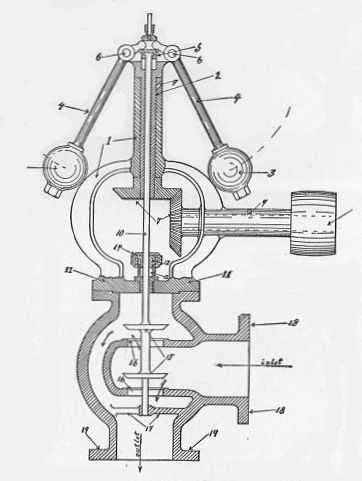
A centrifugal governor is a set of spinning weights that open or close a valve as speed changes. Centrifugal governors were used to regulate the distance and pressure between millstones in windmills since the 17th century. In 1788, James Watt designed his first centrifugal governor for the steam engines of his firm, following a suggestion from his business partner Matthew Boulton. If the engine ran too fast, the weights swung outward and closed the steam valve. If it ran too slowly, they dropped and opened it.
The mathematics came later. A mathematical analysis of Watt's governor was done by James Clerk Maxwell in 1868. He published it as "On Governors" in the Proceedings of the Royal Society of London. It explained why some governors held a steady speed and others swung back and forth. That is the same delay problem described above, in a mechanical system.
Product teams later took the term from this engineering tradition, through systems thinking and through the Lean Startup method. The word kept its meaning. It still names a circuit in which the result of an action returns to shape the next action.
042 min
A reinforcing loop in a real product: Dropbox referrals
Dropbox, the file-storage company, built a reinforcing loop into its pricing. Dropbox Basic users are given two gigabytes of free storage space. This can be expanded through referrals: users recommend the service to other people, and if those people start using the service, the user is awarded additional 500 megabytes of storage space.
The loop has four steps. A user invites a friend. The friend signs up. The invitation gives the user more storage, and the friend also starts as a user who can invite others. Each completed cycle adds a user, and each added user can start another cycle.
Dropbox grew quickly in this period. It surpassed the 1 million registered users milestone in April 2009, followed by 2 million in September, and 3 million in November. The figures do not prove the referral loop caused all of that growth, because the company also earned attention in other ways. They do show the shape a reinforcing loop produces: the second million took five months and the third took two.
A reinforcing loop of this kind needs two conditions. The reward has to be something users want, here more storage, and giving it must cost the company little. The loop also needs a limit that is set on purpose. Dropbox Basic users can earn up to 16 gigabytes through the referral program. Without that cap, the reward would grow without a limit while the cost of storage grew with it.
052 min
A loop that damages its own data: recommendation systems
The second case differs from the first in one way. In the Dropbox loop, the output returns as a reward. In a recommendation system, the output returns as the data the system learns from. That changes what can go wrong.
A recommendation system shows people items. People click on some of them. The system then learns from the clicks and shows more of the same. This is a reinforcing loop, and it learns from its own output.
Allison Chaney, Brandon Stewart and Barbara Engelhardt studied this in a 2017 paper. They wrote that these systems are often evaluated or trained with data from users already exposed to algorithmic recommendations, and that this creates a pernicious feedback loop. Their simulations showed that when a system learned from data shaped by its earlier recommendations, user behavior became more uniform. The quality of the recommendations did not improve.
The variable that differs between the two cases is what the loop returns. Dropbox returns a reward the company chose and capped. A recommendation system returns the behavior it caused, and nobody chose or capped that. The first loop is designed. The second one grows by accident.
The contrast teaches one thing neither case teaches alone. A reinforcing loop needs a limit, and it needs a check that its input still measures what the team thinks it measures. If either is missing, the loop keeps running and the numbers look fine while the product gets worse.
062 min
Feedback loops in product work: build, measure, learn
The best-known product feedback loop is the one in the Lean Startup method. Eric Ries's Lean Startup method has the build-measure-learn feedback loop as a core component. The first step is figuring out the problem that needs to be solved and then developing a minimum viable product to begin the process of learning as quickly as possible.
The three steps map onto the parts of any loop. Build is the action. Measure is the signal. Learn is the comparison with the goal, which decides the next build. The Lean Startup site names the unit of progress as validated learning, which it describes as a rigorous method for demonstrating progress when one is embedded in the soil of extreme uncertainty. In plain terms, a team has made progress when it knows something it did not know before, and it can show the evidence.
Speed matters here because of delay. A loop that completes once a quarter gives four chances to be wrong each year. A loop that completes every week gives fifty-two. Teams that shorten the loop shorten the time between a decision and its result, and the loop can then correct itself before the error grows. The related concept of the iteration cycle covers how long each pass should be.
An A/B test is a tightly controlled version of this loop. It compares two builds for a fixed period and returns one answer about a single change. The loop in a daily support queue is looser, but it can carry richer signals, such as the words customers use to describe a problem.
Which loops a product team usually runs
| Loop | What returns | Typical delay |
|---|---|---|
| Error alerting | Error rate | Minutes |
| A/B test | Difference in a metric | Days to weeks |
| Customer interview round | What users say they tried and why | Weeks |
| Retention review | Share of users who came back | Months |
| Growth loop such as referrals | New users from existing users | Days to weeks per pass |
A team that tracks only the slowest loop cannot learn fast. A team that tracks only the fastest loop optimizes minutes and misses months.
072 min
How to map a feedback loop this week
The artifact for this exercise is a loop map: one page that shows the loop a team is running, with a delay noted on each step. A shared document or a whiteboard is enough.
- Pick one outcome the team wants to change, such as the share of new users who finish setup.
- Write the signal the team looks at for that outcome. Name the exact metric and where it is read.
- Write the action the team takes when the signal moves. If there is no action, the loop is open. Mark it.
- Write how the action changes the signal. Draw the line back to step 2. If you cannot say how, the loop is not closed.
- Mark the delay on each step in hours, days or weeks. Add them up.
- Label the loop balancing or reinforcing. Ask what stops a reinforcing loop, and what would show that a balancing loop is aiming at the wrong goal.
- Pick one step to shorten or one open loop to close this month.
Teams often find that the loop they thought was weekly is quarterly, because the data is only reviewed at the end of the quarter. They also find loops with no action at all, such as a satisfaction survey that nobody reads.
A scenario shows the use. A product manager maps the setup loop for a subscription app. The signal is setup completion, read from a dashboard that updates daily. The action is a new onboarding screen. The delay from change to a readable result is two weeks, because users arrive slowly. The manager decides to test one change per two weeks instead of three at once, so each result can be read. That decision did not exist before the map.
Looking for the biggest effect is the next question. Meadows argues that reducing the gain around a positive loop, which means slowing the growth, is usually a more powerful leverage point in systems than strengthening negative loops. The idea is developed under leverage points. For a product team it means that when a reinforcing loop is running, the first question is how to slow it if it goes wrong.
082 min
Feedback loops done badly
Loops fail in four ways that can be recognized from the outside.
- The signal is a proxy that people learn to improve directly. The economist Charles Goodhart is credited with the core idea, from a 1975 article on monetary policy in the United Kingdom. A common short wording of it is "When a measure becomes a target, it ceases to be a good measure". The tell is a metric that rises while customer complaints stay the same or grow. A support team that closes tickets quickly and sees reopened tickets is an example.
- The delay is longer than the review cycle. The tell is a team that reviews a number weekly when the effect of a change takes a month to appear. It reads noise and reacts to it.
- A reinforcing loop has no limit. The tell is a number that keeps rising and a cost that rises with it, such as a reward that is paid on every invitation. The limit has to be written down before launch.
- Side effects are not in the loop. A change that raises one number can lower another one nobody reads. Second-order effects describe the results that arrive after the first result. A loop that watches only the first result will not see them.
Two of these are misuse and two are limits of the idea itself. Choosing a proxy and ignoring delay are misuse. Not every loop can be closed, and not every effect can be measured. Some effects, such as brand trust, return too slowly or too indirectly to be read at all. A team that treats an unmeasured effect as no effect has made a wrong assumption that no loop will correct.
092 min
Feedback loops vs. nearby concepts
Three concepts are often mixed up with feedback loops.
| Concept | What it is | What decides between them |
|---|---|---|
| Feedback loop | A cycle in which a result returns and changes the next action | It has a return path. Without one, there is no loop |
| Feedback | A single piece of information about a result, such as a comment or a metric | It is one signal. A loop needs the signal to change the next action |
| Iteration cycle | A repeated pass of making and checking | It names the repetition. A loop names the cause and effect between passes |
| Investment loop | A loop where a user's own effort raises the product's value to them | It is one specific kind of reinforcing loop, described in investment loops |
The deciding fact between feedback and a feedback loop is the return path. A customer comment is feedback. It becomes part of a loop only when someone changes the product because of it and then checks whether the next comment is different.
An iteration can happen without a loop. A team can ship a new version every week and never read how the last one performed. The cycles repeat, but nothing returns. When a team wants both, it starts with the loop and sets the cycle length to match the delay.
?6 questions
Questions people ask
What is a feedback loop in product management?
What is the difference between a balancing and a reinforcing loop?
What is an example of a feedback loop in a product?
Why do feedback loops cause oscillation?
How do you close an open feedback loop?
How fast should a product feedback loop be?
§6 sources
Sources
Show all 6 sourcesHide sources
Meadows, D. (1999). Leverage points: places to intervene in a system. The Sustainability Institute.
Wikipedia contributors. Feedback. Includes the history of centrifugal governors, James Watt (1788) and James Clerk Maxwell, "On Governors" (1868).
Wikipedia contributors. Dropbox. Referral program and user growth, 2009.
Chaney, A. J. B., Stewart, B. M. and Engelhardt, B. E. (2017). How algorithmic confounding in recommendation systems increases homogeneity and decreases utility.
Ries, E. The Lean Startup: Principles.
Wikipedia contributors. Goodhart's law. Goodhart (1975) and a common short wording of the idea.