011 min
Where the intention-behavior gap shows up
Picture a product manager who decides on Sunday to run after work on Monday, Wednesday and Friday. They mean it. They buy running shoes, add three runs to the calendar and tell a colleague.
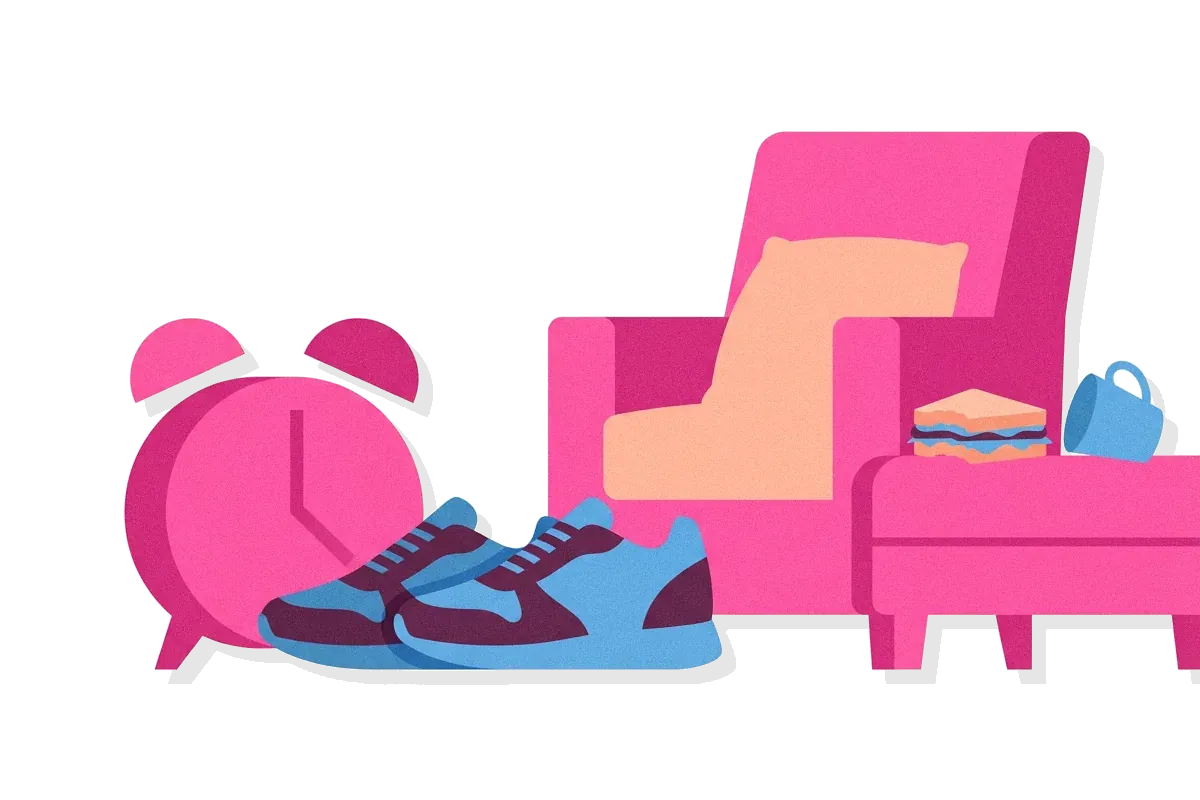
By Wednesday evening, the product manager sits on the sofa with the remote in hand while the running shoes stay by the front door. They did not change their mind. A planning meeting ended late, the evening was cold, and the sofa was close. The run was still a good idea. It did not happen.
Researchers call this pattern the intention-behavior gap. It is measured across groups of people, not in one person's evening: the question is how many of those who intend something go on to do it. The pattern appears wherever plans are made ahead of time, such as saving money, taking medicine, studying for an exam or learning a language.
021 min
How large the intention-behavior gap is
The product manager's Wednesday is common. Rhodes and de Bruijn (2013) pooled studies that asked people about their plans to be physically active and then checked what they did. They put the physical activity gap at 46 percent, meaning that 46 percent of the people who intended to be active were not.
A second way to measure the gap asks a different question: how much of the difference in what people do do their intentions explain? In reviews of studies built on the theory of planned behavior, intentions account for 18 to 23 percent of the differences in what people do.
The two numbers describe different things. The first counts people who intended to act and did not. The second says how well intentions predict behavior across everyone, including people who had no plan. Neither number says why one person fails, and that is the question the rest of this article follows.
031 min
Where the intention-behavior gap comes from
The gap became a research question because of a theory built on intentions. In the late 1960s Martin Fishbein and Icek Ajzen developed the theory of reasoned action to study how attitudes, intentions and behavior relate. It assumes that what people intend is the best guide to what they do. Ajzen later added a person's sense of control over the behavior and renamed it the theory of planned behavior.
The theory held up in one respect: people with stronger intentions did act more often. But the share of behavior it explained was small, and researchers began to ask what happens between deciding and doing. The sections below follow the answers in the order the product manager meets them.
042 min
Why the intention-behavior gap happens
The Sunday decision and the Wednesday action differ in time, place and cost. Four differences account for most of what goes wrong.
The reward is far away
On Sunday, a run on Wednesday looks worth the effort. On Wednesday, the effort is due now and the benefit arrives weeks later. Economists often explain the gap this way, with hyperbolic discounting: people weigh the present more than the future, and the weight shifts as the moment gets closer. A plan that looked right ahead of time looks worse when it is due.
The setting is different
The plan was made at a calm moment. The action has to happen among cues, which are things in the setting that start a response without a new decision: the sofa, the remote, tiredness, a late meeting. A cue can start a habit or an impulse before the person has weighed the plan at all.
The plan asks for more than the person has
Susan Michie and colleagues proposed in 2011 that behavior needs three conditions together: capability, opportunity and motivation. Their COM-B model shows why a strong intention is not enough. An intention supplies only motivation. If the person lacks the skill, the time or the place, the behavior does not follow.
The plan is too hopeful
People tend to plan as if nothing will interrupt them. The planning fallacy is the habit of underestimating the time and effort a task will need. A three-run week assumes three free evenings, and the calendar of a product manager rarely has them.
051 min
Why stronger intentions barely reduce the intention-behavior gap
If the gap came only from weak motivation, raising intentions would remove it. Webb and Sheeran (2006) tested this by pooling experiments that randomly assigned people to conditions that raised their intentions, and then measured what the people did. A medium-to-large rise in intention (d = 0.66) led to only a small-to-medium rise in behavior (d = 0.36). Here d is a standard measure of effect size, in which 0.2 counts as small, 0.5 as medium and 0.8 as large.
Persuasion and pep talks therefore reach only part of the problem. A product team that spends its effort making users want a feature more should expect a smaller change in use than in wanting.
When an intention is unstable
Intentions also differ in quality. Conner and Godin (2007) combined seven studies of physical activity and found that stable intentions predicted behavior with a correlation of 0.60, while unstable intentions managed 0.27. A correlation of 1 would mean perfect prediction and 0 would mean none. An intention is stable when the person reports about the same intention each time they are asked.
062 min
How to reduce the intention-behavior gap
A stronger wish does not repair a plan that has no moment attached to it. The tools that work tie the plan to a situation.
If-then plans
Researchers call a plan of the form "if situation X happens, then I will do Y" an implementation intention. Take the product manager again, with one input changed. On Sunday they write one sentence: if I close my laptop on Monday, Wednesday or Friday, then I put on my running shoes at the door. Wednesday evening now has a trigger that does not depend on how they feel at 6 pm.
Gollwitzer and Sheeran (2006) pooled 94 tests and found that such plans improved goal attainment, with a medium-to-large effect (d = 0.65).
Why an if-then plan works
The same review found two processes at work. Forming the plan made the named situation easier to notice, and it made the planned response more automatic. The decision is already taken, so Wednesday evening does not need a new one.
If [the cue happens], then I will [the action], in [the place].
Other tools
People who expect to give in later can bind themselves in advance by removing the options they would be tempted to choose. That method is called precommitment. A team can also remove steps between the user and the action, and ask for the action at a moment the user is already free.
071 min
Flu shots and the details of a plan
Details decide whether a plan works. Milkman and colleagues (2011) tested this at a large company that offered free flu shots at clinics on its own sites. Every eligible employee received a letter with the clinic times and places. Some employees also received a prompt to write down a planned date for the shot, and others a prompt to write down a date and a time.
Employees who wrote a date and a time were vaccinated at a rate 4.2 percentage points higher than the comparison group, which is unlikely to be chance.
A date alone was not enough
Employees who wrote only a date raised the rate by 1.5 percentage points, which is too small to tell apart from chance. One reasonable reading is that a date names the day but leaves open where in the day the shot fits, so the Wednesday-evening problem remains. A time ties the plan to a specific point in the person's schedule.
081 min
What a gym megastudy found
A test of one idea cannot show how it compares with others. A megastudy can, because many programs are tested at once, on many people, with the same outcome measured for all. In 2021 Katherine Milkman and colleagues published one on gym visits in the journal Nature. In the Nature study, 45 percent of the programs significantly raised weekly gym visits, by 9 to 27 percent, and the most effective one gave small rewards for returning after a missed workout.
After a missed workout
That best program aimed at the moment when the gap had already opened, rather than at the moment of planning. One reading is that a missed session is when people are most likely to drop a routine, so help is worth most there. For the product manager, the plan that survives a missed Wednesday matters more than the plan that looked perfect on Sunday.
091 min
The intention-behavior gap in product and design
Product teams meet the intention-behavior gap in their own data. A survey that asks "would you use this?" measures intention, and the figures above show that intention explains a minority of later behavior. A sign-up flow where users say they will finish setup later records a plan made at a calm moment.
Three practices follow from the research above:
- Ask about past behavior, or watch real behavior, when you need a forecast. Treat stated intent as a weak signal.
- Tie the next step to a moment the user is already in, such as the end of a first session, instead of a general reminder.
- Remove effort at the point of action. Each extra step is another chance for a Wednesday evening.
101 min
Common misunderstandings about the intention-behavior gap
The gap is not only weak willpower
The Wednesday evening above involved no change of heart. Capability, opportunity, cues and timing all work against a plan, and the results on if-then plans show that changing the setting changes behavior without changing motivation. Philosophers use the word akrasia for acting against one's own better judgment. That is one version of the gap, not all of it.
A gap is not always a failure
Intentions change. A daily-diary study by Knapova and colleagues (2024), reviewed by Jekauc and colleagues (2026), found that day-to-day changes within the same person explained 71 percent of the variation in daily physical activity intentions and 60 percent of the variation in daily step counts. A person who intended to run on Monday and decided on Tuesday that rest was better has not failed. Studies that measure intention once and behavior once cannot tell the two cases apart, so newer work follows the same people day after day.
111 min
The intention-behavior gap vs. nearby concepts
The gap describes an outcome. Its neighbours name causes or narrower cases.
| Concept | What it describes | How it differs from the gap |
|---|---|---|
| PsychologyAkrasia | ||
| PsychologyPlanning fallacy | ||
| PsychologyHyperbolic discounting |
?4 questions
Questions people ask
Is the intention-behavior gap the same as procrastination?
Can people act without having intended to?
How much should a team trust survey answers about future use?
Why do New Year resolutions often fail?
§10 sources
Sources
Show all 10 sourcesHide sources
Rhodes, R. E., & de Bruijn, G.-J. (2013). How big is the physical activity intention-behaviour gap? A meta-analysis using the action control framework. British Journal of Health Psychology.
Conner, M., & Norman, P. (2022). Understanding the intention-behavior gap: The role of intention strength. Frontiers in Psychology.
The Decision Lab. Intention-Action Gap (a summary of the theory of reasoned action and the theory of planned behavior).
Webb, T. L., & Sheeran, P. (2006). Does changing behavioral intentions engender behavior change? A meta-analysis of the experimental evidence. Psychological Bulletin.
Gollwitzer, P. M., & Sheeran, P. (2006). Implementation intentions and goal achievement: A meta-analysis of effects and processes. Advances in Experimental Social Psychology.
Milkman, K. L., Beshears, J., Choi, J. J., Laibson, D., & Madrian, B. C. (2011). Using implementation intentions prompts to enhance influenza vaccination rates. Proceedings of the National Academy of Sciences.
Milkman, K. L., Gromet, D., Ho, H., et al. (2021). Megastudies improve the impact of applied behavioural science. Nature.
Jekauc, D., Voelkle, M. C., Sniehotta, F. F., et al. (2026). Beyond the cross-section: Rethinking the intention-behaviour gap through a conceptual and methodological lens. British Journal of Health Psychology.
Michie, S., van Stralen, M. M., & West, R. (2011). The behaviour change wheel: A new method for characterising and designing behaviour change interventions. Implementation Science.
Erasmus School of Economics. Towards a better understanding of the intention-behaviour gap (an economist's account of hyperbolic discounting and the gap).