011 min
A thought experiment in action: Galileo and the two stones
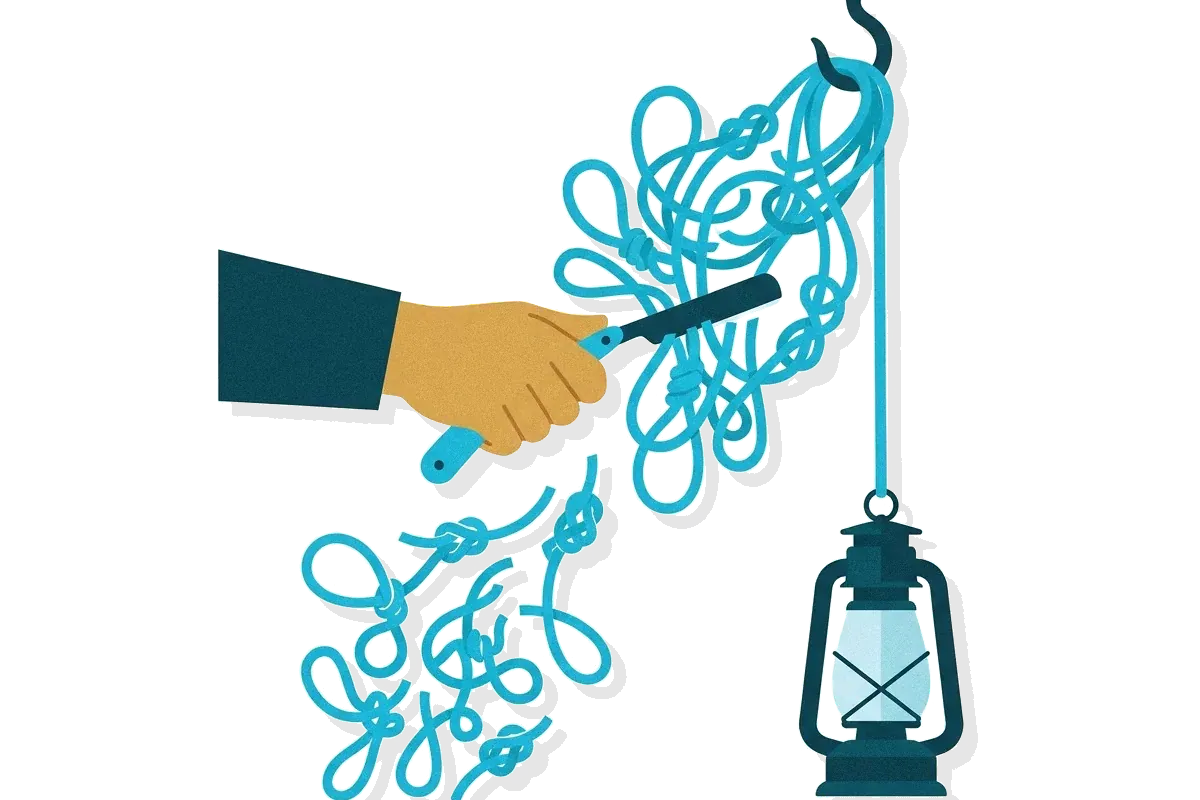
For centuries, scholars taught a rule from Aristotle: the heavier an object is, the faster it falls. Galileo thought the rule was wrong. In his 1638 book on two new sciences, he did not try to prove this with a drop test. He asked readers to imagine a heavy stone and a light stone tied together, and to follow the rule through.
The result took a minute to see and needed no tower, no stones and no stopwatch. The rest of this page is about how that works and where it can go wrong.

021 min
How a thought experiment works
How can a story about stones test a rule about the real world? Every thought experiment follows the same four moves. The thinker builds a situation in the imagination, lets it run, notices what happens, and draws a conclusion.
Galileo's argument can be read as those four moves in order. He starts with a heavy stone and a light stone tied together. Next he applies the rule he wants to test: heavier objects fall faster. The rule says the tied pair must fall slower than the heavy object alone, because the light object drags, and also faster, because the pair weighs more. One rule has given two opposite answers for the same pair, so the rule must be wrong. Galileo went on to argue that all objects fall at the same speed.
Why the result feels convincing
The physicist Ernst Mach argued that a thought experiment works because it calls on knowledge we picked up from past experience, which we may never have put into words. He called it "instinctive knowledge." A reader who sees one rule give two answers does not need a measurement to feel that something is off.
031 min
What real drop tests showed about Galileo's thought experiment
A reader may still want a real test, and several were done, before and after Galileo.
Philoponus, about a thousand years earlier
In the sixth century, the Byzantine Greek philosopher John Philoponus argued that Aristotle's rule was wrong. Objects, he said, do not fall in proportion to their weight.
Stevin and de Groot, 1586
In 1586 Simon Stevin and Jan Cornets de Groot dropped two lead balls from a height of 30 feet, one ten times heavier than the other, and reported that both landed together. Stevin wrote this up in a book on statics, decades before Galileo's book appeared.
The Pisa tower story
A well-known story says Galileo dropped weights from the Leaning Tower of Pisa. It comes from a biography by his pupil Vincenzo Viviani, written in 1654 and published in 1717. Galileo left no account of such a test himself, and many historians think the tower drop was a thought experiment.
Apollo 15, 1971
In 1971 the astronaut David Scott dropped a hammer and a feather together on the Moon. The Moon has almost no atmosphere, so nothing slowed the feather, and both reached the surface at the same time.

041 min
Where the term thought experiment comes from
Galileo never called his argument a thought experiment, because the term did not exist yet. Greek thinkers before Socrates already reasoned this way, although they did not call it a thought experiment. Medieval scholars did too, in natural philosophy and theology, and the practice appears in Islamic and Jewish writing as well.
Hans Christian Ørsted was the first known person to use the German word Gedankenexperiment, around 1812. By 1883 Ernst Mach was using it in a narrower sense, for an imagined run of an experiment that he would later have his students carry out for real. The English phrase first appeared in 1897, in a translation of one of Mach's papers.
Because of this, Mach is often named as the person who invented the term, and some websites say so. The record points to Ørsted. Mach also gave one of the main accounts of why thought experiments work, and it is still discussed today.
053 min
Famous thought experiments in science, philosophy and computing
Galileo's method spread to many fields, and the table lists nine of the best known.
| Thought experiment | Field | What it asks or shows |
|---|---|---|
| Einstein's light beam | Physics | At 16, Einstein recalled, he wondered what the world would look like if he ran beside a beam of light. The question led him toward special relativity. For general relativity he later imagined people in falling and accelerating elevators. |
| Schrödinger's cat | Physics | In 1935 Schrödinger imagined a cat sealed in a box with a device that might poison it. One reading of quantum theory would make the cat both alive and dead. |
| Maxwell's demon | Physics | A tiny imagined being that sorts particles seems able to break the second law of thermodynamics. |
| Zeno's Achilles and the tortoise | Mathematics and philosophy | A fast runner gives a slow one a head start. Each time he reaches the place where the slow runner was, the slow runner has moved on. |
| Ship of Theseus | Philosophy | If every plank of a ship is replaced one by one, is it still the same ship? |
| Plato's cave | Philosophy | People who have only ever seen shadows on a wall take the shadows for reality. |
| Leibniz's mill | Philosophy of mind | Enlarge a thinking machine until you can walk inside it. You find parts pushing on parts, and never a perception. |
| Trolley problem | Ethics | A runaway trolley will kill five people unless you divert it to a track where it kills one. Is diverting it right? |
| Thomson's violinist | Ethics | You wake up joined to a famous violinist who needs your body to stay alive for nine months. Must you stay joined? |
Other fields have their own cases. The next four show how far the method reaches.
Hilbert's hotel, in mathematics
Hilbert's hotel is a thought experiment from mathematics that shows a surprising property of infinite sets. Imagine a hotel with infinitely many rooms, all full. A new guest arrives. Every guest moves from room n to room n+1, room 1 is empty, and the newcomer has a bed.
The Two Generals' Problem, in computing
In computing, the Two Generals' Problem is a thought experiment about two parties who must agree on an action while their messages can be lost. Two armies must attack a city at the same moment, and the messengers between them may be captured. A confirmation needs its own confirmation, and so on without end. However many rounds of confirmation the generals add, neither can be sure the last message arrived. Networking courses use it to explain why TCP, a core internet protocol, cannot guarantee that both ends hold the same state.
Nozick's experience machine, in the study of well-being
Robert Nozick's experience machine, from his 1974 book Anarchy, State, and Utopia, asks whether people would choose a simulated life of pleasure over ordinary reality. Nozick used it against the claim that pleasure is all that matters.
Rawls's veil of ignorance, in politics
Rawls's veil of ignorance is a thought experiment in which people choose the rules of a society without knowing which position they will hold in it. John Rawls developed it in his 1971 book A Theory of Justice, as a way to judge whether rules are fair.
An objection to the veil of ignorance
The philosopher Michael Sandel replied that nobody can fully set aside their own beliefs and convictions, as the veil of ignorance requires. The objection shows a general limit: a thought experiment can ask for a mental state that real people cannot reach.
062 min
What a thought experiment is used for
These cases do different jobs. Some only teach, by making an abstract idea easy to picture. Some test a concept, by checking whether it still holds in an unusual case. Some argue for or against a theory, and those draw the most debate, because they treat an imagined case as evidence. People use them in physics and philosophy, and also in law, economics and marketing. Lawyers often call them hypotheticals.
An argument against a theory takes one of three forms.
- A contradiction: the theory gives two opposite answers to one case, as the tied stones do for the falling rule.
- A conflict with beliefs we hold: the theory leads to a result we cannot accept. Schrödinger's cat does this to one reading of quantum theory.
- A broken assumption: the case shows that a premise everyone relied on fails. Thomson's violinist, from 1971, did this by showing that a right to life and a right to what is needed to stay alive are different rights.
The philosopher Karl Popper used a different split: cases that explain a theory, cases that criticise it and cases that defend it. Cases also differ in time. Some ask what might have happened before an event, and others ask what may happen after it. They differ in realism too. Some could happen, and some break the known laws of nature, such as people who split in two like an amoeba. The philosopher Kathleen Wilkes thought that such cases mislead.
072 min
Thought experiments in AI, product and design work
Builders of software and products use the same method. The best-known case in AI is John Searle's Chinese room, from a 1980 paper. In Searle's version, a person who knows no Chinese sits locked in a room with a book of rules and uses it to send back correct answers to questions written in Chinese. Slips of Chinese writing arrive through a slot. The person follows the rules to pick symbols and passes slips back out. People outside conclude that someone inside reads Chinese. Searle argued that the person understands nothing, and that a computer running a program is in the same position. Anyone who judges a chatbot by its answers faces the same question: do correct answers show understanding?
Nick Bostrom's paperclip example asks a different question. What happens if a very capable AI has one arbitrary goal, such as making as many paperclips as possible? Bostrom wrote that such a system could resist any attempt to change its goal. The example separates two things people tend to join, how capable a system is and what it is trying to do.
Design research uses the method too. In 2024 Swaroop Panda of Northumbria University proposed thought experiments as a tool for design fiction in data visualisation. Design fiction is the practice of telling invented stories about future products to start a discussion. Panda built each thought experiment from a situation, a story and a scenario. One philosopher argues that video-game worlds can host thought experiments too.
082 min
Where a thought experiment misleads
A thought experiment persuades because its setup is simple, and that is also where it can fail.
A hidden assumption: the spear at the edge of space
The Roman writer Lucretius argued that space has no edge. Throw a spear at the supposed edge. If it flies through, there is more space beyond. If it bounces back, something solid is there, and that is in space too. Later thinkers found a hidden assumption in the setup, which is that a finite space must have an edge. A circle is finite and still has no edge, and the universe might be a three-dimensional version of that.
A story that does not scale: the drowning child
Peter Singer's drowning child asks whether you must wade into a pond to save a child, even if it ruins your clothes. Almost everyone says yes. Critics note that societies solve large problems with policy, such as lifeguards and fences, rather than with one person's rescue, so the story may not fit the larger problem.
The same setup, a different ending
The philosopher Frank Jackson imagined Mary, a scientist who knows every physical fact about colour but has only ever seen black, white and grey. When she first sees a red tomato, she seems to learn something new. Daniel Dennett told the story again with a bright blue banana. Mary says she is being tricked, because she knows bananas are yellow. Both versions feel plausible, and they point in opposite directions.
A setup that shows our fears: the paperclip maximiser
The writer Erik J. Larson argued in October 2026 that thought experiments like Bostrom's say less about AI than about our own intuitions and fears. He reads the paperclip maximiser as a system that looks less intelligent, not more, the harder it pursues its goal.
Do people in every culture answer the same way?
In philosophy, a Gettier case is a short story in which someone holds a belief that is true and well supported, but only by luck. Most philosophers say that person does not really know. In 2001 Weinberg, Nichols and Stich reported evidence that the common answer to Gettier stories differs between cultures.
A 24-site replication
In a study of 24 sites, a large majority of people at 23 of them gave the common answer when asked whether the person knew or only thought they knew. The authors, Edouard Machery, Stephen Stich and colleagues, published it in 2017. The claim of cultural variation is therefore contested. A team should not assume that a scenario feels the same to everyone, and should not assume it differs either. It should ask.
An age effect
The study also tentatively found that older people were less likely to give the common answer.
092 min
Can a thought experiment teach us about the world?
Failures like these raise a harder question: why should thinking about an imagined case tell us anything about the real world? Philosophers still disagree. John Norton argues that every thought experiment is an argument in disguise, built from premises taken from experience and rules of inference. If he is right, the story is a vivid way to present a chain of deductive reasoning, and the chain can be checked like any other.
James Robert Brown disagrees. He holds that a few thought experiments, Galileo's among them, give knowledge of nature that does not come from data at all, although that knowledge can still be wrong. Mach saw thought experiments as real experiments carried out in thought, using stored experience. Nancy Nersessian and others say that we build a mental model of the situation and run it. Pierre Duhem took the strongest position against them and wanted thought experiments kept out of science, because they cannot replace real experiments.
Most scientists did not follow Duhem. Einstein and Niels Bohr, for example, tested each other's views on quantum theory with imagined set-ups at the Solvay physics conferences. For a practitioner, a safe position is a middle one. A thought experiment is a good way to find a contradiction or a hidden assumption. It is a poor way to learn a size, a rate or a probability. The essayist Evan Moore adds that thought experiments exist to provoke discussion more than to give final answers.
101 min
Thought experiment vs experiment, hypothesis and mental simulation
Because the method is so wide, the name gets used for things that are not thought experiments. The Stanford Encyclopedia of Philosophy says that calling every hypothetical situation a thought experiment is too broad, because a thought experiment needs a scene the reader can picture.
| Concept | What it does | Does it produce new measurements? |
|---|---|---|
| Thought Experiment | Works through an imagined case to test whether an idea holds together | No |
| Experiments | Changes something in the real world and measures what happens | Yes |
| Hypotheses | States a possible explanation that still has to be tested | Not until it is tested |
| Mental Simulation | Pictures how a situation could unfold, usually to prepare for it or choose between options | No |
The deciding question is where the answer comes from. A real experiment gets it from measurement. A thought experiment gets it from working out what a stated rule implies in a concrete case. A hypothesis is the claim being tested, and a thought experiment is one way to test it. A mental simulation rehearses an outcome, while a thought experiment tests a claim.
112 min
How to run a thought experiment on your own work
A team can borrow the method for its own decisions. Say a staff designer's team follows this rule: remove any feature that most users never touch. To test it, the designer imagines one concrete feature, a button that exports tax records. Most users never press it on an ordinary day, but every user needs it once a year, when the records are due. The rule says to remove it. Everyone who needed the button would then be stuck at the worst moment. The rule fails on this case, so it needs a condition about how badly people need a feature, not only how often they use it.
- Write the rule or claim you want to test in one sentence.
- Build one concrete case where the rule applies. Name who acts and what each person does. Keep the details that matter and drop the rest, because a setup that is rich in the right places makes a better test.
- Run the rule exactly as written. Do not protect the rule by adding exceptions as you go.
- Write down the result. Look for a contradiction or an outcome nobody would accept.
- Change one detail and run it again. If the answer flips, that detail was doing the work.
- Ask someone else to run it. People imagine different details, and some answers differ between groups.
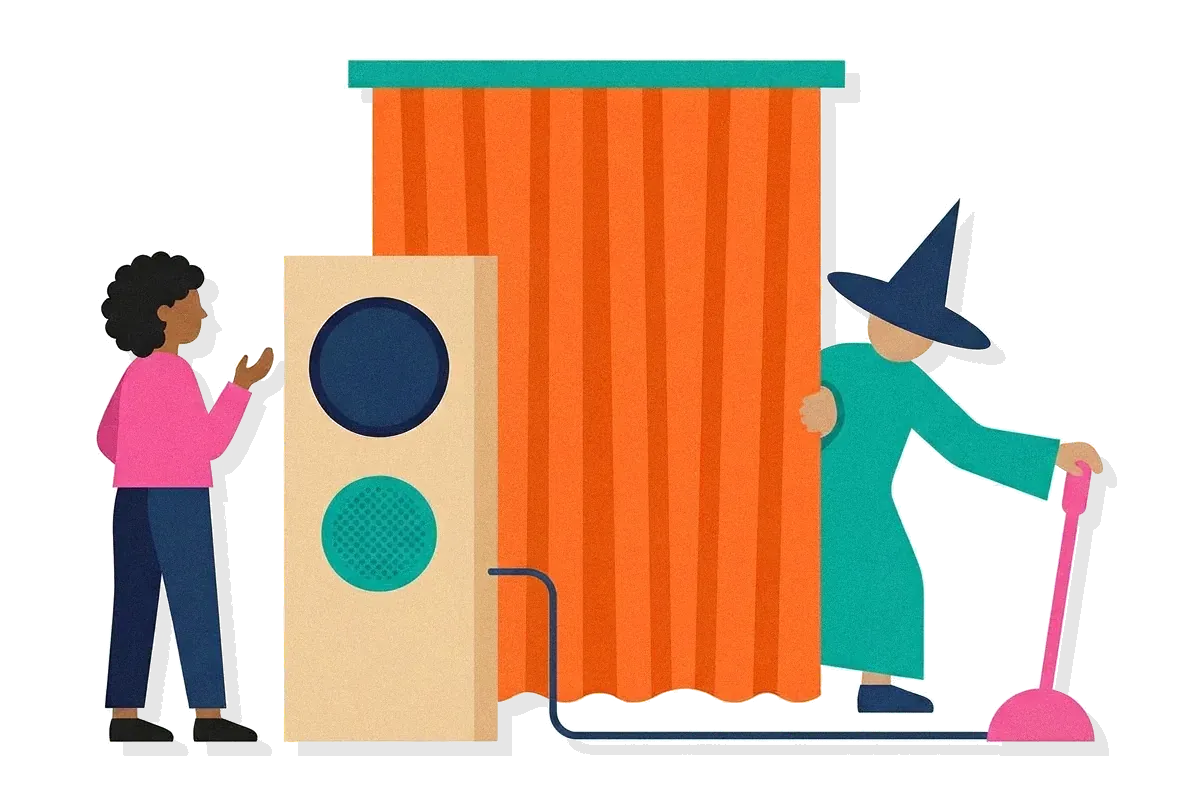
- Decide what still needs a real test. A thought experiment can find a flaw but cannot give a number. A Wizard of Oz test, where a person secretly plays the part of a system that is not built yet, is one way to find out with real users.
Use a thought experiment to find the question worth testing, then test it.
?3 questions
Questions people ask
What makes a thought experiment good?
Can anyone run a thought experiment?
How is a thought experiment different from a daydream?
§16 sources
Sources
Show all 16 sourcesHide sources
James Robert Brown and Yiftach Fehige, "Thought Experiments", Stanford Encyclopedia of Philosophy (substantive revision 28 November 2023).
Wikipedia, "Thought experiment".
Wikipedia, "Galileo's Leaning Tower of Pisa experiment".
Wikipedia, "Einstein's thought experiments".
Erik J. Larson, "Will AI really turn us into paperclips?", Engelsberg Ideas, 7 October 2026.
Nick Bostrom, "Ethical Issues in Advanced Artificial Intelligence".
John R. Searle, "Minds, brains, and programs", Behavioral and Brain Sciences (1980).
David Cole, "The Chinese Room Argument", Stanford Encyclopedia of Philosophy.
Edouard Machery, Stephen Stich, David Rose and others, "The Gettier Intuition from South America to Asia", Journal of the Indian Council of Philosophical Research (2017).
Wikipedia, "Two Generals' Problem".
Wikipedia, "Hilbert's paradox of the Grand Hotel".
Wikipedia, "Experience machine".
Wikipedia, "Original position".
Swaroop Panda, "Thought Experiments in Design Fiction for Visualization", arXiv:2411.08621 (2024).
The Decision Lab, "Thought Experiments".
Evan Moore, "The origin and meaning of thought experiments", Mythic Pilgrim, 22 August 2024.