011 min
Why Wizard of Oz testing exists
Jeff Kelley, who named the Wizard of Oz method in his 1983 dissertation, built a calendar program called CAL at IBM's Watson Research Center. Business people who did not use computers were meant to manage their calendars by typing ordinary English. Kelley did not write the program first. He sat in the next room and secretly typed the replies to each message a participant sent, and participants believed the program was answering. That is Wizard of Oz testing: a hidden person plays the system, so a team can watch real people use a product that does not exist yet.
A paper prototype cannot answer a typed or spoken request, so the method suits conversation, voice, recommendations and lookups of live information. It also lowers risk, because a team learns whether people want a behaviour before it pays to build it.
022 min
How a Wizard of Oz session runs
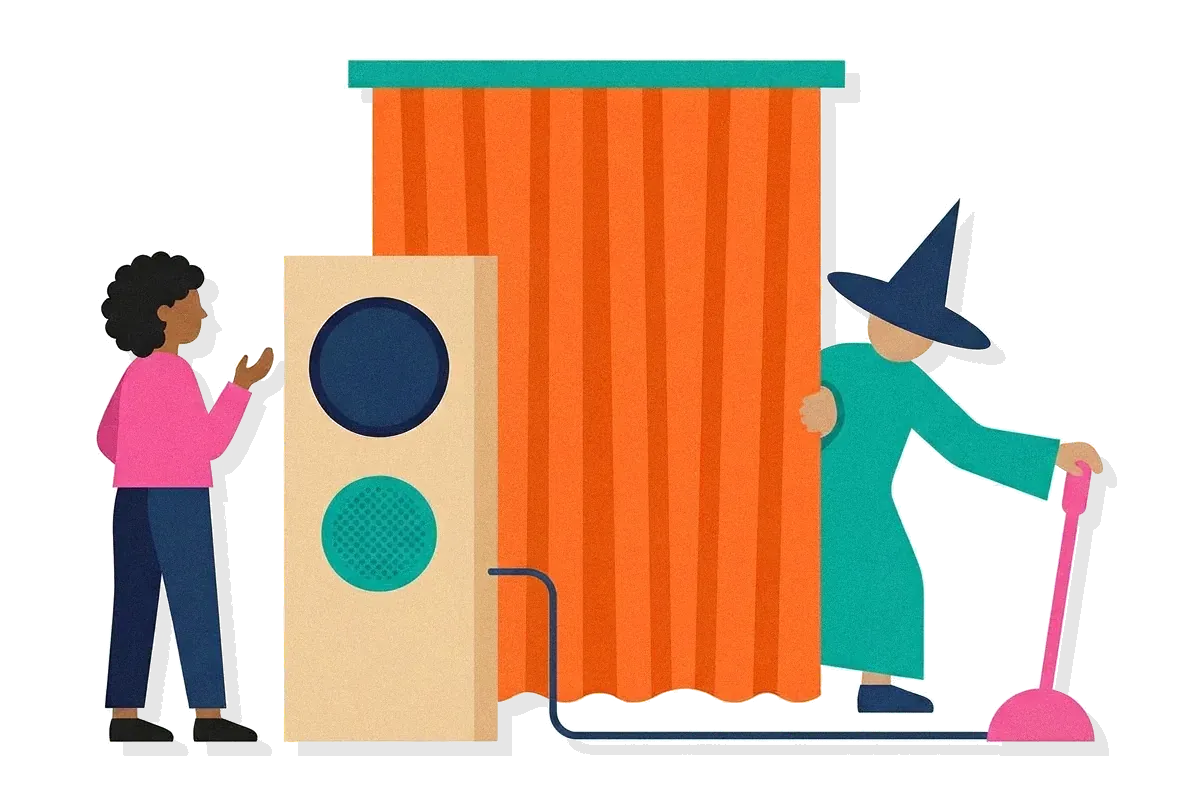
A Wizard of Oz session needs a few roles. The participant uses the interface and is the person being studied. A facilitator gives the tasks and asks questions. The wizard produces the system's responses from out of sight, in another room or behind a screen. An observer takes notes. In a small team one person can hold two roles, but the wizard and the facilitator work better as two people.
What the wizard says
The team must decide, before the first session, where the wizard's answers come from. In the closed method, the wizard picks from a prepared list of responses. The list keeps sessions comparable and easy to analyse. The list's weak point is a request that fits no entry on it. In the open method, the wizard writes new replies during the session. That handles surprises, but replies vary between sessions and take longer to produce. Many teams mix the two, with a list for common requests and free writing for the rest.
Take a team testing a voice assistant on a car dashboard, where drivers ask for the nearest charger or ask the car to get warmer. Its closed list could hold replies for navigation, temperature and music. A fallback line such as "Sorry, I did not catch that" covers everything else. Fallbacks matter because a real system also fails. A wizard who never fails shows drivers a system that will not exist.
Preparing the wizard
The wizard must know the product's rules and keep to them. Giving the same reply to the same request in every session is the job. Rehearse the full session first, then pilot it with a colleague. A pilot shows whether the wizard can answer quickly enough and which requests nobody planned for.
The order of a study
- Step 1Decide what the sessions must teach you, such as which words people use for a request.
- Step 2Build the surface the participant sees, such as a screen or a speaker that plays audio.
- Step 3Write the list of responses the wizard may give, and a fallback for everything else.
- Step 4Train the wizard and rehearse the whole session.
- Step 5Pilot it with a colleague and fix what broke.
- Step 6Run sessions with people from the real audience.
- Step 7Tell each participant about the wizard at the end.
032 min
Where the Wizard of Oz method comes from
People tested systems that did not exist long before the method had a name. In the 1960s, the design researcher Nigel Cross ran studies with simulated computer-aided design systems, where the apparent machine was a human operator. Cross noted that a person lacks a computer's speed and accuracy, but a team of experts working at the same time can make up the difference. He later called this a kind of reverse Turing test, because a person plays the machine.
The trick is older still. The Mechanical Turk, a chess-playing machine first shown in 1770, seemed to play on its own, but a hidden chess master moved its pieces with levers and magnets. It fooled its audiences for show. The Wizard of Oz method uses the same hidden human, but for learning.
Don Norman and Allen Munro used the method in 1973 to test an automated travel assistant for an airport computer terminal. In 1983, Jeff Kelley named it in his dissertation about interfaces that understand everyday language, written at Johns Hopkins University. Other accounts put the naming nearer 1980, and W. Randolph Ford believed the technique had been used at least twice before Kelley.
Kelley first called his approach the OZ paradigm. The name comes from L. Frank Baum's 1900 novel, in which the ruler of Oz turns out to be an ordinary man putting on a show. Like that wizard, the hidden operator makes a simple setup look powerful.

042 min
Kelley's calendar program: Wizard of Oz in a real project
Jeff Kelley's calendar program CAL shows the Wizard of Oz method used in a full project. At IBM's Watson Research Center he built CAL so that business people who did not use computers could manage their calendars by typing ordinary English. Users got a five-minute introduction to the keyboard and a two-page overview, with no manual.
What the task analysis found first
Before any simulation, Kelley's task analysis surveyed office workers about their calendars. Habits varied widely. Some people changed about 2 percent of their appointments after making them, and others changed about 80 percent. That spread is the kind of fact a team learns before it writes a single simulation script.
How the sessions were set up
Kelley did not write the program first. He asked participants to use CAL while he played the program himself. In Kelley's setup, the experimenter sat in the next room and secretly caught each message the participant typed, then typed the reply. Participants were told they could call the experimenter on an intercom with questions. They were not told that the answers came from him.
What the finished program achieved
Kelley tested the finished program with six new participants. CAL responded correctly to between 86 and 97 percent of the requests it received, depending on the criteria used. Kelley wrote that the program's processing model was simple, and that the result depended on building it from real sessions.
How to count success
CAL's success rate depended on what counts as a failure. Counted generously, CAL's understanding reached 97 percent. Twice the program stored an appointment wrongly, and the user noticed and fixed it. Adding those two errors raised the estimated failure rate from 3 percent to 5.7 percent. A team that runs this method should agree before the first session on what counts as a failure.
051 min
How the wizard is phased out of the work
A hidden human cannot run a product forever. When Jeff Kelley built his calendar program CAL, his method planned from the start for the hidden experimenter to step out.
From full simulation to partial help
In the first round of sessions, the experimenter simulated the whole system. In the later sessions, the experimenter stepped in only when the draft program made a mistake. As the program grew more capable, the experimenter was phased out of the exchange between participant and program.
Sessions become the dictionary
After each round, Kelley's team extended the program's dictionaries and code to cover the wording and the functions that round had revealed. So every session did two jobs. It tested the design, and it supplied the material the next version was built from. The words people typed became the word list.
One step among six
The hidden-human sessions were only part of Kelley's method, which had six steps. The task analysis came first, and Kelley called it indispensable for everything that followed. The first run of the simulation was step three, and the second run, with the experimenter stepping in only for mistakes, was step five. A team that runs only the hidden-human session skips the steps that make it useful.
061 min
What Wizard of Oz sessions teach that guessing cannot
Designers could write down from imagination what users will type. Wizard of Oz sessions replace that guess with what users really say.
The armchair alternative
Jeff Kelley, who built the calendar program CAL through Wizard of Oz sessions, set his work against what he called the armchair method of program development, and chose an iterative, empirical approach instead. In plain terms, he preferred watching real users over guessing what they would do.
Take a designer of a voice assistant for a car dashboard who writes the request navigate to the nearest charger from imagination. In sessions, drivers say where can I plug in and I am low on battery. The wizard answers both, and the team now has real wording to design for.
People change their wording for machines
Kelley also noted that people who think they are talking to a machine may use plainer words, with fewer unusual ones. Wizard sessions are one place where this happens, because participants believe a machine is answering. So the wording a team collects is real, but it may be tidier than the wording people use with each other.
071 min
Wizard of Oz and the listening typewriter
Speech was the hardest case for the Wizard of Oz method and one of its earliest large tests. In the early 1980s, speech recognition was too weak to type out what a person said. IBM researchers John Gould, John Conti and Todd Hovanyecz built a simulated listening typewriter, a machine that types what it hears, to find out whether an imperfect one would still help people compose letters. They published the results in 1983.
Researchers at the University of Dundee later ran experiments in which a human operator turned speech into written text, standing in for a speech recogniser. The Dundee team presented its main experiment as a partial repeat of the IBM study. Two studies, seven years apart, used the same trick on the same question. The method let speech researchers test an interface years before recognisers worked well enough to build it.
082 min
Wizard of Oz beyond the lab: Zappos and Swiss Post
The Wizard of Oz method also works outside research labs. Founders use it to test a business idea before they build the business. A product that looks complete to customers but runs on manual work behind the scenes is called a Wizard of Oz MVP. MVP is short for minimum viable product, the smallest version that can test an idea.
Zappos
Nick Swinmurn wanted to know whether people would buy shoes online before he paid for warehouses and stock. He tested the idea by fulfilling orders himself. When an order arrived, Swinmurn went to a local shoe store, bought the pair and mailed it to the customer. The customers were real buyers placing real orders, so the test measured demand rather than opinion.
Swiss Post lockers
ELCA's UX team used the Wizard of Oz method to test Swiss Post's new parcel lockers, which customers open with their own phones. The client supplied a demo locker, and a clickable prototype on the tester's phone played the part of the app. An operator mirrored the test phone to a laptop and used it to trigger the system messages that the real app would show. Six testers took part.
The ELCA team found that running the simulation while also taking notes is hard. It recommends a second person when in doubt.
What the hidden person imitates
In Jeff Kelley's calendar program CAL, the hidden person imitated a program that talked. In Nick Swinmurn's Zappos test the hidden person imitated a whole shop, and in the ELCA locker test a set of messages on a phone. What the hidden person imitates changes from case to case. The method stays the same.
091 min
How rough a Wizard of Oz prototype can be
In a Wizard of Oz test, the part the participant sees can be crude or polished. Low fidelity means paper interfaces, static mockups or simple clickable wireframes. High fidelity means near-production interfaces with branding, animation and polished visuals. The right level depends on the stage of the project, the resources and the research goals.
Early on, rough is enough, because the question is whether people want the behaviour at all. Later, when the question is trust or the feel of the whole experience, a polished surface matters more. For a voice assistant on a car dashboard, early sessions can use a speaker and a wizard in the next room. Later sessions can use a full in-car mock-up with a synthetic voice. The same wizard works behind every level, and the usual rules of prototype testing still apply to the surface.
102 min
When Wizard of Oz testing misleads
Wizard of Oz testing has real limits, because it relies on a person imitating a system.
The wizard is too good
A person does not mishear in the way a speech recogniser does. A flawless wizard hides the mistakes that real software will make. A team that watches a flawless wizard can expect too much from the software it later builds. The test also says nothing about whether the real system will be accurate or reliable.
The wizard gets tired
Playing the wizard is hard work. Mental fatigue can change the wizard's replies during a long session. Training a wizard also costs time. Keep sessions short and the number of tasks small, and write the script so that replies stay the same across sessions.
The method does not scale
Manual work cannot be repeated for thousands of users. In January 2018, Facebook announced the end of M, a virtual assistant that relied on human helpers. Facebook closed M after finding it could not scale, because people did far too much of the work compared with the software. M was no secret test, since its users knew humans were involved. It still shows the limit of a hidden human who stays in the loop.
Other mismatches
Large graphical interfaces are hard to simulate by hand. The wizard can also nudge results without meaning to. A wizard who knows what the team hopes to see may steer sessions toward it, a risk known as the observer-expectancy effect.
When to choose it
A static prototype, such as a set of clickable screens, is enough in many cases. The table sets Wizard of Oz against a static prototype.
| ChooseWizard of Oz | Choosea static prototype |
|---|---|
| The answer depends on what the person says.A spoken or typed request can lead anywhere, so fixed screens cannot follow it. | The answers are the same every time.Each screen leads to a known next screen. |
| The technology does not exist yet.You want to learn whether people want the behaviour before paying to build it. | The design is about layout and wording.A set of clickable screens shows whether people find their way. |
111 min
Telling participants about the Wizard of Oz setup
Hiding the wizard is part of the method, and that makes it a form of deception. The wizard's presence is usually not revealed during the session, so that people behave realistically. At the end, participants must learn what really happened and be able to withdraw their data. Jeff Kelley found that the participants in his calendar program study readily accepted the low-level deception in his setup.
A debrief is routine in this method. Explain who the wizard was, why the team did it this way, and ask whether the participant agrees to the use of their session. A wizard who breaks character mid-session spoils the test, which is another reason to rehearse.
121 min
Wizard of Oz vs nearby concepts
Wizard of Oz testing gets mixed up with three nearby methods: paper prototyping, fake door tests and usability testing. The table sets all four side by side by what is faked and who does the work.
| Concept | What is faked | Who does the work |
|---|---|---|
| This pageWizard of Oz | ||
| ResearchPaper prototyping | ||
| ResearchFake door (painted door) test | ||
| ResearchUsability Testing |
A fake door test measures whether people want something at all. Wizard of Oz shows what happens once they try it. Usability testing is the wider practice of watching people use a product, and a Wizard of Oz session is one way to produce the thing they use. Paper prototyping looks similar, but the person acting as the computer is in plain view and works from fixed pages.
131 min
Checking a Wizard of Oz plan before the first session
A Wizard of Oz plan can still fail before the first session, even when the method is the right choice. A team testing a voice assistant on a car dashboard can run through this list before the first driver arrives:
After a few weeks of sessions, the dashboard team holds a list of the words drivers used, the answers that satisfied them, and the requests that stumped the wizard. That list tells it what to build first.
?4 questions
Questions people ask
Does the Wizard of Oz method only work for AI and voice?
Who should play the wizard?
Is the Wizard of Oz method the same as the OZ paradigm?
How many tasks should a session include?
§11 sources
Sources
Show all 11 sourcesHide sources
J. F. Kelley, "An iterative design methodology for user-friendly natural language office information applications", ACM Transactions on Office Information Systems 2(1), 1984. student.cs.uwaterloo.ca
Sara Paul and Maria Rosala, "The Wizard of Oz Method in UX", Nielsen Norman Group (2024). nngroup.com
Interaction Design Foundation, "What are Wizard of Oz Prototypes?" ixdf.org
Usability Body of Knowledge (UXPA), "Wizard of Oz". usabilitybok.org
Alexander Gyger, ELCA, "The Wizard-of-Oz method: testing users' interaction with Swiss Post's new consignment lockers". elca.ch
Wikipedia, "Wizard of Oz experiment". en.wikipedia.org
Wikipedia, "Mechanical Turk". en.wikipedia.org
J. D. Gould, J. Conti and T. Hovanyecz, "Composing letters with a simulated listening typewriter", Communications of the ACM 26(4), 1983 (abstract on IBM Research). research.ibm.com
A. F. Newell and colleagues, "Listening typewriter simulation studies", International Journal of Man-Machine Studies 33(1), 1990 (record at the University of Dundee). discovery.dundee.ac.uk
Sue Gee, "Facebook Closes M, Its Virtual Assistant", I Programmer (2018). i-programmer.info
Smashing Magazine, "Unmasking the Magic: The Wizard of Oz Method for UX Research" (2025). smashingmagazine.com