011 min
Where mental models show up
Say someone comes home on a winter evening to a cold house. The thermostat on the wall is set to a comfortable temperature, but the room is far below it. They want heat fast, so they turn the dial to its highest setting and walk away. Someone else in the same house would leave the dial alone and wait.
Both people are sure they understand the thermostat. The first pictures it as a faucet. In that picture, a higher setting sends out more heat, just as a faucet opened wider sends out more water. The second pictures a switch that reads the room temperature and shuts the furnace off once the room reaches the set number. Neither picture is written down anywhere. Each one is a mental model.
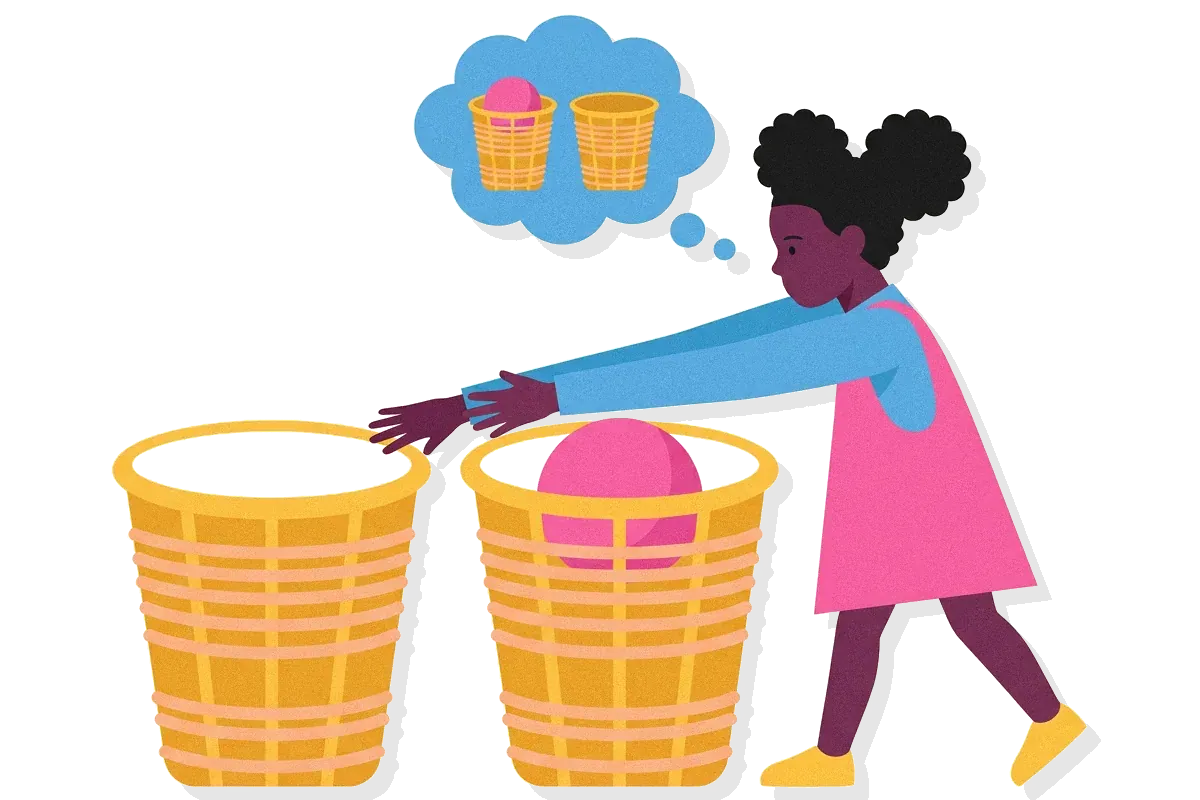
People form these pictures without trying. They come from things a person has used, seen or been told, and people use them without noticing. Someone who has never read about search engines still has a model of one, and types queries to fit it. A team that has never discussed how its release process works still holds one model per person, and the models may disagree.
021 min
Where the idea of mental models comes from
Both pictures are guesses about what happens inside a device. The idea of studying such guesses is older than the wall thermostat. In 1943 the psychologist Kenneth Craik proposed that the mind builds small-scale models of reality and uses them to anticipate events. His point was that a mind which can try out an action on an inner copy of the world does not have to try it on the world itself.
Two research traditions later took the idea in different directions. Philip Johnson-Laird published a book called Mental Models in 1983. He argued that people reason by building models of the situations that a statement describes, not by applying the rules of formal logic. In the same year Donald Norman, who studied how people use machines, wrote a paper called "Some Observations on Mental Models". He separated the conceptual model, which a designer builds to explain a system, from the mental model, which is what a person actually holds in mind and uses to decide how to handle the system.
The two traditions ask different questions. Johnson-Laird asks how people reach conclusions. Norman asks how people use things. The next section follows Johnson-Laird, because his theory explains how a model is built and why it breaks. The section after it returns to the thermostat, which is closer to Norman's question.
032 min
How a mental model works
A mental model works by being run. The person sets up a starting situation in their head, changes one thing, and watches what the picture does. The faucet picture says that a higher setting gives faster heat, so the dial goes up. The result is a prediction, and the prediction decides the action.
A model is also built so that its parts match the parts of the situation it stands for. Johnson-Laird calls this an iconic structure. A model of two people standing in a line has a place for each person and a before and after between them. That is why a model can be read for new facts that no one told the person directly.
A model keeps what is true and drops what is false
Johnson-Laird's account says a model records what is true in each possibility and mostly leaves out what is false. He calls this the principle of truth. It keeps the load on working memory low. Working memory is the small space where a person holds thoughts while thinking.
The price is a predictable kind of mistake. In three experiments reported in 1999, Johnson-Laird and Fabien Savary found that people reliably accept conclusions that feel compelling but do not follow. The people had never pictured the cases in which the statements are false. The error is not carelessness. It comes from the same shortcut that makes the model cheap to hold.
A model is corrected by looking for a case that breaks it
When people test a conclusion, the theory says, they look for a counterexample: a situation that fits the starting statements but not the conclusion. If they find one, the conclusion is shown to be wrong. If they do not look, a wrong conclusion stands. The theory also predicts that an inference gets harder as it needs more models at once. A 2010 review of the evidence reports that trouble starts when a person must hold more than about three models.
043 min
Why a wrong mental model can still work
Johnson-Laird's work shows how models fail. The thermostat shows something less obvious: a model can be wrong and still serve its owner well.
In the 1980s the researcher Willett Kempton studied this in homes. He interviewed households in Michigan and compared what people said with automatic hourly records of thermostat settings from 26 townhouses. He published the result in 1986 in Cognitive Science, in a paper called "Two Theories of Home Heat Control". He called a picture like those in the opening scene a folk theory, meaning an everyday account held by people who are not specialists.
Kempton found the two pictures from the opening scene. In the feedback theory, the thermostat reads the room temperature and switches the furnace on and off to hold it steady. In the valve theory, the thermostat controls how much heat the furnace sends out. Heating engineers who read the study told him the feedback theory is correct. Kempton agreed that both pictures simplify and distort, and that each one has uses.
Most people hold more than one picture. Valves are far more common than feedback devices, so nearly everyone has a valve picture. People with the feedback theory kept the valve theory too and applied the feedback theory to only a few devices. An interviewee who held the valve theory listed the faucet, the electric mixer and the car's gas pedal as devices that work the same way: the higher the setting, the more comes out. A picture formed on one device had moved to the next.
The wrong picture that predicts fuel use correctly
The valve theory predicts that the house burns more fuel at a higher setting. That prediction is right. The reason is different from the one the theory gives: a warmer house loses more heat through its walls, so more fuel is needed. The picture is wrong about the cause and right about the cost, and cost is what a household pays for. Kempton also noted a price: the valve picture seems to encourage frequent adjustments that are not needed. They waste effort, and they waste fuel if the person forgets to turn the dial back down. A separate survey in Wales, which Kempton reported, found that 62% of residents of 38 new thermostat-controlled houses said a cold house would warm up faster if the thermostat were turned up full.
The correct picture that leads to a wrong decision
The feedback theory has its own failure. Kempton quoted a woman whose husband used it to argue that turning the heat down at night wastes fuel, because the house would need more fuel to warm up again in the morning. Kempton judged the husband wrong, and he traced the error to a gap in the husband's model. The husband had a model of the thermostat but none of how heat escapes from a house at different indoor temperatures.
The person who turned the dial to the top in the opening scene is in the same position. Their picture gives a right answer to one question, how much fuel the house will burn, and a wrong answer to another, how fast the house will warm. A model is not simply right or wrong. It is right for some questions and wrong for others, and the owner usually cannot tell which is which.
Why correcting a mental model is hard
Kempton heard from three people whose spouses turned the dial up to heat the house faster. All three had tried to talk their spouse out of it, and all had failed. He thought the reason was that they offered one fact when the spouse needed a whole replacement theory. The spouse's own theory was already working well enough. Earlier work on everyday theories of motion, which Kempton summarised, points the same way: students kept their own theory and reinterpreted classroom physics to fit it.
052 min
Mental models in product and design
A thermostat maker cannot sit beside each owner and explain the device. Every designer is in that position. They reach users only through what the product shows and does. Norman called this the system image: the designer's own model made visible. Users read it as well as they can, and they also guess what happens behind it. What the designer builds is a conceptual model. What the user ends up holding is a mental model, and the two can differ.
A familiar pattern in the Back button
Nielsen Norman Group describes a long-running example. On the web, people learned that the Back button returns them to the previous screen, so it works like an undo. Smartphones then changed the rule. In some mobile apps, Back took people up one level in the site instead. Someone who expected an undo and got a move upward was wrong about a button they had trusted for years.
People keep such expectations even when a new pattern is better, so designers usually do better by working with a familiar model than against it. This is the reasoning behind Jakob's Law, which says people expect your product to work like the others they already use.
When behaviour and picture disagree, Norman's two gaps appear. In the gulf of execution, the person cannot find how to do what they want. In the gulf of evaluation, they cannot tell what the system just did. A person with a faucet picture of the thermostat can meet both gaps: they turn the dial up, and nothing they can see tells them the furnace is running at one speed.
Products that promise more than they do
The same gap opens with AI features. Google's People + AI Guidebook warns that messaging which promises magic from AI can lead people to hold a model in which the product can do more than it really can. A person with that model asks for things the product cannot do, then loses trust when it fails.
Models shared across a team
Mental models also matter between people. In a study published in 2000, John Mathieu and colleagues had 56 pairs of undergraduate students fly missions in a combat flight simulator. They kept models of the task apart from models of the team. To measure how alike two partners' models were, each person completed paired comparisons of concepts, and the researchers analysed the answers. Pairs whose models were more alike worked together better and scored higher. Coordination between partners fully explained why matching models led to better results.
062 min
How to find and fix a mismatch in mental models
Nobody can see a mental model directly, so the first job is to find out what people believe. Three methods are common.
Think-aloud sessions.
Ask a person to use the product and say what they expect before each step. Nielsen Norman Group advises that a few quick sessions show most of the picture.
Card sorting.
Give people cards with the names of topics or features and ask them to group the cards. The groups show how they organise the space, and the navigation can follow it.
Predict first.
Before a person presses a control, ask what they think will happen. The gap between the answer and the result is the mismatch, measured.
Once a mismatch is known, there are two fixes. The first is to change the product so that it fits the picture people already hold. Keeping Back as an undo is an example. The second is to improve the picture itself, with clear labels and short explanations of the few ideas people need to understand the system. People rarely read long help text, so keep it brief. For the thermostat, one option is to show the room temperature beside the set temperature. The person then sees the furnace stop when the two numbers meet, which is the feedback picture made visible.
Teams can use the same idea inward. Ask each member to explain, separately, how their release process works. Compare the answers. Differences in those answers are the early warning that the team is not working from one picture.
071 min
Common misunderstandings about mental models
A model has to be accurate to be useful
The thermostat case shows the opposite. A model is judged by the decisions it supports. Asking whether it is accurate is less helpful than asking which questions it answers well.
Mental models are a list of thinking tools
The same phrase has a second meaning in business writing. Charlie Munger argued that around 80 or 90 important models from fields such as physics, economics and biology account for most of what it takes to become worldly-wise. These are explanations a person learns on purpose and then applies to decisions. The models in this article are different: they are pictures people already hold and use without noticing. The two share the idea of a simplified explanation, but one is chosen and the other is inherited.
A mental model is a diagram
A diagram is something a person draws. A mental model is what the person holds. Diagrams made from interviews or sorting exercises are one way to see a model from outside, and they can be wrong.
081 min
Where the evidence on mental models is contested
Not everyone agrees that people reason with models. Researchers have not settled whether people create mental models or use other kinds of vehicle for reasoning, and a review from the Interaction Design Foundation calls this an open research question. Rival accounts say that reasoning runs on formal rules of inference, on rules that suit one domain, or on probabilities. Lance Rips, for example, argued for the rule-based view, often called mental logic.
The objection is fair. A model is hard to observe, and a theory that can explain any answer after the fact explains none. Defenders of the model view reply that it predicts mistakes before they are found, such as the illusory inferences above, and that these mistakes were then observed.
For a practitioner, the disagreement is narrower than it sounds. The claim that people hold working pictures of products is well supported by usability work and by Kempton's interviews. What remains open is the exact way those pictures are stored and used.
091 min
Mental models vs. nearby concepts
Four ideas sit close to mental models. Each one differs on one axis.
| Idea | Whose it is | What separates it |
|---|---|---|
| Schema | A person's general knowledge of a kind of situation | A schema covers a type, such as a restaurant visit. A mental model is a picture of one system that is run to predict. Sources draw this line in different places. |
| Conceptual model | The designer's or teacher's | It is built to explain a system. A mental model is what the learner actually ends up holding. |
| Mental simulation | An act | Mental simulation is the running of the model. The model is the thing that gets run. |
| Thinking tools | A collection a person studies | These are chosen explanations from other fields. A mental model in the sense of this article is inherited from experience. |
?3 questions
Questions people ask
Do mental models change over time?
Is a mental model a mental image?
Is a mental model the same as a belief?
▶3 videos
Watch
Understanding Mental Models
9 Mental Models You Can Use to Think Like a Genius
Farnam Street
Charlie Munger: Mental Models for the Rest of Your Life
The Swedish Investor
§9 sources
Sources
Show all 9 sourcesHide sources
Kempton, W. (1986). Two Theories of Home Heat Control. Cognitive Science, 10(1), 75-90.
Johnson-Laird, P. N. (2010). Mental models and human reasoning. PNAS.
Johnson-Laird, P. N., & Savary, F. (1999). Illusory inferences: a novel class of erroneous deductions. Cognition, 71, 191-229.
Mathieu, J. E., Heffner, T. S., Goodwin, G. F., Salas, E., & Cannon-Bowers, J. A. (2000). The influence of shared mental models on team process and performance. Journal of Applied Psychology, 85(2), 273-283.
Nielsen Norman Group. Mental Models.
Interaction Design Foundation. Mental Models (Glossary of Human-Computer Interaction).
Google PAIR. People + AI Guidebook: Mental models.
Wikipedia. Mental model.
Clear, J. Mental Models: How to Train Your Brain to Think in New Ways (quotes Charlie Munger).