011 min
The short version
- What it is: judging a claim by who said it, and checking it less because of that.
- Origin: Stanley Milgram's obedience experiments at Yale (1961 to 1962, published 1963) and Charles Hofling's hospital study (1966).
- Where it bites: a junior reviewer who approves a senior engineer's design without testing it.
- Guard against it: collect each person's judgment in writing before the senior person speaks.
- Contested: the size of the Milgram effect and the reason people obeyed are both still argued over.
021 min
Where authority bias shows up
A principal engineer proposes a caching design in a design review. The design has a flaw: it serves stale data after a user changes their account settings. A mid-level engineer notices this while reading the document. The principal engineer then says, "I have built this pattern three times, so I am confident." The mid-level engineer decides the flaw is probably handled somewhere and says nothing. The design ships, and users see old settings for hours.
Now change one input and run the same review again. The document is shared without an author name, and each reviewer writes comments before the meeting. The mid-level engineer writes the stale-data problem as a comment. Two other reviewers had seen it too. The flaw is found before any code is written.
The engineers' knowledge was the same in both reviews. What changed was whether the reviewer knew who wrote the claim before judging it.
The effect starts earlier than the discussion. It starts when a reader sees a title or a past record and adjusts how closely they will read. The same pattern appears when a manager's estimate is accepted without a check, when a clinician's note is copied forward without being re-read, or when a famous founder's product opinion ends a debate that data could have settled.
032 min
Why authority bias happens
Authority bias combines two separate effects. The first is about belief. The second is about action.
Belief: a position is used as a sign of accuracy. Checking a claim takes time and knowledge. A title, a record of past success or a uniform is cheap to read. People use it as a shortcut, a rule of thumb that usually works. Experts are, on average, right more often than non-experts in their own field, so the shortcut is reasonable. It becomes a bias when the claim is outside the expert's field, when the expert has a reason to be wrong, or when the reader stops checking at all. In those cases the shortcut gives a confident wrong answer.
Action: legitimate authority is obeyed. People accept orders from someone they see as having the right to give them. Legitimacy comes from a role that others recognise, such as a doctor in a hospital, a manager in a company or a researcher in a laboratory. The same order from someone without that role is refused more often.
Haslam, Loughnan and Perry (2014) tested what makes obedience rise or fall across Milgram's experimental conditions. They gathered data from 21 conditions with 740 participants in total. Their analysis found eight factors that changed the chance that a participant continued to the maximum shock. Four are about the authority itself: how directive, how legitimate and how consistent the experimenter was, and how far away the experimenter stood from the participant. The others concern the victim and the group: how close, direct and personal the link to the victim was, and whether other participants pushed the person to stop.
The practical meaning is that authority bias is not a fixed trait. A change in how an authority behaves, or in how close a person is to the effect of their action, changes how much people comply.
A related explanation comes from social identity theory, the idea that people act as members of groups they identify with. Haslam and Reicher (2012) argue that people follow an authority when they identify with it and believe it is right, rather than because they obey blindly. We return to this view in the section on contested evidence.
042 min
Where authority bias comes from
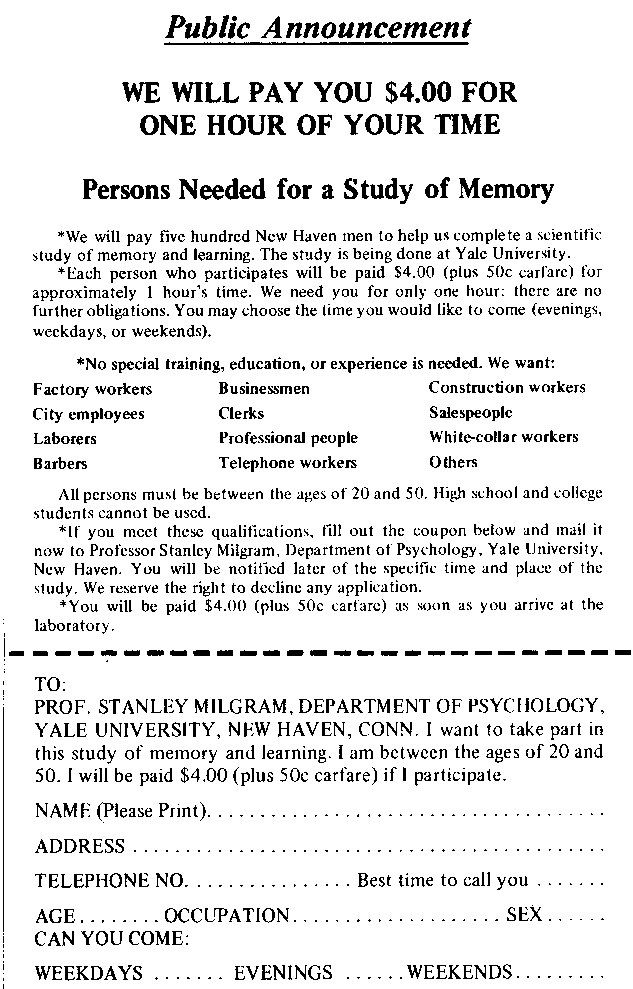
The best-known evidence is Stanley Milgram's obedience research at Yale University. Milgram began it in August 1961 and published a first account in the Journal of Abnormal and Social Psychology in 1963.
Participants were recruited from the public to act as "teachers" in what they were told was a study of learning. A second person, who was actually an actor, played the "learner." Whenever the learner gave a wrong answer, an experimenter in a lab coat told the teacher to give an electric shock, raising the voltage with each mistake up to 450 volts. No shock was real. The learner was heard protesting and, in the first version, falling silent.
In the best-known version, 62.5% of participants went to the maximum 450 volts. Haslam, Loughnan and Perry (2014) note that this rate exceeded by a factor of 500 the figure that psychiatrists estimated after reading the protocol. People who were asked to predict the result expected almost nobody to continue.
Milgram ran 23 conditions in total, and the obedience rate varied widely between them. Averaged over the 21 conditions in which participants could continue to the maximum voltage, the overall rate was 43.6%. The famous figure comes from one condition, not the whole programme.
Milgram studied obedience, which is a behaviour. Authority bias in the wider sense also covers belief: judging a claim more accurate because of its source. Milgram's work is the starting point because it shows how strongly a legitimate-looking authority can move people who have no reason to agree with it.
052 min
A second case: nurses and an unknown doctor
Milgram's setting was a laboratory. In 1966 the psychiatrist Charles Hofling and colleagues tested the same question in a working hospital, with trained professionals, in a study titled "An experimental study in nurse-physician relationships."
A researcher telephoned a nurse and said he was a doctor with a name the nurse did not know. He asked the nurse to give a patient 20 mg of a drug called Astroten and said he would sign the order later. A bottle labelled Astroten was in the drug cabinet, and its label said the maximum daily dose was 10 mg. The drug was not on the hospital's approved list. Hospital rules said nurses should not take drug orders by telephone from a doctor they did not know.
Hofling found that 21 out of the 22 nurses would have given the patient an overdose of medicine. Nurses who started toward the patient's room were stopped at the door before giving anything.
What makes the result sharp is the prediction that came first. The protocol was described to a group of twelve nurses and twenty-one nursing students, who were asked to predict how many nurses would give the drug. Ten nurses and all the nursing students said they would not do it. The people closest to the situation did not expect their own profession to comply.
The difference between the two cases is the setting. Milgram's participants were volunteers in a university lab with no stake in the outcome. Hofling's nurses were professionals with training and rules that told them to refuse, and they still complied with a stranger who said he was a doctor.
062 min
Where the evidence is contested
The founding studies are real, but their meaning is disputed. Three objections matter for anyone who wants to use the concept.
The Milgram record has been questioned. In 2012 the Australian psychologist Gina Perry reviewed Milgram's archived data and writings and reported a "troubling mismatch between (published) descriptions of the experiment and evidence of what actually transpired." Her objection is that the published account was cleaner than what happened in the sessions. Milgram's own report and Perry's reading are both still discussed.
The Hofling result did not repeat easily. A 1977 study by Rank and Jacobson is titled "Hospital nurses' compliance with medication overdose orders: a failure to replicate." Hofling used one hospital and 22 nurses, so the sample was small.
The reason people obeyed may not be authority alone. Haslam and Reicher (2012) argue that participants did not obey out of blind conformity. Their work suggests that individuals' willingness to follow authorities is conditional on identification with the authority in question and an associated belief that the authority is right. This changes the lesson. Authority bias is not just a response to rank. It depends on whether the person believes the authority is legitimate and acting for a shared purpose.
Replication is partial. In 2009 Jerry Burger ran a partial replication of the Milgram design that stopped at 150 volts, to meet current ethics rules. He found obedience rates virtually identical to those reported by Milgram in 1961–62. This supports the idea that the pattern is not limited to the 1960s. It does not show what would have happened at 450 volts.
Where does this leave a practitioner? The safe reading is narrow. A person's rank and apparent legitimacy can lower the checking that others do, and the effect is stronger when the authority is close, direct and confident. The exact percentages from the 1960s should not be quoted as a law of behaviour.
072 min
How authority bias shows up in product, design and AI
Design and engineering reviews. The scenario earlier is common. When the most senior person speaks first, later comments tend to agree with that person. A reviewer with a doubt has to contradict a colleague in front of others. Written comments collected before the discussion remove that step.
Product decisions. A founder or executive states a preference for a feature, and the team looks for evidence that supports it instead of testing it. Two other biases join in here. The leader's view becomes the starting point that later discussion adjusts from, which is anchoring. The team's search for evidence then favours results that agree with the leader, which is confirmation bias. Authority bias supplies the first push, and the other two keep it going.
Judging research and data. A claim from a famous author, a large company or a well-known journal is often checked less than the same claim from an unknown source. A reviewer who wants to test for this can hide author names and institutions for the first read.
AI assistants. People may accept a confident answer from an assistant without checking it. Whether this is the same bias is an open question, because an assistant has no legitimate role of the kind a doctor or a manager has. A team that ships an assistant should test whether users check its answers, and should not assume they do or do not.
Deliberate use. Interfaces sometimes borrow authority on purpose: a badge, a doctor's photograph or a "recommended by experts" label. In that case the builder uses the bias, and the user suffers it. When the badge is earned and a user can check it, it helps people decide faster. When it is not, it is a dark pattern, a design that steers people against their own interest.
082 min
How to guard against authority bias
Awareness alone is a weak defence. Knowing about the bias does not stop it from working in the moment, so the guard has to change the process and not rely on people to notice.
Collect judgments before the senior person speaks.
In a review, each person writes a verdict and their reasons. The facilitator then reads them out together. This works because nobody has an authority's view to react to when they form their own.
Ask the senior person to speak last.
A leader who speaks last still gets heard, and does not set the range for everyone else. In a group, ask them to say so openly: "I will give my view after everyone else."
Review the work, not the author.
Remove names from design documents, pull requests and research papers for the first pass. The reviewer then judges the claim on its content.
Name a dissent role.
Assign one reviewer in each meeting to argue the case against the proposal. Because the role is assigned, saying "I disagree" does not need courage.
Ask for the evidence, whatever the rank.
A fixed question such as "what would change your mind?" applies to everyone in the room and stops the question from reading as a challenge.
A leader can also change how much authority bias costs by showing, in public, that a junior colleague's correction was accepted. Obedience in Milgram's conditions fell when the setting changed, which shows that the situation, and not only the person, drives the effect.
091 min
When deferring to an authority is the right call
Deferring to an expert is often correct. A pilot follows a checklist, and an engineer trusts a security library whose maintainers have audited it. Treating every expert claim with suspicion would make work impossibly slow, and the opposite error also exists: rejecting a claim because of who said it. The aim is not to ignore authority. The aim is to match the amount of checking to the cost of being wrong.
Three signs separate sensible trust from authority bias.
- The claim is inside the expert's field. A famous database engineer is a strong source on databases and a weak one on pricing.
- The expert has a track record on this kind of question, which can be checked.
- The claim can be tested cheaply, and nobody tested it. If a ten-minute check was available and skipped because of who made the claim, the bias is probably at work.
When a mistake is cheap to fix, defer and move on. When it is costly or cannot be undone, as in the Hofling case where an overdose could harm a patient, the check is worth its time.
101 min
Authority bias vs. nearby concepts
| Concept | What it is about | What separates it from authority bias |
|---|---|---|
| PsychologyHalo effect | ||
| MarketingSocial proof | ||
| PsychologyConfirmation bias | ||
| PsychologyObedience |
The line between authority bias and obedience matters because the research uses both words. Milgram measured obedience. The wider concept, taught in cognitive bias lists, adds the belief side: the shortcut of judging accuracy by status.
?7 questions
Questions people ask
Is deferring to an expert always a bias?
§9 sources
Sources
Show all 9 sourcesHide sources
Milgram, S. (1963). Behavioral study of obedience. Journal of Abnormal and Social Psychology 67(4), 371-378.
Hofling, C. K., Brotzman, E., Dalrymple, S., Graves, N. and Pierce, C. M. (1966). An experimental study in nurse-physician relationships. Journal of Nervous and Mental Disease 143(2), 171-180.
Haslam, N., Loughnan, S. and Perry, G. (2014). Meta-Milgram: an empirical synthesis of the obedience experiments. PLoS ONE 9(4), e93927.
Haslam, S. A. and Reicher, S. D. (2012). Contesting the "nature" of conformity: what Milgram and Zimbardo's studies really show. PLoS Biology 10(11), e1001426.
Rank, S. G. and Jacobson, C. K. (1977). Hospital nurses' compliance with medication overdose orders: a failure to replicate. Journal of Health and Social Behavior 18(2), 188-193.
Burger, J. M. (2009). Replicating Milgram: would people still obey today? American Psychologist 64(1), 1-11. (the publisher blocks automated requests)
Wikipedia, Authority bias, used for the definition.
Wikipedia, Hofling hospital experiment, used for the procedure of the nurses study.
Wikipedia, Milgram experiment, a summary used for the 2009 partial replication and for Gina Perry's 2012 review.