011 min
Where the bandwagon effect shows up
Picture a tech lead who must choose a database for a new service. The team has read the documentation for three options and finds them close. In the first meeting nobody knows how many other teams use each option. The engineers argue about features, and the discussion runs long without an answer.
Now run the same meeting again with one change. This time the lead mentions that most other teams in the company already run the first option. The room agrees on it within minutes. The other two options stop being discussed, and nobody checks whether the first one fits this service better.
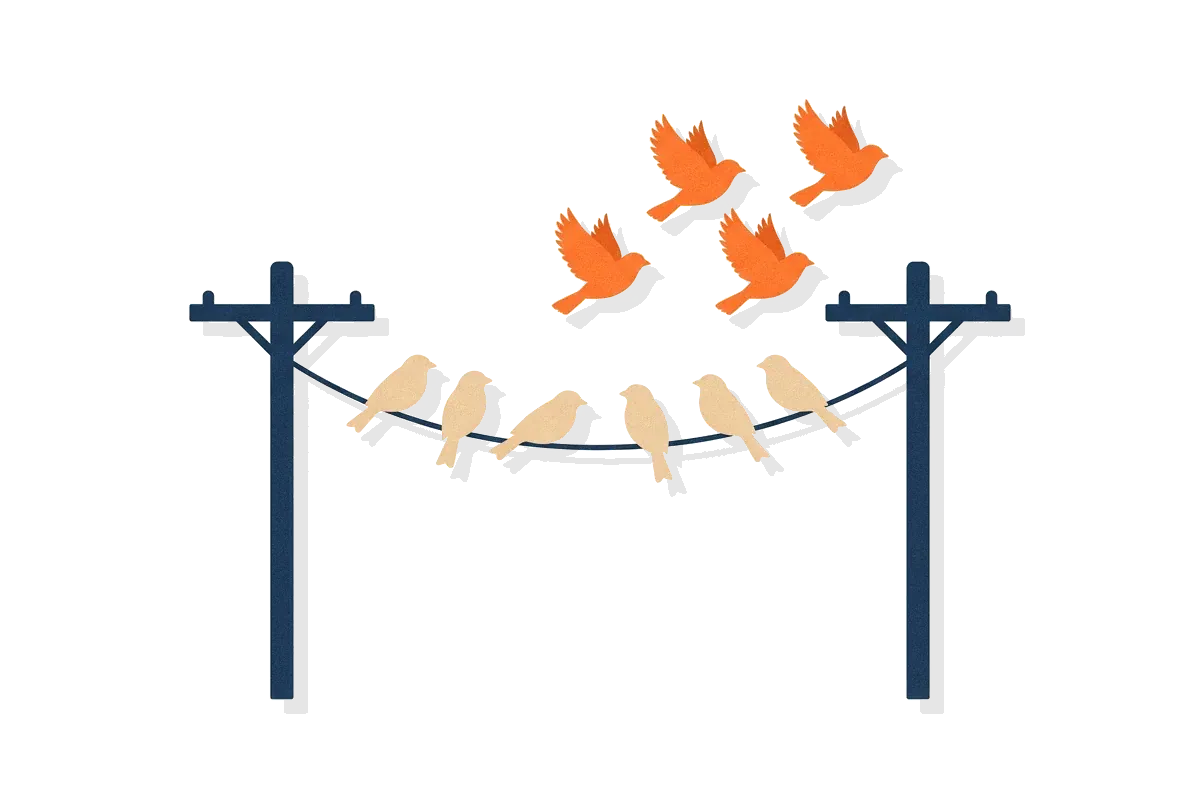
Nothing about the three options changed between the meetings. Only one fact changed, and it was a fact about other people. A choice gained support because it already had support. The same pattern appears when voters back the candidate who seems to be winning, when shoppers pick the product with the most reviews, and when investors buy an asset because its price is rising.
Each of these has the same two parts: a visible count of what others chose, and a person who is unsure what to pick. That raises a question about the name. Why a wagon?
022 min
Where the bandwagon effect comes from
The name is older than the research. In the 1800s a travelling circus led its parade with a band riding on a large horse-drawn wagon, and onlookers were invited to climb aboard. In 1848 the circus clown Dan Rice invited Zachary Taylor, a candidate for US president, to ride on his circus wagon. As Taylor's campaign gained support, people began telling his opponents to jump on the bandwagon too, which meant joining the likely winner while there was still time. By the 1900 campaign of William Jennings Bryan, the phrase had become an insult.
The scientific idea came a century later and from economics, not psychology. Standard demand theory of the 1940s assumed that every buyer decides alone. In 1950 the economist Harvey Leibenstein argued that this leaves out a real pattern, and he named it. In his paper he defined the bandwagon effect as the rise in demand for a good that happens because other people are also buying it. His list of buyer motives is plain: to belong to the group they want to be linked with, to be fashionable, and to be one of the crowd.
Separating price from popularity
Leibenstein also showed how to measure it. A fall in price raises demand for two reasons at once: the good is cheaper, and more people now own it. He built a method that splits the change in demand into a price effect and a bandwagon effect. Without that split, a rise in sales after a discount could not tell you how much of the rise came from the discount and how much came from other people's purchases. That is why later work keeps asking what the popularity signal itself adds, apart from everything else.

033 min
Why the bandwagon effect happens
Leibenstein's buyers wanted to belong. Later researchers added a second cause that has nothing to do with belonging. The two are usually called social influences.
Normative social influence is the wish for approval. A person adopts what the group does to avoid standing out. Informational social influence is the wish to be right. A person who is unsure treats other people's choices as evidence, on the reasoning that so many people cannot all be wrong. The tech lead in the meeting is mostly under informational influence. Nobody was afraid of the lead. They simply took the count as news about which database works.
Three smaller drivers sit on top of these two.
- A mental shortcut. Copying the majority costs almost no effort, and it is often right, because popular options frequently are popular for good reasons.
- The wish to back a winner. In elections and sports, being on the winning side has its own reward, so a visible lead attracts more support.
- Fear of missing out. When people see others getting in early, they worry about being left behind. Messages that stress scarcity, such as only a few left, make this worse.
The shortcut is the reason the effect is so common. It is a good rule when the people before you chose with their own judgment. It fails when they did not, and the next part shows how that happens.
How a cascade starts
In 1992 the economists Sushil Bikhchandani, David Hirshleifer and Ivo Welch described a model of this failure, which they called an informational cascade. Imagine people choosing one after another between adopting something or not. Each has a private hint about whether it is good, and each can see the earlier choices but not the hints behind them.
The first person follows their own hint. The second can work out the first person's hint from what they did, so the second person's choice still carries some information. Now suppose the first two both adopted. The third person sees two choices pointing one way and one private hint pointing the other. Two choices outweigh one hint, so the third person adopts too. The authors state this result directly: when both earlier people adopted, even a negative hint is enough to make the third person adopt.
From this point every later person is in the same position as the third. Their choice depends only on the people ahead of them, so it tells the next person nothing new. A hundred adopters can be one early hint repeated a hundred times. In the authors' words, a cascade once started can last forever even if it is wrong. In their model, wrong cascades are common when the private hints are noisy.
The same model explains why bandwagons can collapse fast. Everyone rests on very little information, so a small piece of fresh evidence that points the other way can move many people at once.
043 min
What a music market showed about the bandwagon effect
A model says what could happen. A 2006 experiment tested what does. Matthew Salganik, Peter Dodds and Duncan Watts built an artificial music market on the web. In it, 14,341 participants listened to songs by unknown bands and could download the ones they liked.
The design had one key feature. Some participants saw only band and song names. These formed the independent group, and their choices show what people like when they cannot see anyone else. Other participants also saw how many times each song had already been downloaded. These were randomly sent to one of eight separate worlds, and each world started with zero downloads and grew on its own. All participants were free to use the count or ignore it.
The result was that the count reshaped the market. In every world with a visible count, popular songs became more popular and unpopular songs became less popular than in the independent group. The songs that won also differed from world to world, even though all eight worlds began with the same 48 songs and the same starting conditions. Quality still counted for something. The best songs seldom ended near the bottom and the worst seldom ended near the top, but the places in between were open to almost any song.
A stronger signal gave a stronger effect
The researchers ran the experiment twice. In the second run they changed only how the count was shown: songs were listed in one column from most to least downloaded, so the popularity signal was hard to miss. Inequality grew further. This matches how a real product behaves, because a ranked list shows the count more strongly than a plain grid does.
Shared taste is not the same as a bandwagon
When many people choose the same thing, there are two explanations. They may share a taste, or they may be following each other. A popular item alone cannot tell you which. The independent group solves this. Because it chose with no signal, its choices show the shared taste, and any extra gap in the other worlds can be credited to the count. This is why the study is stronger evidence than a sales chart.
Can a false lead last?
Two years later Salganik and Watts changed the experiment to test the limit of the effect. They secretly reversed the true popularity of songs for 12,207 new participants, so the weakest songs looked like hits. For most songs, the false popularity became real over time. For the market as a whole, though, the reversal did not hold. The strongest songs won their popularity back over time, and the distortion left fewer downloads overall. A bandwagon can carry a song a long way, but a large gap in quality can still pull the result back.
052 min
What the bandwagon effect costs
For one decision
Back in the meeting, the cost is a decision made on the wrong evidence. The team may now run a database that is built for a different workload, and it will be hard to leave later. The error goes in one direction: popular options get too much weight, and unfamiliar options that may fit better get too little. The cost is invisible, because the team never ran the comparison that would have shown it.
Across many decisions
The effect compounds when many people take the same shortcut. Three cases show three ways.
In medicine, the surgeon Layton Rikkers defined a medical bandwagon as the overwhelming acceptance of therapies that are popular but unproven. The harm here comes from time. A treatment spreads faster than the trials that would test it, and doctors who start late see only that many colleagues already use it.
In elections, the economists Áron Kiss and Gábor Simonovits studied Hungary's parliamentary elections of 2002 and 2006. A candidate's first-round lead became about 10 percent larger in the runoff, after they accounted for national swings. Part of that gain came from turnout. Voters whose candidate looked likely to lose by a wide margin were less likely to vote at all. The bandwagon here works partly by keeping the trailing side at home, not by changing minds.
In cultural markets, the music study above shows the third way: early luck gets amplified into lasting success, so the market's winners tell you less about quality than they appear to.
062 min
How the bandwagon effect shows up in product, design and AI
Any screen that shows what others did can start the effect. Ratings, user counts, most popular labels, trending lists and upvote totals are all popularity signals. A builder who adds one is choosing to turn the effect on. The music study gives a rule of thumb: the more prominent the count, the stronger the pull. A list sorted by popularity also feeds itself, because the items at the top get seen more and so gain more votes, which keeps them at the top.
Some teams use this on purpose. A store that labels a product as a bestseller is borrowing the shopper's trust in the crowd. Other teams suffer it without meaning to. An engineering group that picks tools because other companies use them, or a product team that copies a feature because all competitors have it, is following a count it has not examined.
Analysts and people who build AI systems face a quieter version. Clicks, likes and downloads on a popularity-ranked list measure two things at once: how good each item is and how much of the audience the ranking sent to it. If those numbers become quality labels for evaluation or for a recommender, the ranking's own effect is counted as quality. The independent group in the music study is the fix to copy. Keep a sample of users who see items with no count and no ranking, and compare their choices to everyone else's.
A PM reading this will recognise a roadmap meeting where one feature is approved because everyone else has it. Ask in that meeting what the count is evidence of, and whether the others chose on their own.
072 min
How to guard against the bandwagon effect
Knowing about the effect is not a guard by itself. The steps below change the process, so the count cannot influence a decision before it is made.
Collect judgments before showing counts.
In the tech lead's meeting, ask each engineer to write down a pick and a reason before anyone mentions adoption. This copies the independent group in the music study: the count cannot sway what people have already written.
Ask what the crowd knew.
Before treating adoption as evidence, ask whether earlier adopters chose from their own testing or copied others. Many choices that trace back to one early choice are worth little. This is the cascade problem.
Make disagreement cheap.
In Solomon Asch's 1951 experiments, people judged line lengths in a group that gave a wrong answer in unison. Asch found that one other person who answered correctly was enough to weaken the pull of the majority. In a design review, name one person to argue for the least popular option, or ask the group for one stated reason against the favourite.
Compare on your own criteria.
Write down what the choice must do for your case. Then score every option, popular or not, against that list.
Treat a fast lead with suspicion.
A rise in support with no new evidence behind it is the pattern of a cascade, and cascades can reverse when new facts arrive.
081 min
Common misunderstandings about the bandwagon effect
- Belief: following the crowd is always a mistake. It is not. In the cascade model, a person who follows two earlier adopters is acting sensibly on what they can see. The problem begins only when the crowd's choices carry no independent information.
- Belief: it always moves people toward the popular option. Sometimes it moves them away. Leibenstein named the opposite pattern the snob effect: demand falls because other people are also buying, since some buyers want what is rare.
- Belief: a popular item is a good item. The music study says only partly. The best songs rarely failed and the worst rarely won, but the order in the middle depended heavily on early luck.
- Belief: it only matters for voting and shopping. The same pull appears when engineers choose tools, when doctors adopt treatments and when product teams copy competitors.
- Belief: everyone is affected equally. People differ. In the music study, participants were free to use the count or ignore it, and the market-level effect came from the sum of many small choices.
There are cases where guarding against the effect would be a mistake. If you know nothing about a topic and others have tested it carefully, copying them is a sound rule, and a bandwagon of careful adopters is evidence.
091 min
The bandwagon effect vs. nearby concepts
Four concepts overlap with this one. One axis separates each: what the person is responding to.
| Concept | What the person responds to | How it differs |
|---|---|---|
| MarketingSocial proof | ||
| PsychologyConformity | ||
| PsychologyGroupthink | ||
| PsychologyFalse consensus |
A related case is authority bias. There the signal is who chose, not how many. An expert's single choice can move people more than a thousand strangers.
?3 questions
Questions people ask
Is the bandwagon effect always a mistake?
Why do bandwagons end so fast?
Can a company use the bandwagon effect honestly?
§8 sources
Sources
Show all 8 sourcesHide sources
Leibenstein, H. (1950). Bandwagon, Snob, and Veblen Effects in the Theory of Consumers' Demand. Quarterly Journal of Economics, 64(2), 183-207.
Salganik, M. J., Dodds, P. S., and Watts, D. J. (2006). Experimental Study of Inequality and Unpredictability in an Artificial Cultural Market. Science, 311(5762), 854-856.
Salganik, M. J., and Watts, D. J. (2008). Leading the Herd Astray: An Experimental Study of Self-Fulfilling Prophecies in an Artificial Cultural Market. Social Psychology Quarterly, 71(4), 338-355.
Bikhchandani, S., Hirshleifer, D., and Welch, I. (1992). A Theory of Fads, Fashion, Custom, and Cultural Change as Informational Cascades. Journal of Political Economy, 100(5), 992-1026.
Kiss, A., and Simonovits, G. (2014). Identifying the Bandwagon Effect in Two-Round Elections. Public Choice, 160(3-4), 327-344.
Asch, S. E. (1951). Effects of Group Pressure Upon the Modification and Distortion of Judgments. In H. Guetzkow (Ed.), Groups, Leadership and Men, 177-190.
University of Washington News (2003). On and off the medical bandwagon. A news item announcing a lecture by Layton Rikkers and quoting his introduction.
Wikipedia, "Bandwagon effect", for the history of the phrase.