012 min
Gestalt psychology starts at a window
In 1923 the German psychologist Max Wertheimer described an ordinary moment. Wertheimer wrote that he stood at a window and saw a house, trees and sky, although the light reaching his eyes could be counted as 327 separate brightnesses and shades of colour. He did not experience 327 of anything. He saw three things, and the way the scene divided into those three was settled before he thought about it.
The psychology of his time worked in the opposite order. Structuralism, the leading school, took every perception to be a sum of small sensations such as spots of colour, edges and tones. Larger experiences, it said, were built from these by habit and memory. Wertheimer's window argued that this order is backwards. The scene arrives already organized, and its parts take their character from the arrangement.
That was the position of Wertheimer and two colleagues in Berlin, Wolfgang Köhler and Kurt Koffka. They named their approach with the German word Gestalt, which means shape or form. In their use it means an organized whole whose features cannot be found by examining the parts one at a time.
Wertheimer gave other cases from sight and sound. Two faces seen cheek to cheek are seen as two faces, not as one pattern of light. A listener hears a melody and its accompaniment, not a count of separate tones. A row of dots on a plain background is seen as figures, not as a sum of dots.
022 min
Where Gestalt psychology began
Wertheimer was not the first to say that wholes behave differently from their parts. Christian von Ehrenfels, an Austrian philosopher, made the first clear case in 1890, in an essay on what he called Gestalt qualities. His example was music: people can tell that a tune is the same tune after every note has changed pitch, for example when it is played in a new key. He concluded that a melody has a quality of form that its notes do not have one by one. For him, the notes still came first and the form was added on top of them.
The school itself began later. Historians date Gestalt psychology from 1912, when Wertheimer published a paper on phi motion, a kind of apparent movement. Wertheimer did not stop at saying wholes exist. He built an experiment in which the whole could be seen to appear while the parts stayed the same.
What the phi experiment involved
Wertheimer showed observers two thin lines of light, one after the other, through two slits in the spinning wheel of a tachistoscope, a device that controls exactly how long an image is shown. He changed the pause between the two flashes. When the pause between the two flashes was longer than about 200 milliseconds, observers saw two lines one after the other; at about 30 milliseconds the lines seemed to appear together; and at about 60 milliseconds observers saw smooth motion. When the pause was a little shorter than the best one, and after repeated viewing, observers saw motion with no moving object. Wertheimer called this phi motion. Only three observers took part, and each one reported the effect clearly.
The result mattered because nothing in the display moved. The motion could not be assembled from the two flashes, since each flash is only a still line. It was a new feature that belonged to the pair seen together. From this, Wertheimer concluded that organized wholes, and not sensations, are the basic units of mental life. Film works on a related effect: still frames shown in quick order look like movement.
Two schools: Berlin and Graz
Wertheimer, Köhler and Koffka are known as the Berlin school. A separate Graz school, with Meinong, von Ehrenfels and Benussi, also used the word Gestalt. The two disagreed on a basic point. In the Graz view the parts are the foundation of the whole. Wertheimer claimed that the relations between elements decide what appears as a whole and what appears as a part, and that people often grasp the whole before they notice the parts. When people say Gestalt psychology, they usually mean the Berlin school.
032 min
What Gestalt psychology claims
Wertheimer's window, the phi experiment and the tunes of Ehrenfels all point to the same set of claims. The school defended four of them.
The first is that wholes come first. A part is seen as the part it is because of the whole it sits in. The edge of a roof looks like a roof edge because it belongs to a house.
The whole is different, not bigger
The school's best-known line says the whole is more than the sum of its parts. That wording fits Ehrenfels better than Wertheimer, because for Ehrenfels the parts stayed the base on which the whole rested. Koffka also objected to the wording. In his view a whole is a different kind of thing from its parts, because adding is the wrong way to relate a part to its whole.
The second claim is about method. The school wanted psychologists to start from experience as people naturally have it, and to describe the units people actually see. The structuralists did the reverse. They trained observers to look inward and split their experience into elementary sensations.
The third claim concerns the brain. Köhler proposed psychophysical isomorphism, the idea that the structure of an experience matches the structure of activity in the brain. He pictured the brain as a system in which whole processes interact and organize themselves, rather than a set of separate signals that are added together later.
The fourth claim is that this organization favours simple, regular forms. Wertheimer set it out in 1923 as the law of Prägnanz: what we see takes on the simplest and most encompassing structure that the conditions allow.
Why Köhler expected the brain to prefer simple forms
Köhler's reason came from physics, not from vision. Köhler pointed to physics: systems left to themselves move toward their most stable state, which is also their simplest and most regular one. If the brain is a physical system too, he argued, then what we see should be the simplest and most regular arrangement the stimulus permits. This argument is what tied the law of Prägnanz to isomorphism. It is also why the brain theory could be tested, and why a failed test hurt the whole school, as a later section describes.
042 min
The grouping laws
The claims needed evidence, and the most lasting evidence came from Wertheimer's 1923 paper. Its question was simple. When five items a, b, c, d and e appear together, why do people see them as abc and de, and not as ab and cde? He tried dots, lines and tones, and listed the factors that decide the split. Several of the factors worked for hearing as well as for sight.
Each factor became a law, and each has its own entry in this library:
- Items near each other group together: proximity.
- Items that look alike group together: similarity.
- A gap in an outline is filled in so that the shape seems complete: closure.
- Items that follow a smooth path group as one: continuity.
- Items that move together group as one: common fate.
Two more belong to the same family, though Wertheimer did not state them. Items inside the same outline group together: common region. A region stands out as an object while the area around it becomes background: figure-ground. The entry on Gestalt principles collects them for design work, so this article does not explain each one again.
Grouping laws added later
Wertheimer's list did not stay fixed. The 2012 review by Wagemans and colleagues separates the classical laws from newer principles, such as synchrony, common region, and element and uniform connectedness. Synchrony means that elements that change at the same moment group together. Connectedness means that elements joined by a line group together.
Grouping measured in dot grids
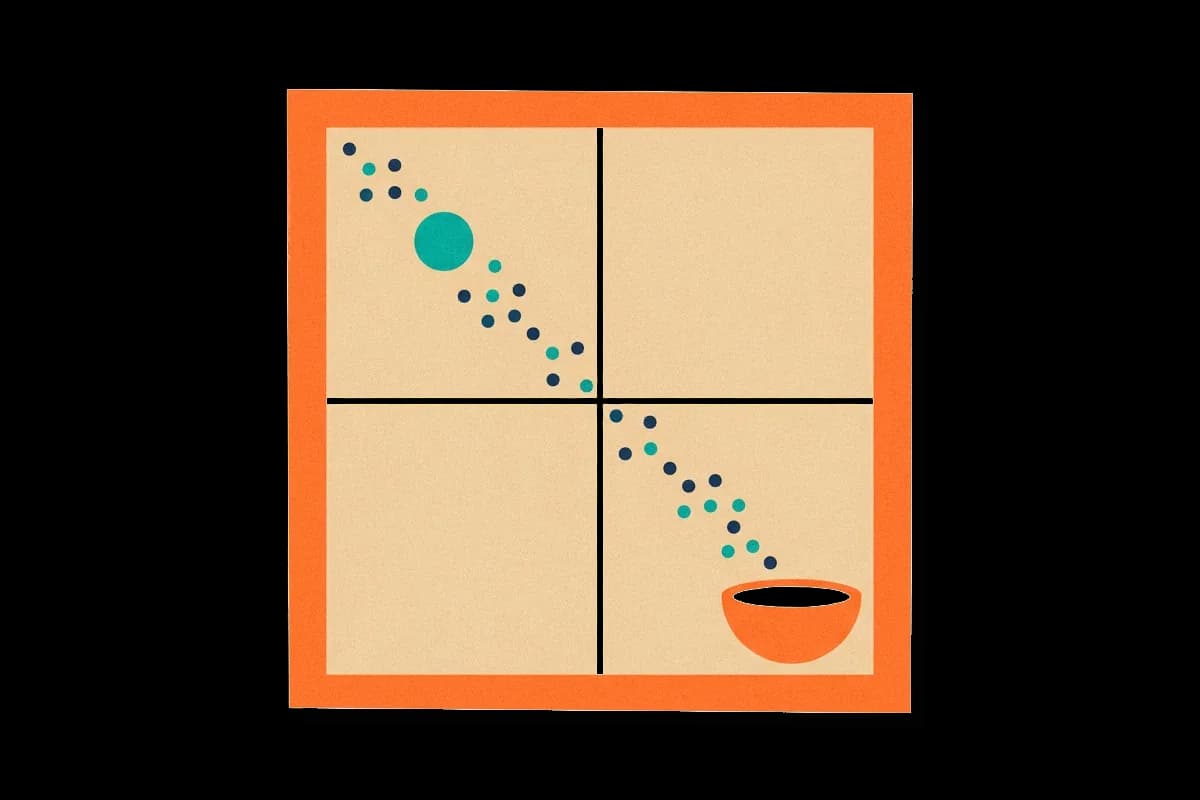
For decades the laws were stated in words only. Michael Kubovy and colleagues showed that grouping can be measured. They used regular grids of dots, which can be read as rows in more than one direction. The row that wins depends on the relative distances between the dots alone, not on the angle between the competing rows. They also tested closeness and likeness together. When closeness and likeness act on the same pattern, the two effects add together.
052 min
Gestalt psychology and problem solving
The same idea reached into thinking. Köhler directed a research station for apes on the island of Tenerife from 1914 to 1920, and the First World War kept him there. In one of Köhler's tests, a chimpanzee named Sultan stacked boxes to reach a reward, and in another he joined two sticks into one tool to bring food within reach.
Many learning theorists of the time held that animals learn by trial and error, repeating whatever happened to work. Köhler argued that the chimpanzees did something else. They took in the whole situation, with the boxes, the reward and the height, and the answer came when they saw that situation in a new way. He called this insight.
Wertheimer carried the idea to human thinking. He separated reproductive thinking, which repeats steps learned before, from productive thinking, which finds a solution by seeing the structure of the problem. His book Productive Thinking appeared in 1945, two years after his death.
Karl Duncker, another Gestalt psychologist, showed how the first kind of thinking can block the second. In 1945 he gave people a candle, a box of tacks and a box of matches, and asked them to fix the candle to the wall so that wax would not drip on the table. Most tried to attach the candle directly with tacks, or to glue it with melted wax. Very few people saw that the box itself could be tacked to the wall and used as a holder for the candle. The box was already a container for tacks in their minds, and that use hid the use the problem needed. Duncker named this block functional fixedness.
061 min
How designers borrow Gestalt psychology
Gestalt psychologists studied perception, not interfaces. Designers borrowed the grouping laws later, and they now use them in interface design and in map making. Similarity and nearness guide how radio buttons are placed, and rows and columns of desktop icons use the same two cues. On a map, similarity separates cities from rivers, closure lets a dashed line read as one border, and continuity lets a state outline stay readable where a road crosses it.
The laws also explain mistakes. Say a designer lays out a sign-up form so that each label sits closer to the input above it than to its own input. Nearness decides the grouping, so people read the label as belonging to the wrong field. No rule about labels was broken. The layout simply showed a different whole from the one the designer meant.
The entry on Gestalt principles goes through these uses in detail. The point to keep from the school itself is the order of thought: decide which whole people will see, then check that the parts support it.
072 min
Why Gestalt psychology lost its influence
Gestalt psychology was strongest in German universities, and events removed that base. Many professors lost their posts after the Nazi government took power in 1933. By 1935 the founders and their closest colleagues had all been forced to leave Germany, and they settled in the United States. Once abroad, the founders mostly wrote books instead of running new experiments. Koffka published Principles of Gestalt Psychology in 1935, and Köhler published Dynamics in Psychology in 1940. Koffka died in 1941 and Wertheimer in 1943.
The cortex experiments that ended field theory
Köhler tried to prove his brain theory with measurements. In 1949, with a colleague named Held, he recorded electrical currents from the scalp that followed the direction of moving objects. If those currents carried the pattern of what is seen, then disrupting them should distort the shapes an animal sees. In 1951 Lashley and colleagues inserted metal strips and pins into the visual cortex of rhesus monkeys to short-circuit any electrical current, yet the monkeys still performed shape discriminations they had learned. In 1955 Sperry and colleagues did something similar with cats, slicing and filling the visual cortex with metal wires, and the cats could still tell a triangle from distorted triangles.
Together the two studies showed that global currents in the cortex are not needed to see shapes. Köhler replied in 1965, but his reply was largely ignored. Electrical field theory, which had been one of the supports of the school's science, was considered finished.
Gestalt ideas applied beyond perception
Researchers including Solomon Asch and Fritz Heider carried Gestalt ideas into personality and social psychology. The further the ideas were applied, the harder it became to connect them to Köhler's picture of a self-organizing brain.
Metzger's Laws of Seeing
Wolfgang Metzger stayed in Germany and published Gesetze des Sehens (Laws of Seeing) in 1936. It summarized Gestalt research on perception, and it was largely ignored outside Germany. It was translated into English only in 2006.
Kanizsa and the Italian school
Italy stayed a centre of the school. Cesare Musatti introduced the Berlin school's ideas there and trained Fabio Metelli and Gaetano Kanizsa. In the 1950s Kanizsa published studies of subjective contours, which are edges that people see where the image has none. The best known example is the Kanizsa triangle.
082 min
What holds up today
In 2012, a hundred years after Wertheimer's phi paper, Johan Wagemans and six colleagues reviewed what had become of the school. They found that many psychologists believed it died with its founders or with the field-theory results, yet most textbooks still contain a chapter on perceptual organization. Köhler's specific theory of brain fields was rejected. But research in neuroscience has confirmed that the brain carries out visual organization before attention is applied, which is what Gestalt theory had proposed.
The criticism of the original work was also fair. The early evidence was mostly demonstrations that the experimenter showed and the observer described. The laws were stated loosely. Koffka defined the law of Prägnanz as organization that is as good as the conditions allow, and never said how to measure good. Wertheimer wrote that a good form is recognized by its own "inner necessity". Later researchers answered with measurement and models, as the next two cases show.
Simplicity measured with information theory
After Claude Shannon's information theory appeared, a few researchers tried to put a number on the school's idea of simplicity. Attneave in 1954 and Leeuwenberg in 1969 are among those the review names. A shape is simple, on this approach, when it can be described with little information.
Grouping that may be learned
Gestalt theory placed the origin of organization in automatic, built-in laws, not in learning. The 2012 review adds that the school never claimed learning or past experience play no role. Newer work raises the question again. A 2019 study by Been Kim and colleagues found that a neural network trained to classify natural photographs represents scattered edge fragments in a way that matches the closed shape they suggest. If closure can be learned from natural images, some grouping may come from the statistics of the world, not from a built-in rule.
091 min
Gestalt psychology vs. nearby concepts
The word Gestalt is used for several different things, and the confusion has real costs.
| Concept | What it is | How it differs from Gestalt psychology |
|---|---|---|
| Gestalt principles | The grouping rules of perception, used in design | They are one result of the school. The school also covers insight, problem solving and a theory of the brain. |
| Gestalt therapy | A form of psychotherapy developed by Fritz and Laura Perls | It is only loosely linked to the school, and how much it drew on the school is disputed. It is not a method of perception research. |
| Structuralism | The older view that experience is built from sensations | It is the view the school opposed. |
| Behaviorism | The view that psychology should study stimuli and responses | The school studied experience and insight, which behaviorism left out. |
| Gestalt language processing | A term used for a style of learning language | It is a separate topic with a shared word. |
101 min
When to use Gestalt psychology
Return to Wertheimer's window. Its lesson is a question to ask before looking at details: which whole will people see here, and is it the one I intend?
Use the school's ideas when the problem is how people see things as units, such as a layout, a chart, a map or an icon set. Use them also when a problem will not yield because familiar objects are fixed in one use, as in Duncker's candle problem.
Do not treat the laws as guarantees. They were first shown with simple dots and lines, and when several cues compete they are hard to predict. Test the layout with real viewers. Before adding a label, a border or a colour, ask which whole it will create.
?4 questions
Questions people ask
Why is it called the Berlin school?
Did Gestalt psychologists say perception is inborn?
How many Gestalt laws are there?
Where can I read Wertheimer's original paper?
§6 sources
Sources
Max Wertheimer, Laws of Organization in Perceptual Forms, 1923, English translation in W. D. Ellis, A Source Book of Gestalt Psychology, 1938. Classics in the History of Psychology, York University.
Johan Wagemans, James H. Elder, Michael Kubovy, Stephen E. Palmer, Mary A. Peterson, Manish Singh and Rüdiger von der Heydt, "A Century of Gestalt Psychology in Visual Perception: I. Perceptual Grouping and Figure-Ground Organization", Psychological Bulletin, 2012.
"Gestalt psychology", Wikipedia (an encyclopedia summary).
"Sultan (chimpanzee)", Wikipedia (an encyclopedia summary of Köhler's Tenerife experiments). (chimpanzee)
Show all 6 sourcesShow fewer sources
"Functional fixedness", Wikipedia (an encyclopedia summary that describes Duncker's 1945 candle experiment).
Been Kim, Emily Reif, Martin Wattenberg, Samy Bengio and Michael C. Mozer, "Neural Networks Trained on Natural Scenes Exhibit Gestalt Closure", arXiv, 2019.