012 min
How System 1 thinking answers the bat-and-ball puzzle
A bat and a ball cost $1.10 together, and the bat costs $1.00 more than the ball. How much does the ball cost? Chances are an answer reached you before you decided to look for one: 10 cents. The psychologist Shane Frederick put this puzzle to university students, and Daniel Kahneman described the results in his 2002 Nobel lecture.
The number 10 comes up because $1.10 splits naturally into $1 and 10 cents, and 10 cents is about the right size. That automatic, effortless answer is System 1 thinking at work. Kahneman called the feeling that an answer is easy and familiar cognitive ease. You don't choose that answer. It simply arrives, and it is wrong. A 10-cent ball would make the bat $1.10, so the pair would cost $1.20. The right answer is a 5-cent ball and a $1.05 bat.
At Princeton, 50 percent of 93 students gave the 10-cent answer, and so did 56 percent of 293 students at the University of Michigan. These students had the arithmetic to solve it. Kahneman read the errors as a sign that System 2, the slow mode of thinking that works in steps, checks the answers of System 1 only lightly. The first answer felt finished, so many students never started the check.
The same fast mode lets you pick out a friend's face in a crowd, and there it is nearly always right, because you've seen that face many times.
022 min
How System 1 thinking works
Picture an on-call engineer, the person who gets paged when a service breaks, woken at night by an alert. Before opening a single log, they decide the afternoon's deploy caused it. The deploy came to mind first because it was the most recent change. Then they open the logs and find that a security certificate expired at midnight. The deploy was fine.
That quick guess shows how System 1 thinking works. In his 2002 Nobel lecture, Kahneman called the operations of System 1 fast, automatic and effortless. He added that they are associative, so they link things that went together before, and that they are hard to control or modify. For the engineer, an alert linked to the last change, much as a frown links to anger. You can't switch this off by deciding to, any more than you can look at a road sign and not read it.
What comes to mind first
Kahneman pointed to accessibility, the fact that some thoughts arrive much more readily than others, and the quickest to arrive tends to become the answer. For the engineer, the deploy was the most accessible suspect. Judging how likely a cause is by how easily examples of it come to mind is the availability heuristic, a quick rule of thumb that System 1 relies on.
Answering an easier question
When the question is hard, System 1 often answers an easier one in its place. Kahneman called this attribute substitution, judging a difficult feature through an easier one that comes to mind sooner. The engineer was asking what caused the alert, which is hard to answer from a pager screen. The answer they gave was to another question: what changed most recently?
Where System 2 comes in
System 2, the slow mode of thinking that works in steps, can check what System 1 offers. Kahneman said you correct a quick judgment only if a rule you trust comes to mind in time. For the engineer, that rule was "check the logs first", and it came to mind after the guess had formed.
031 min
Where System 1 thinking comes from
From early in their work, Kahneman and Tversky saw quick judgments as a middle step: more automatic than reasoning, but less automatic than seeing. In 1973 they tested how such judgments behave, using a made-up graduate student called Tom W. People read a sketch that described him as bright and tidy-minded, a dull writer with little feeling for others. One group ranked nine fields of graduate study by how closely Tom W. resembled a typical student in each. A second group ranked how likely he was to be in each field. They were psychology graduate students, told that the sketch came from tests of doubtful value.
Sound reasoning would have sent that second group to the base rates, meaning how many students each field has. Instead the likelihood rankings matched the resemblance rankings almost exactly, with a correlation of .97. Kahneman read the match as a sign that an easy question, how much Tom W. resembles a typical student, had quietly replaced a hard one, how likely he is to be in each field.
The labels came later. In 2000, the psychologists Keith Stanovich and Richard West gave fast, automatic thinking and slow, deliberate thinking the labels System 1 and System 2. Kahneman adopted them in his December 2002 Nobel lecture, and later in his book Thinking, Fast and Slow.
042 min
When System 1 thinking can be trusted
A fire lieutenant and his crew went into a one-story house to put out a fire in the kitchen at the back. They sprayed it, and the fire roared back. The living room was hotter than a small kitchen fire should have made it, and it was too quiet. The lieutenant felt something was wrong and ordered everyone out. Moments after the crew left the building, the floor they had been standing on collapsed. The fire had been burning in the basement beneath them. The psychologist Gary Klein described the case in his research on how experts decide, and the writer Matthew Syed retold it in his book Bounce.
The heat, the quiet and the fire's refusal to die down did not fit a kitchen fire. Put together, those cues said the fire was under the floor, and the lieutenant's sense that something was off matched them.
Kahneman studies how judgment goes wrong, and in 2009 he and Klein published a joint paper on when you can trust a gut feeling. Kahneman and Klein agreed that skilled intuition needs two things: an environment regular enough to contain learnable cues, and enough chances to learn them. A regular environment is one where the same cues have led to the same results many times. A fire lieutenant meets many fires and learns how each one turns out, so his feeling had something real behind it.
When the conditions are missing
Where results are hard to predict, or where nobody ever learns whether they were right, a confident answer carries no skill, however certain it feels.
052 min
When System 1 thinking leads people astray
Linda is 31, single, outspoken and very bright. She majored in philosophy, and as a student she cared about discrimination and social justice and joined antinuclear demonstrations. Amos Tversky and Daniel Kahneman gave respondents that description and asked them to rank eight things Linda might be doing now, among them "a bank teller" and "a bank teller who is active in the feminist movement". Some respondents ranked the items by how well each fits Linda, and others by how probable each is. About 85 percent of the first group and 89 percent of the second put the feminist bank teller above the plain bank teller.
That ranking can't be right. Every feminist bank teller is also a bank teller, so the longer description can't be more probable than the shorter one. This mistake is called the conjunction fallacy, rating two things together as more likely than one of them alone. The description of Linda made one answer feel right, and that feeling did the ranking.
An error that leans the same way each time is a bias. Anchoring, where the first number you see pulls your estimate toward it, is another one. Quick answers go wrong in this predictable way where a setting is irregular or gives no feedback.
A one-second judgment of faces
In 2005, Alexander Todorov and colleagues showed people the faces of candidates in US congressional elections for one second and asked them to rate how competent each candidate looked. Using those ratings alone, the researchers picked the winner in 68.8 percent of the 2004 US Senate races, better than chance, and the ratings also tracked the margin of victory. The study does not show why voters chose as they did. It does show that a one-second impression of a stranger's face was enough to pick most of the winners.
061 min
System 1 thinking in a swipe
Tinder's discovery screen, the main screen of the dating app, gives you one photo to judge. The photo fills the card, with a name and an age over its lower part and two chips reading 3 Photos and Has Bio. Under the card are five round buttons, and the two largest are a heart for yes and an X for no.
The screen asks for a yes or a no and does not ask for a reason. What you have to go on is a first look at a face, the kind of one-second judgment that people in a 2005 study made about election candidates' faces, when they rated how competent each candidate looked. A designer who builds a screen like this is asking people to decide on a first look.

071 min
System 1 thinking and one-click buying
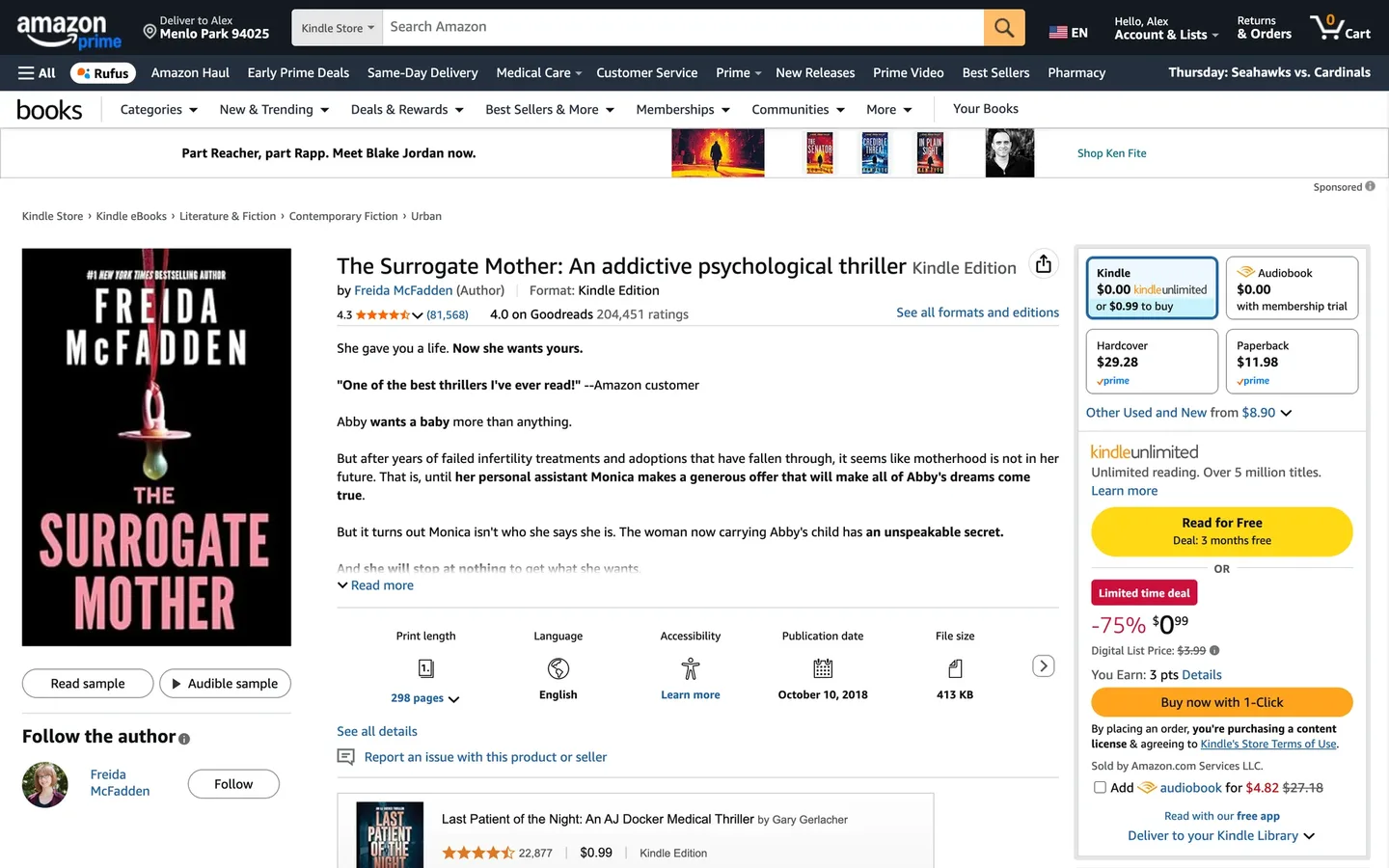
Amazon's Kindle Store page for an ebook sets a one-step purchase beside a price cut. In the buy box, a button reads Buy now with 1-Click. Just above it sit a badge reading Limited time deal, a label reading -75% and the price $0.99.
Nothing on the screen asks you to pause. Every extra step in a purchase is a place where System 2, the slow mode of thinking that checks quick answers, can step in, so a page with one step has fewer such places than a flow with four. The designer's choice is whether the page makes stopping easy or leaves it all to the buyer.
081 min
How to work with System 1 thinking
You can't switch System 1 off. The psychologist Daniel Kahneman found its operations hard to control or modify. What you can change is the setting around a decision, and the table sorts cases into the ones where a quick answer is fine and the ones that deserve a pause.
| Choosethe quick answer | Chooseto slow down |
|---|---|
| A mistake is cheap.You can undo it, or catch it later. | A mistake is costly.You can't undo it, or the cost lands on other people. |
| Someone will check.A reviewer or a test looks at the result before it matters. | No one will check.Your quick answer becomes the decision. |
| You know this ground.You've met this kind of case many times and learned how it ended. | The ground is new.Your sense of certainty has nothing behind it yet. |
Two changes help when you do slow down. One is to write down your quick answer before you look at any evidence, then check it against a second source, so the check can't be skipped later. The other is to put a forcing function in front of a costly action, a step you can't complete on habit.
091 min
A forcing step in practice: GitHub's delete dialog
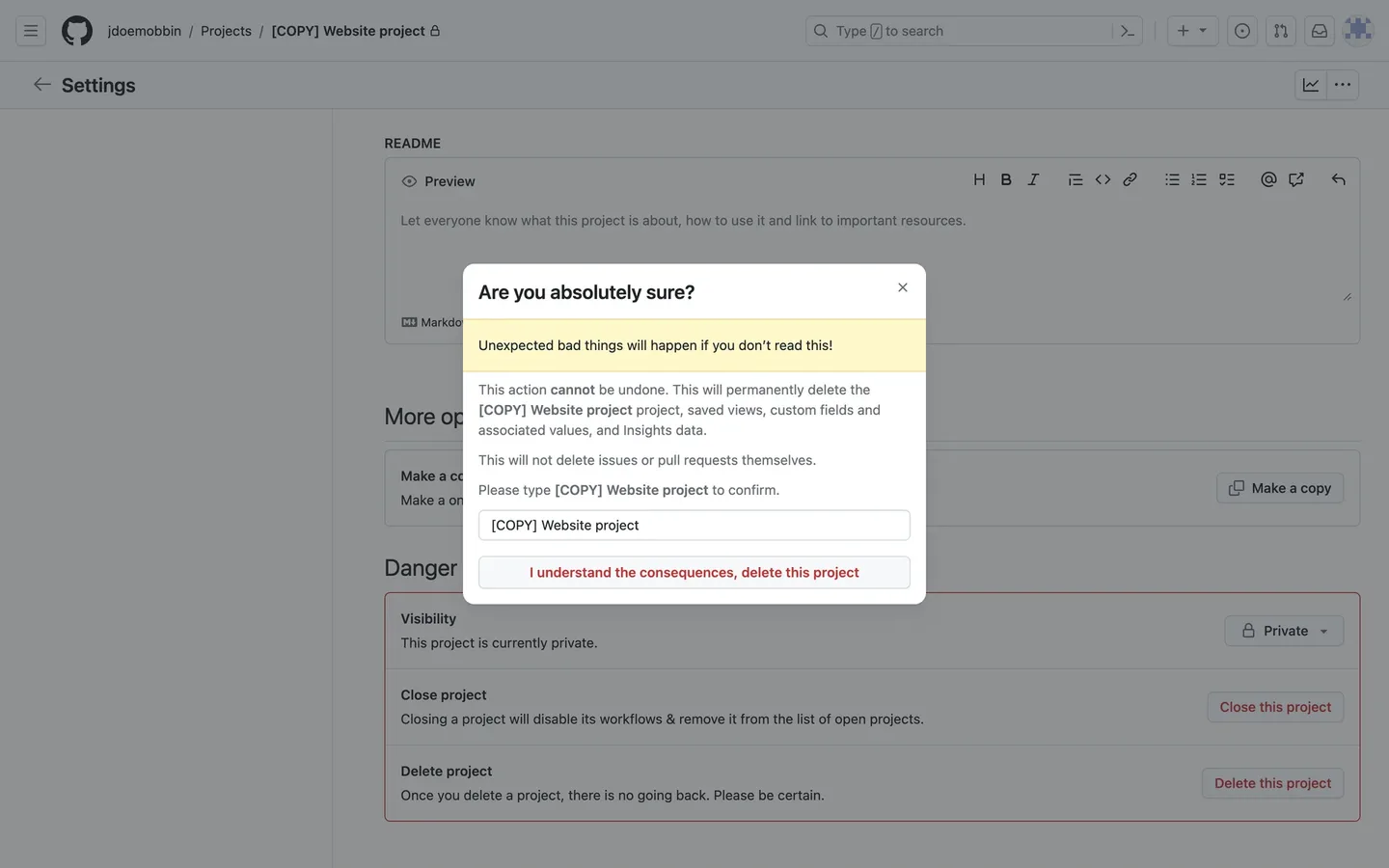
GitHub's dialog for deleting a project asks you to slow down. In the project settings, the delete button opens a dialog titled Are you absolutely sure?. A warning strip reads Unexpected bad things will happen if you don't read this!. The dialog asks you to type the project name into a text box, and the full-width button under it reads I understand the consequences, delete this project.
You can click through an ordinary dialog out of habit, but you can't type a name out of habit. So the typing gives System 2, the slow mode of thinking that works in steps, a reason to take over. It adds a step exactly where a mistake would be hard to undo.
Misunderstandings
Common misunderstandings about System 1 thinking
Belief: Being fast is what makes thinking System 1.
Actually: Speed is common but not the definition. The psychologists [Jonathan Evans and Keith Stanovich](https://scottbarrykaufman.com///wp-content/uploads/2014/04/dual-process-theory-Evans_Stanovich_PoPS13.pdf) call the fast kind of thinking Type 1 processing. They say it tends to be rapid and associative, linking ideas that went together before, but that these features only usually go with it and are not what defines it.
Belief: System 1 and System 2 are two parts of the brain.
Actually: They are labels for kinds of thinking. Evans and Stanovich call the two kinds Type 1 and Type 2 processing and note that each can have conscious and unconscious aspects.
Belief: System 1 is always the sloppy mode.
Actually: Quick answers can be logical. In [four experiments with logic puzzles, reported in 2016](https://bps.org.uk/research-digest/contra-kahneman-your-minds-fast-and-intuitive-system-one-capable-logic), Bence Bago and Wim De Neys found that quick intuitive answers could already be logical, with no help from System 2.
112 min
Where the evidence is contested
Priming is the idea that words or images you saw a moment ago change how you act without you noticing. It is one of the ideas linked with automatic thinking, and one of its best-known studies has not held up. In 1996, John Bargh and colleagues reported that people who had seen words about old age walked more slowly when they left the lab. In 2012, Stéphane Doyen and colleagues tried to repeat that study with automated timing and a larger sample, and their first experiment did not show priming. A single priming result is a weak basis for a design decision.
The two-system idea is debated too. The psychologists Jonathan Evans and Keith Stanovich say that critics of the two-system idea, such as Arie Kruglanski and Gerd Gigerenzer, treat the listed features of the two systems as if they must all appear together.
Treat System 1 and System 2 as a handy way to describe two routes to an answer, not as two parts with fixed properties. Lean on the two conditions for trusting intuition: a setting regular enough to learn from, and many chances to learn it. They come from a joint paper by Kahneman, who studies the errors of intuition, and Klein, who studies expert intuition, so researchers who study the errors of intuition and researchers who study its skill both stand behind them. Treat any single priming result with care.
121 min
System 1 vs System 2 thinking and nearby concepts
Four concepts are easy to mix up with System 1 thinking. The table shows what sets each one apart.
| Concept | What it describes | What separates it from System 1 |
|---|---|---|
| This pageSystem 1 Thinking | ||
| PsychologySystem 2 thinking | ||
| PsychologyHeuristics | ||
| PsychologyAutomatic Thinking | ||
| DesignCognitive Ease |
?6 questions
Questions people ask
Is System 1 thinking the same as intuition?
Can System 1 thinking be trained?
How can I tell which mode I am using?
Why does System 1 thinking matter for designers and product managers?
Is there a System 3 thinking?
Is System 1 thinking emotional or unconscious?
§8 sources
Sources
Show all 8 sourcesHide sources
Kahneman, D. (2002). Maps of bounded rationality: A perspective on intuitive judgment and choice. Nobel Prize lecture.
Kahneman, D. and Klein, G. (2009). Conditions for intuitive expertise: A failure to disagree. American Psychologist 64(6), 515-526.
Syed, M. (2010). Excerpt from Bounce, retelling a fire lieutenant's decision from Klein's Sources of Power. NPR.
Todorov, A., Mandisodza, A. N., Goren, A. and Hall, C. C. (2005). Inferences of competence from faces predict election outcomes. Science 308(5728), 1623-1626.
Doyen, S., Klein, O., Pichon, C.-L. and Cleeremans, A. (2012). Behavioral priming: It's all in the mind, but whose mind? PLoS ONE 7(1).
Evans, J. St. B. T. and Stanovich, K. E. (2013). Dual-process theories of higher cognition: Advancing the debate. Perspectives on Psychological Science 8(3), 223-241.
Jarrett, C. (2016). Contra Kahneman, your mind's fast and intuitive "System One" is capable of logic, a summary of Bago and De Neys's study. British Psychological Society Research Digest.
The Decision Lab. From Tool to Thinker: When AI Becomes Part of How We Reason, a summary of Shaw and Nave's Tri-System Theory.