011 min
Why a reminder fails: the Fogg Behavior Model
Picture a designer at a subscription app that helps people track a weekly budget. Most people sign up, set a budget, and never open the app again. The designer's first idea is a daily reminder at 8 p.m. A week later the reminders are going out, and the number of people who log a purchase has not changed.
The designer is right that people need a cue, because people forget. But a cue works only when the person also wants to act and is able to act at that moment. So the designer now has three questions instead of one. Does the user want to track spending right now? Is tracking easy enough for a tired person at 8 p.m.? Did the reminder arrive when they could act on it?
Those three questions are the Fogg Behavior Model. BJ Fogg, who founded the Behavior Design Lab at Stanford, built it to diagnose why a behavior does not happen. When a behavior fails, find which of the three parts is missing and fix that one. The rest of this article follows the designer as they use it. The same logic runs through behavioral design, the practice of shaping a product so that one specific action becomes more likely.
023 min
The three parts of the Fogg Behavior Model
The designer begins by checking what each part means, because each word is narrower than it is in everyday speech.
B = MAP. A behavior needs Motivation, Ability and a Prompt to be present together.
Motivation
Fogg names three core motivators, and each has two sides. Sensation is pleasure or pain. Anticipation is hope or fear. Belonging is acceptance or rejection. A person who wants to feel good, expects something good, or wants to fit in has motivation, and the opposite feelings count as well.
Fogg adds that motivation does not stay steady. He calls its rise and fall a motivation wave. While motivation is high, people will do hard things. After it drops, they will only do easy things. For the budget app, motivation is moderate and uneven at best, because few people feel pleasure from logging a coffee.
Ability
In this model, ability means simplicity: how easy the action is for this person at this moment. Fogg's key point is that simplicity depends on the resource the person has least of right now. If an action takes 10 minutes and the person has two minutes, it is not simple, however small it looks. Designers often assume people have more ability than they really do.
Summaries of the model list six resources. Fogg's own site draws five, so treat the exact count as loose.
| Resource | The question | In the budget app |
|---|---|---|
| Time | How long does it take? | Entering a whole week of purchases at once |
| Money | Does it cost anything? | A paid plan needed to see the charts |
| Physical effort | How much body effort does it need? | Typing every purchase by hand |
| Mental effort | How much thinking does it need? | Choosing a category for each purchase |
| Social deviance | Does it go against what people nearby do? | Taking out a phone to log a bill during a meal |
| Non-routine | Does it break the person's usual day? | A new task that fits nowhere in the day |
Prompts
A prompt is the cue that says to act now. Without one, the behavior does not happen, however much the person wants it and however easy it is. A prompt can come from outside the person, such as an alarm. Product teams call this an external trigger. A prompt can also come from the day itself: walking through the kitchen may lead someone to open the fridge. Other names for it are cue, trigger and call to action. Fogg used trigger himself until late 2017, and now uses prompt.
Fogg names three types, and the right one depends on the person's mix of motivation and ability:
- Spark: motivation is low but the action is easy. The prompt gives the person a reason to want it.
- Facilitator: motivation is high but the action is hard. The prompt makes the action easier.
- Signal: both are high. The prompt is only a reminder.
032 min
The action line in the Fogg Behavior Model
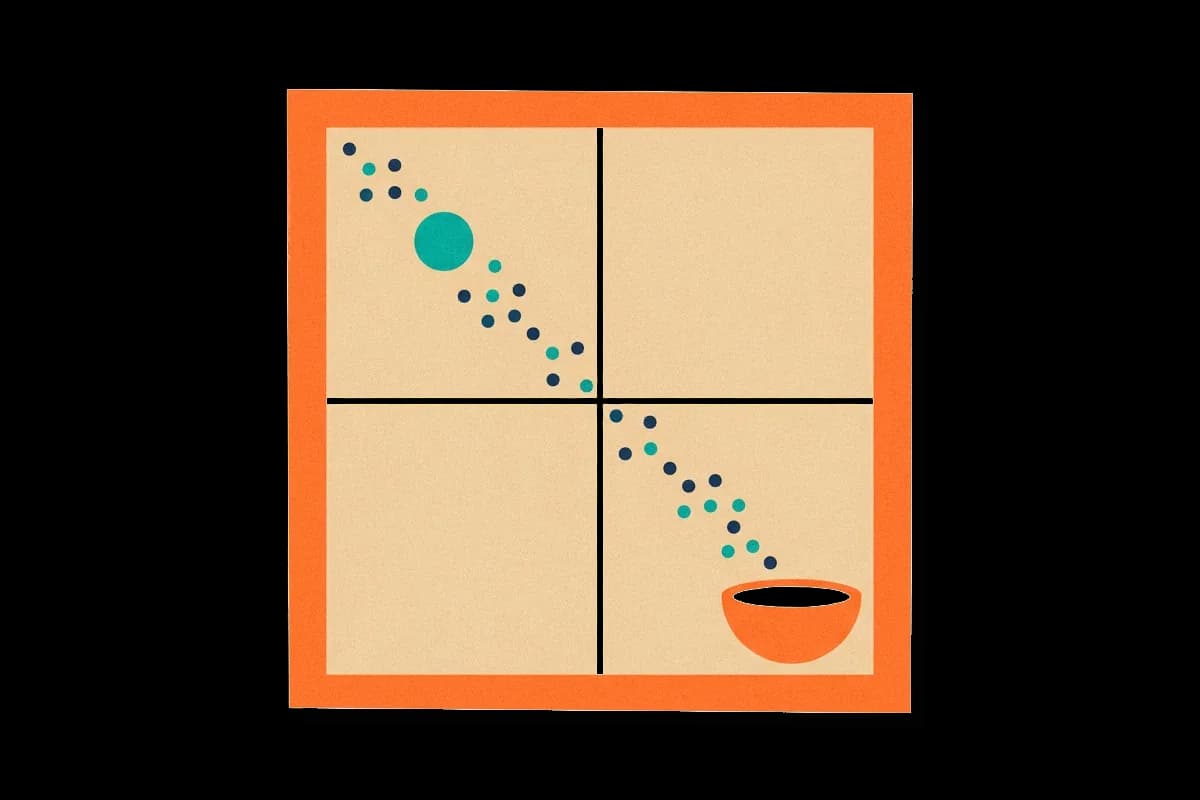
The three parts do not work alone, and the model shows how they interact on one chart. Motivation runs up the side and ability runs along the bottom, from hard to easy. A curved line, the action line, crosses the chart from top left to bottom right. When a prompt arrives, a person above the line is likely to act and a person below it is not.
The line curves down because motivation and ability trade off. A very easy action needs little motivation, and a hard action needs a lot. Fogg calls this a compensatory relationship, which means that more of one can make up for less of the other.
The chart explains why the budget designer's reminder failed. Entering a week of purchases is hard, so it needs high motivation, and motivation at 8 p.m. is low. The user is below the line. Raising motivation is slow and unreliable. Making the action easier moves the user to the right, with no change in the person.
Three ways to raise ability
Fogg lists three ways to raise ability, and he calls training people the hard path. People resist learning new things, so training is the route to avoid unless it is the only one. A second way is to give people a tool or resource that makes the action easier, as a cookbook does for cooking at home. The third is to shrink the behavior until it is easy. Fogg recommends this one, and it is the idea behind his Tiny Habits method.
042 min
Where the Fogg Behavior Model comes from
The model began as a tool for a narrower field. Fogg started studying how computers persuade people in the 1990s, as a doctoral student in psychology at Stanford. In 1998 he founded the Stanford Persuasive Tech Lab, and his 2003 book Persuasive Technology described the field.
Around 2009 Fogg moved from studying how technology persuades to studying human behavior in general, and he published the model. He presented it in a paper, A behavior model for persuasive design, at the Persuasive 2009 conference. The first version used the word trigger, and the formula was B = MAT. In December 2011 he developed Tiny Habits, a method for building habits from very small steps, and in 2020 he published a book of the same name. The lab is now called the Stanford Behavior Design Lab. Mike Krieger, a co-founder of Instagram, was one of his students.
It is not the first model with three parts
A reader may suspect that motivation, ability and a prompt are old ideas with new names. Fogg raises this himself on his website. The earliest three-part model he can find is by Lilian Ripple, in a 1955 paper on motivation, capacity and opportunity in the use of casework services. He says the two only look alike. Ripple defines her words differently, and her use of motivation is not his.
He also separates his model from earlier work on persuasion, which mostly studied how people process information or change attitudes. His model aims at behavior, and he states that attitude change and behavior change are different things.
052 min
Facebook's email, read with the Fogg Behavior Model
The budget designer wants to see the three parts in a real product, and Fogg offers one.
Fogg had not used a demo Facebook account for a while. Facebook then emailed that account a prompt with one aim: get the person to sign in. Fogg reads the email as mostly a facilitator. A prominent green sign-in button made the action easy, and the email offered three more links to Facebook besides. None of them led to the home page. Each opened a page for finding people the account holder might know.
How a Facebook email led a dormant account back
That choice matters because signing in is only the first step of a longer path. In Fogg's reading, Facebook's larger aim is to make using the site a daily habit. The path he traces has four steps: the email gets the user to sign in, the friends page gets the user to add people, the new friends respond to the user, and the user responds to them and becomes more involved. The email did not tell the user to connect with more friends. That would have asked for a bigger behavior at the very start.
Behavior chains: a small behavior that leads to a bigger one
Fogg calls a path like this a behavior chain, a series of behaviors in which each one leads to the next. His simplest example is exercise. Picture someone who rarely moves and is prompted to walk for 10 minutes a day. A short walk is easy to start. Once the walks are happening, that person may go on to buy walking shoes with no further prompt. Asking the same person to buy walking shoes first would be a much bigger request.
Fogg's advice to designers is to write down the chain they want, get people to do the first behavior, and add a prompt for any later step that does not happen on its own. For the budget app, the first behavior is logging one purchase. Setting a weekly goal can come after that.
A second product: BeReal
The Decision Lab describes the photo-sharing app BeReal in the same terms. Once a day, users get a notification and have a two-minute window to post a photo. Belonging to a close group of friends supplies the motivation. The action is easy, because the user answers the notification, takes a photo and presses send. The notification is the prompt, and it arrives once a day, at any time.
062 min
The evidence for the Fogg Behavior Model
A neat example does not show that a model works, so the designer looks for tests.
A 2007 class at Stanford
In the fall of 2007, Fogg co-taught a Stanford course in which students built Facebook applications, and he later said the apps had reached 16 million people by the end of the 10-week course. Students used psychology and measurement to make their apps more appealing. This was before the model was published in 2009, so it shows the approach and not the model itself. A reporter for Stanford Magazine added that much of the success came from the power of Facebook, which spreads as friends invite friends. The number shows what was possible on that platform in 2007. It does not measure the model.
A small trial in diabetes care
In 2020, Sittig and colleagues published a pilot trial of capABILITY, a mobile app for managing type 2 diabetes. The app sent text messages built from the Fogg model: spark messages to give a reason to act, and facilitator messages to make the task easier. Twenty people took part, and each received the messages in some periods and not in others. Scores on three of seven health survey measures changed significantly before and after: general diet, exercise and blood glucose.
The authors said the sample was too small to compare message types, but that spark messages may have brought people back to the app. It was a feasibility study, so it could not show that the model's predictions hold.
A 2025 review of health studies
In 2025, BMC Public Health published a scoping review of the model. A scoping review maps which studies exist rather than weighing how good they are. The authors searched several medical databases for health studies that applied the model and reported results. They found six, covering areas such as vaccination, chronic disease management and reproductive health. Results varied by study. The authors judged the model an effective framework for health behavior change. They also noted that few studies followed people over a long time, and called the model underused in public health research.
072 min
Where the Fogg Behavior Model falls short
Six studies is not much evidence, and critics raise problems that more studies would not fix.
The Behavioral Scientist, a practitioner site, points out that Fogg's 2009 paper was a conference paper. It reports that most papers citing the model apply it as a design framework, and that no published randomized trial tests its core predictions directly. That does not make the model wrong. It means the model is a useful way to ask questions and has not been shown to predict outcomes.
Other limits follow from how the model is built:
- It describes one moment. It fits a single action, such as opening an app, better than a long change such as managing a chronic illness or changing how a team works.
- It does not give surroundings their own part. Money problems or poor access to services affect behavior whatever the person's motivation or ability.
- It treats motivation as one scale. It does not separate deliberate wanting from automatic urges, so it says little when the two disagree.
Who chooses the behavior
The model says how to make a behavior happen. It does not say which behaviors a designer should aim for. A team that uses it to get people to sign in more often and a team that uses it to get patients to take medicine use the same tool for different ends. The risk is a prompt that works on someone who does not understand what is happening. A useful test is whether the person would still agree to the behavior if they saw exactly how the design leads them to it.
082 min
Fogg Behavior Model vs. COM-B and nudges
Because the model is simple, readers often meet it next to two others that sound similar.
COM-B is the closest neighbor. Michie, van Stralen and West proposed it in 2011 as the core of a method for designing behavior change programs. It also has three parts: capability, opportunity and motivation. The main difference is where the surroundings go. In COM-B, opportunity covers every factor outside the person that makes the behavior possible or prompts it, and motivation includes habits and emotional reactions as well as deliberate goals. In the Fogg model, outside factors are spread across ability and prompts.
| Fogg Behavior Model | COM-B | Nudge theory | |
|---|---|---|---|
| Question it answers | Why did this person not act at this moment? | Which conditions must a behavior program change? | How can a choice be arranged so people pick better? |
| Parts | Motivation, ability, prompt | Capability, opportunity, motivation | None fixed; it changes how options are shown |
| Surroundings | Folded into ability and prompts | Their own part: opportunity | The main tool |
| Usual home | Single actions in a product | Health programs and policy | Defaults and choice design |
Nudge theory differs on one axis. A nudge changes the setting of a choice for everyone, while the Fogg model diagnoses why one behavior fails for one kind of person. They combine well, because a default is a nudge that raises ability by removing a step.
Nir Eyal's Hook Model is a third neighbor. It describes a loop that repeats to build a habit, while the Fogg model looks at a single moment.
092 min
Applying the Fogg Behavior Model
The designer now has a diagnosis, and it points to ability.
- Name one specific behavior. Log one purchase is specific. Manage money is not.
- Find where people stop. If they never see the cue, the prompt is missing. If they see it and quit partway, ability is the problem. If they ignore it, check motivation.
- Make the action easier first. Cut time, effort and thinking at each step. Every extra field is friction, meaning anything that makes an action take more effort.
- Match the prompt to the person. Use a spark when the action is easy but wanting is low, a facilitator when wanting is high but the action is hard, and a signal when both are high.
- Time the prompt for a moment when the person can act. A reminder in the middle of a meeting fails even for a motivated user.
- Test the change. Compare the share of users who complete the action before and after.
The budget designer replaces the weekly entry with one field, the amount, and sends the reminder at a moment when the user has just paid for something. The user's position on the chart moves to the right, and the same prompt now works. The same reading applies to advertising: the ad is the prompt, and the page it opens decides how easy the next step is.
Fogg's Tiny Habits method applies the idea to personal habits. Scale the behavior down to its smallest version, attach it to something you already do, and celebrate straight after. Before adding another reminder to any product, ask which of the three parts is missing and change that one.
?3 questions
Questions people ask
Does the Fogg Behavior Model say motivation does not matter?
What is the difference between the Fogg Behavior Model and Tiny Habits?
Is the Fogg Behavior Model only for apps and websites?
§13 sources
Sources
Fogg, B. J. Fogg Behavior Model, Motivation. Stanford Behavior Design Lab.
Fogg, B. J. Fogg Behavior Model, Ability.
Fogg, B. J. Fogg Behavior Model, Prompts.
Fogg, B. J. Fogg Behavior Model, References to related work.
Show all 13 sourcesShow fewer sources
Fogg, B. J. (2009). A behavior model for persuasive design. Proceedings of the 4th International Conference on Persuasive Technology (Persuasive '09).
B. J. Fogg, biography and timeline. Wikipedia.
Krakovsky, M. (2008). It's Who You Know (Or Don't). Stanford Magazine, July/August 2008.
Sittig, S., Wang, J., Iyengar, S., Myneni, S. and Franklin, A. (2020). Incorporating Behavioral Trigger Messages Into a Mobile Health App for Chronic Disease Management. JMIR mHealth and uHealth 8(3):e15927.
Duarte-Anselmi, G. and colleagues (2025). Behavioral science meets public health: a scoping review of the Fogg behavior model in behavior change interventions. BMC Public Health.
Michie, S., van Stralen, M. and West, R. (2011). The behaviour change wheel: a new method for characterising and designing behaviour change interventions. Implementation Science.
The Behavioral Scientist. The Fogg Behavior Model: B = MAP.
Larson, J. (2014). The Invisible, Manipulative Power of Persuasive Technology. Pacific Standard.
The Decision Lab. Fogg Behavior Model (BeReal example).