012 min
Where analysis paralysis shows up
A product manager has to pick an analytics vendor for a mobile app. Three vendors meet the requirements. The manager builds a comparison sheet with 14 criteria. A colleague mentions two more vendors, so those are added. Finance asks for a price quote at three usage levels. Six weeks later the sheet has 5 vendors and 20 criteria, no vendor is clearly ahead, and the team still tracks events by hand.
Now run the same scenario with one input changed. The manager is told in advance that the contract can be cancelled after one month and that exporting data is free. They shortlist two vendors, agree that the one that passes a one-week trial wins, and sign on day nine.
The task is the same in both runs. What changed is the cost of being wrong. When a choice looks expensive to undo, each new fact feels like a reason to wait for the next one. When a choice is cheap to undo, a decision rule is enough.
The pattern has a visible sign. The person is still gathering information, and each new piece changes the ranking very little. The sheet grows, but nobody can say what result would end the search.
Three tells
- The list of options or criteria keeps growing after the first shortlist.
- The same comparison is made again with new wording or a new tool.
- Nobody can state what finding would make them stop.
022 min
Why analysis paralysis happens
Analysis paralysis is not a single mechanism. It combines three well-studied pieces of decision research.
Decision conflict
Decision conflict is the tension a person feels when no option clearly wins. In 1992, Amos Tversky and Eldar Shafir reported that people are more likely to delay a choice or look for new alternatives when the conflict between options is high, and that this tendency can rise when the set of options is enlarged or improved. That result runs against classical decision theory, which assumes that a better set of options makes choosing easier. People who feel conflict choose the exit instead: they wait, or they keep searching.
Maximizing
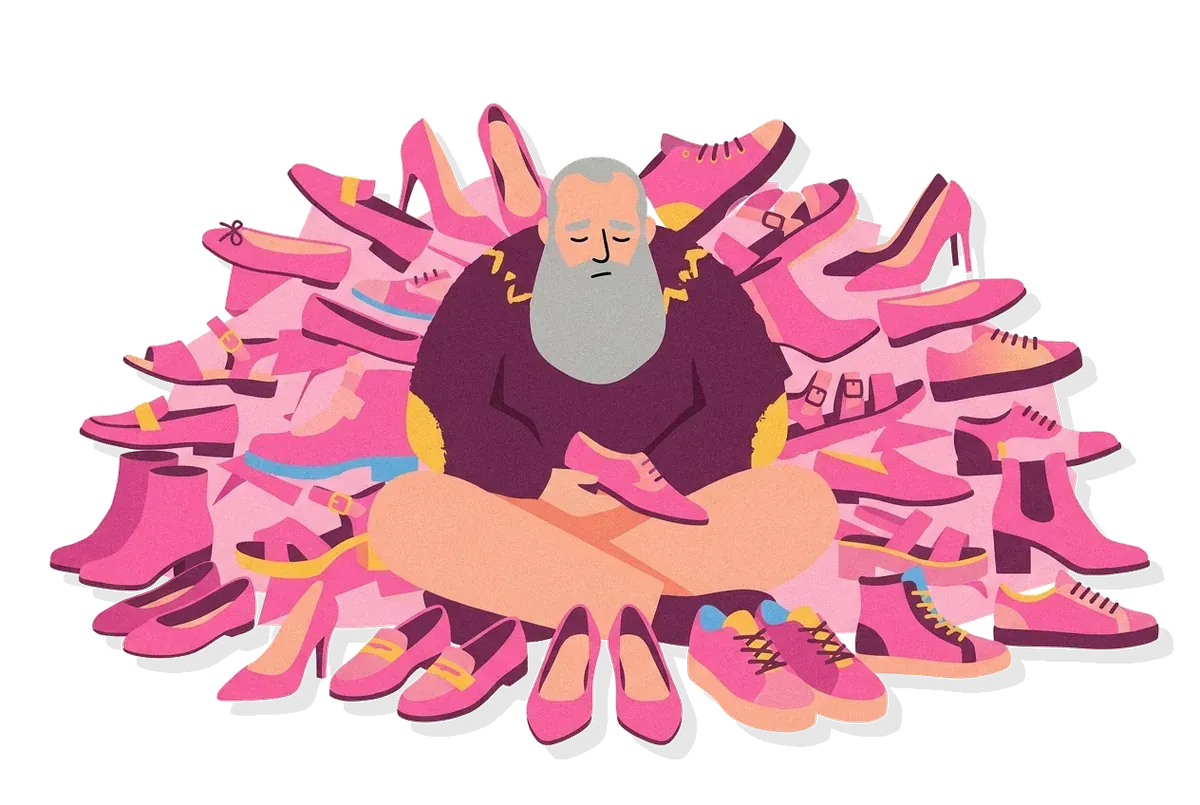
A maximizer is a person who wants the best possible option and checks the field before choosing. A satisficer picks the first option that meets a standard they set in advance. Herbert Simon described the satisficer in 1955, and later researchers built on his work to compare maximizers and satisficers. In 2002, Barry Schwartz and colleagues built a Maximization Scale and found that maximization correlated with more regret and more perfectionism, and with less happiness, optimism and life satisfaction. Regret is the pain of imagining that another choice would have been better. A maximizer has more ways to feel it, because the search never proves that nothing better exists.
The size of the comparison
Comparing options in pairs grows quickly. Five options give 10 pairs. Ten options give 45. Each added criterion multiplies the work again. This is plain arithmetic, and it explains why a sheet that started small becomes too large for anyone to hold in mind. Hick's Law describes a related effect: the time to choose rises as the number of choices rises.
Why more analysis feels useful
Gathering information feels like progress, and it cannot be blamed if the outcome is poor. A person who decides can be wrong. A person who is still researching cannot. This last point is an inference from the research above, not a measured result of one study, so treat it as a likely driver and not a proven one.
031 min
Where analysis paralysis comes from
The phrase is older than the research. The phrase "paralysis by analysis" was already in use in 1928, when the Reverend C. Leslie Glenn warned an Episcopal Church convention that college religious work risked it by being too speculative. No single originator is established.
The research behind it came later and from decision science. Herbert Simon described the satisficer in 1955, and later researchers built on his work to compare maximizers and satisficers. Simon's idea was that people with limited time and information stop searching once an option is good enough, instead of searching for the best one.
In a 2006 study by Sheena Iyengar, Rachael Wells and Barry Schwartz, final-year students with high maximizing tendencies secured jobs with 20% higher starting salaries than students with low maximizing tendencies, yet they were less satisfied with those jobs. The researchers measured maximizing tendencies in the fall of the students' final year and followed them through their job search. The result is important for this topic. Searching harder produced a better outcome and a worse feeling about it.
042 min
Examples
A real case: the job search
The Iyengar study is the clearest measured case. Maximizers got the better offers, as measured by salary. They also reported more negative feeling during the search, and they were less satisfied once they had the job. The extra analysis paid off in money and cost them in satisfaction. Analysis paralysis is the version of this pattern where the search never ends, so the payoff never arrives.
A real case: a rule for stopping
In his 2016 letter to Amazon shareholders, Jeff Bezos wrote that most decisions should be made with around 70% of the information you wish you had, and that waiting for 90% usually means being slow. That rule is a stopping rule written down by a company leader. It gives the team a number to compare against, so a missing 20% of the information stops being a reason to wait.
In the same letter he said that many decisions are reversible, which he called two-way doors, and that those decisions can use a light-weight process. The rule works by sorting decisions first. A reversible decision gets a fast process, because being wrong costs little and can be corrected.
Choosing a message queue
A staff engineer in a design review has to choose between two message queues. Both handle the expected load. The engineer asks for a third benchmark, then a fourth, each with a new traffic pattern. The first two benchmarks already showed a gap of under 5% in throughput. No further result would change the plan, because the team can swap queues behind an interface in about a week. The decision point the definition does not contain is this: ask what result would change the choice. If no result would, the analysis has stopped being useful.
| Decision | Cost to reverse | Reasonable amount of analysis |
|---|---|---|
| Pick a queue behind an interface | About a week | One or two benchmarks, then decide |
| Sign a three-year hosting contract | High | More research is justified |
| Choose a name for a draft feature | Near zero | Pick one and move on |
052 min
How analysis paralysis shows up in product, design, and AI
Analysis paralysis is almost always suffered, not exploited. Nobody designs it into a product the way a dark pattern is designed. These are the places where teams recognise it.
Product
A roadmap review keeps adding scoring criteria to a prioritisation model. Each new criterion changes the order of two or three items. The model becomes harder to explain, and the team spends the review debating weights instead of choosing what to build.
Design
A design team compares three navigation patterns in a usability test. The test shows no clear winner. Instead of picking one, the team commissions a larger test. The second test costs three weeks and, again, shows no clear winner. When two designs perform about the same, the choice is cheap in outcome terms, and the cost is the delay. See opportunity cost for why the delay is the real expense.
AI and data
An analyst comparing two model candidates adds evaluation metrics until each model wins on at least one. The team then cannot agree which metric matters. The fix is to decide, before the evaluation, which metric decides the ranking. That is the same move a satisficer makes: set the standard first, then test against it.
Engineering
A team picks a framework by building a prototype in each of four options. The prototypes take longer than the production feature would have. A reversible choice was treated as if it were permanent.
061 min
How to guard against analysis paralysis
Awareness alone is a weak guard, because the feeling that more analysis is needed is convincing from the inside. These techniques change the process instead. They are practitioner rules, and the studies above do not test them directly.
Sort the decision by how hard it is to undo.
If it is reversible, use a light process and a short deadline. This is the two-way door idea from the Amazon letter. Mechanism: it lowers the cost of being wrong, which is what drives the search.
Write the stopping rule before collecting information.
State the criteria, the minimum score that is good enough, and the date. Mechanism: this turns an open search for the best option into a test against a standard, which is how a satisficer works.
Shortlist to two or three options.
Mechanism: pairs of comparisons fall from 45 for ten options to 3 for three options.
Ask what finding would change the choice.
If nobody can name one, stop. Mechanism: it separates information that can alter the decision from information that only feels comforting.
Set a deadline that is shorter than you want.
Parkinson's Law says work expands to fill the time available. A short deadline limits that expansion.
Before gathering more, answer: what result would change my choice, and by when must I choose?
071 min
Common misunderstandings
"Analysis is the problem." It is not. Careful analysis is correct for decisions that are hard to undo. Bezos's rule separates those from reversible ones and does not tell anyone to skip research on the first kind. Guarding against analysis paralysis on a one-way decision would be a mistake.
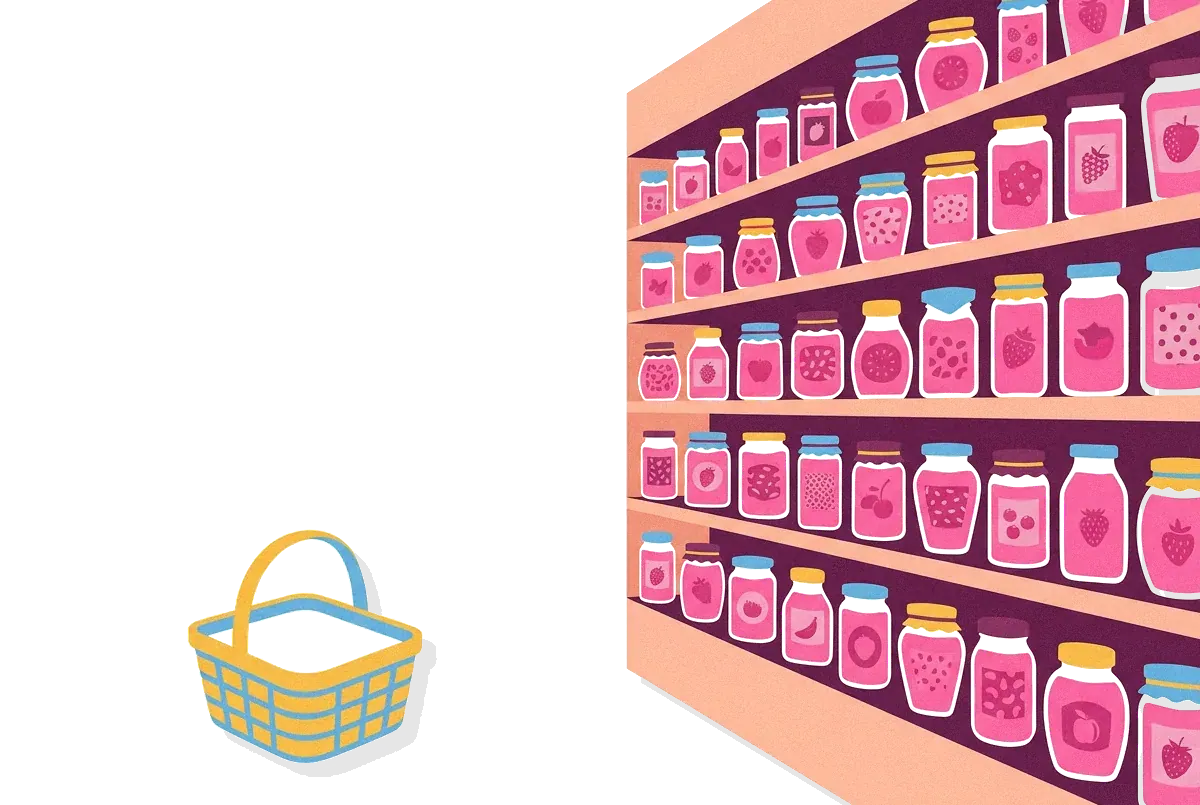
"More options always freeze people." This is the popular version, and the evidence does not support it as a general rule. In 2010, Benjamin Scheibehenne, Rainer Greifeneder and Peter Todd combined 63 conditions from 50 experiments (5,036 participants in total) and found a mean effect size of virtually zero. The authors found preconditions in which choice overload appears, but no conditions that guarantee it.
"Maximizers always do worse." In the job-search study they did better on salary. What they lost was satisfaction, not results.
"It is a character flaw." Maximizing is measured as a tendency on a scale, so people differ in degree. Conditions matter too, as the two runs of the vendor scenario show.
081 min
Analysis paralysis vs. nearby concepts
Three neighbours are often mistaken for analysis paralysis. The separating axis is what the person is doing while they fail to decide.
| Concept | What it is | How it differs |
|---|---|---|
| PsychologyChoice overload | ||
| PsychologyParadox of choice | ||
| PsychologyDecision fatigue |
Analysis paralysis is also not procrastination. A procrastinator avoids the task. A person in analysis paralysis works hard on the task, and the work does not end in a decision.
091 min
Where the evidence is contested
Analysis paralysis is a practitioner's label, not a measured construct with its own scale or effect size. The research that supports it comes from neighbouring topics, and one of them is contested.
The strongest objection comes from the choice overload literature. Choice overload is the idea that too many options lower motivation or satisfaction. The meta-analysis described above found the idea holds in some settings and not in others, which means the claim "too many options paralyse people" holds in some settings and not in others.
The same caution applies to the maximizing studies. They show correlations between a personality scale and feelings such as regret. A correlation does not show that maximizing causes a stalled decision.
What to do while this is unsettled: treat analysis paralysis as a useful description of a workplace pattern, and test the remedy on your own decisions. A stopping rule costs little to try.
?7 questions
Questions people ask
What is analysis paralysis?
What causes analysis paralysis?
How do you overcome analysis paralysis?
What is the difference between analysis paralysis and choice overload?
Is analysis paralysis a real psychological effect?
How much information is enough to decide?
Can too much analysis ever be good?
§6 sources
Sources
Show all 6 sourcesHide sources
Schwartz, B., Ward, A., Monterosso, J., Lyubomirsky, S., White, K., & Lehman, D. R. (2002). Maximizing versus satisficing: Happiness is a matter of choice. Journal of Personality and Social Psychology, 83(5), 1178-1197. Abstract page
Iyengar, S. S., Wells, R. E., & Schwartz, B. (2006). Doing better but feeling worse: Looking for the "best" job undermines satisfaction. Psychological Science, 17, 143-149. Abstract page
Tversky, A., & Shafir, E. (1992). Choice under conflict: The dynamics of deferred decision. Psychological Science, 3(6), 358-361. Abstract page
Scheibehenne, B., Greifeneder, R., & Todd, P. M. (2010). Can there ever be too many options? A meta-analytic review of choice overload. Journal of Consumer Research, 37(3), 409-425. Abstract page
Bezos, J. (2016). 2016 letter to shareholders, Amazon. Letter
Analysis paralysis, a reference summary of the phrase's history, including the 1928 use by C. Leslie Glenn. Wikipedia