011 min
Where the paradox of choice shows up
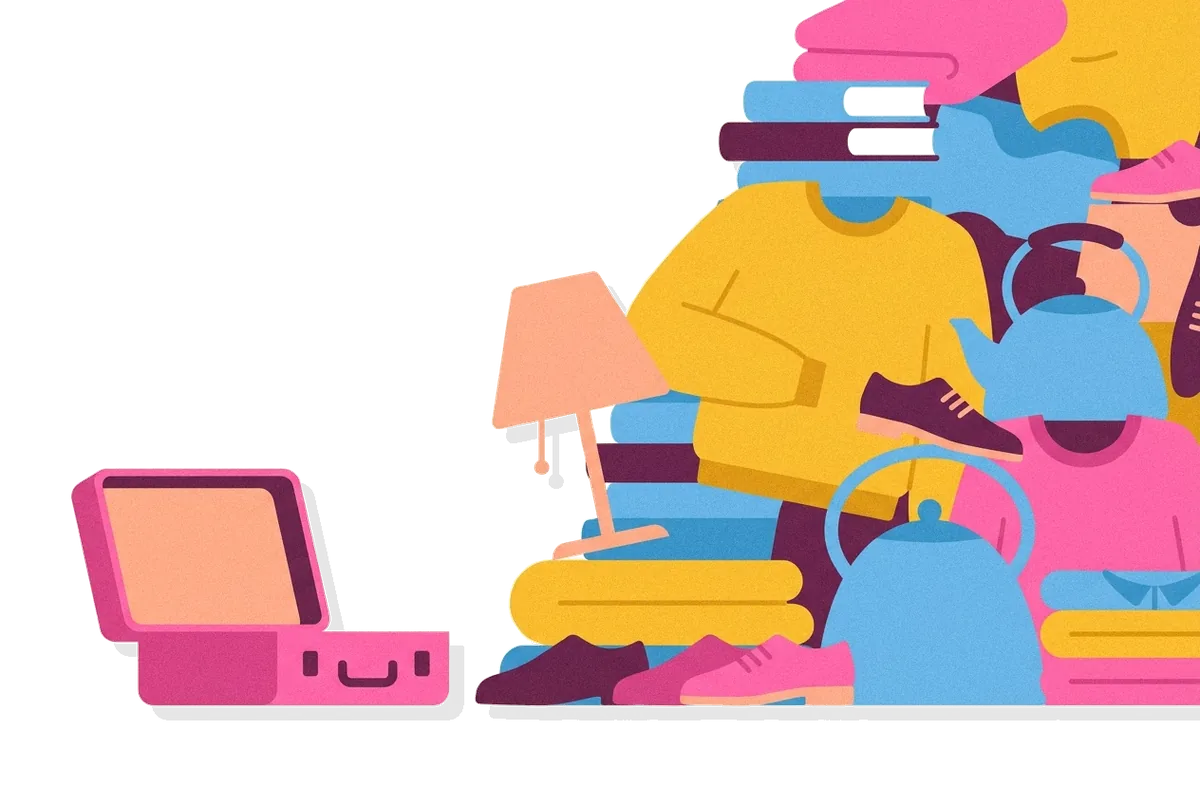
A product manager cutting a pricing page from twelve plans down to three, a designer trimming a settings screen from forty toggles to eight, an engineer deciding how many starter templates a new project wizard should offer — all three are running into the paradox of choice, whether they name it or not. The common instinct is that more options serve more users better. The paradox is that past a fairly low point, each extra option makes the page harder to act on, not easier.
The effect shows up twice, in opposite directions. Before someone chooses, a longer list looks more appealing — it seems more likely to contain "the one." After someone chooses, a longer list leaves them less satisfied with whatever they picked, because they now carry the cost of imagining every option they turned down. A subscription page with three tiers gets picked quickly and confidently. The same page with eleven tiers gets abandoned, or picked slowly and second-guessed. Choice overload names the general problem of too many options; the paradox of choice is the specific, measured gap between how attractive more choice looks in advance and how satisfying it feels afterward.
022 min
Why more choice backfires
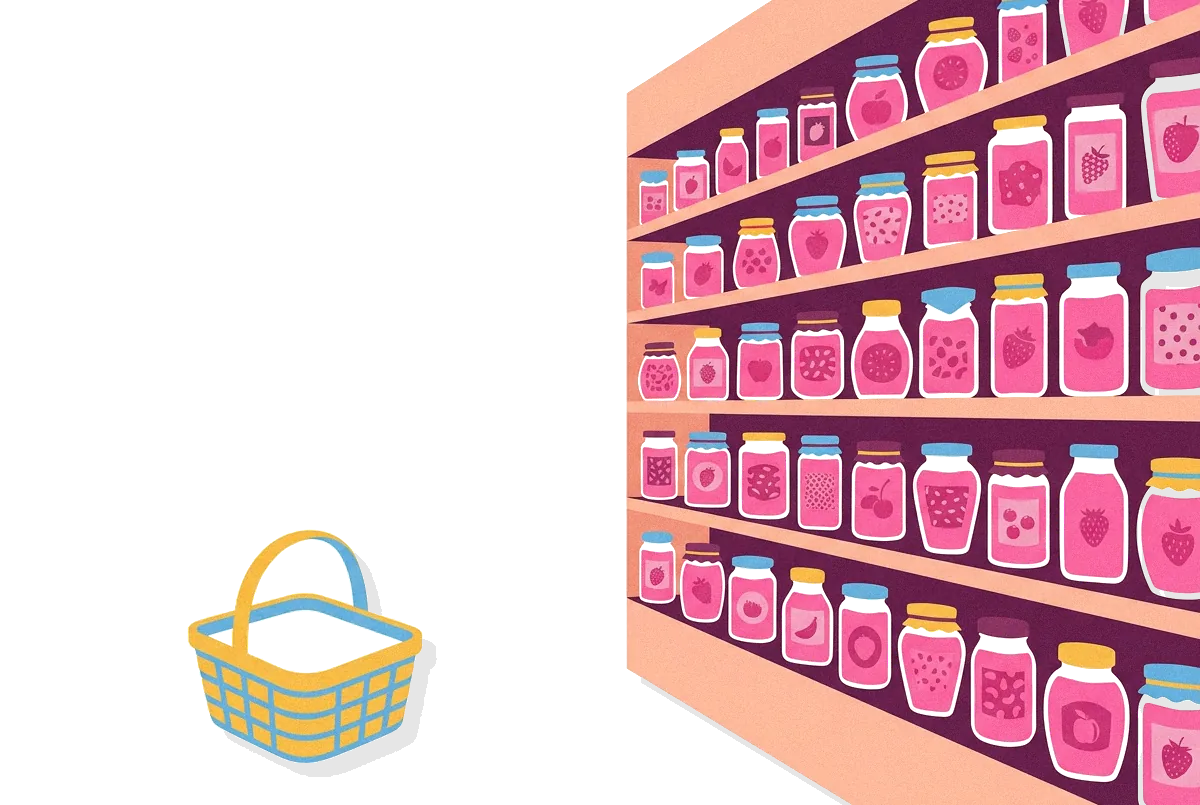
Three things drive the gap. The first is decision effort: comparing twenty-four items on several dimensions takes real cognitive work, and the effort itself is unpleasant enough that some people just stop rather than finish. The second is opportunity cost. Economist Herbert Simon's distinction between satisficing — picking the first option that clears a "good enough" bar — and maximizing — searching for the single best option — explains why the effect hits maximizers hardest. A maximizer facing twenty-four jams has to mentally weigh twenty-three rejected jars against the one purchased, and each rejected jar is a small, nagging cost that a shopper picking from six jars never has to pay.
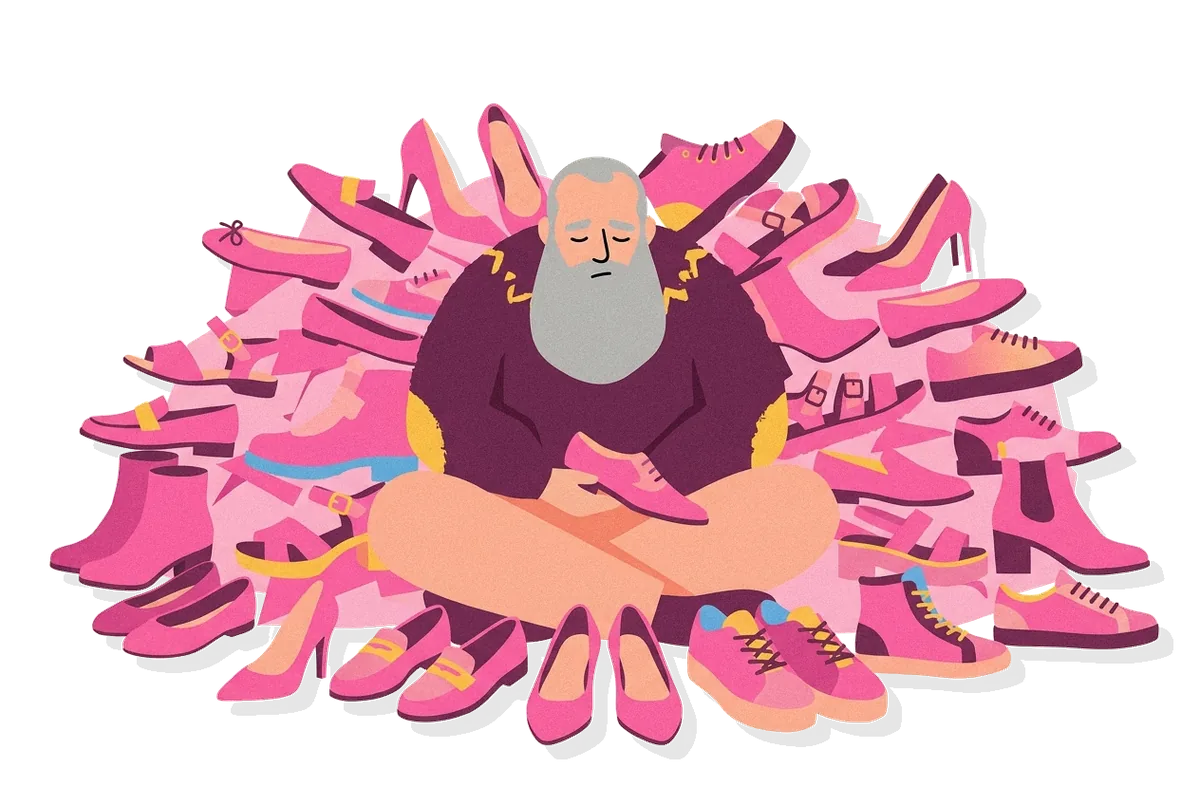
The third is regret. Once a choice is made, an unchosen option does not disappear from memory; it becomes a counterfactual the chooser can compare their real outcome against. Adding more options adds more counterfactuals, and more counterfactuals make an ordinary, adequate outcome feel worse than it would have felt on its own. This is why the paradox of choice produces a specific, counterintuitive split: initial attraction to a large selection goes up, while satisfaction with whatever gets chosen from it goes down. A page can win the click and lose the sale in the same interaction.
None of this means every additional option costs something. The effect depends on the options being comparable enough to require real trade-off reasoning — six genuinely different jam flavors force a decision in a way that six shades of the same white paint mostly do not.
The satisficing-versus-maximizing split also explains why two people can look at the same 24-item menu and come away with opposite experiences. A satisficer scans until something clears their bar, stops, and rarely revisits the decision. A maximizer keeps comparing after finding something good enough, chasing the guarantee that nothing better was left on the table — a guarantee a large assortment can never actually give, since the search cost of checking every remaining option usually exceeds whatever a slightly better jam would be worth. The term satisficing was introduced by Herbert A. Simon in 1956 to describe how real decision-makers, with limited time and information, choose adequately rather than optimally; the paradox of choice is in large part a story about what happens when an environment pushes people toward maximizing without giving them the time or information to do it well.
032 min
The jam study
The clearest evidence comes from a 2000 field experiment by psychologists Sheena Iyengar and Mark Lepper, run at Draeger's, an upscale supermarket in Menlo Park, California that stocked around 300 varieties of jam. Iyengar and Lepper set up a tasting booth that alternated, hour by hour across two Saturdays, between a limited display of 6 jams and an extensive display of 24 jams, and tracked both how many shoppers stopped to taste and how many later bought a jar.
The extensive display won the first contest by a wide margin: 60% of shoppers who passed it stopped to taste, against 40% for the limited display — more choice was more attractive. But the result flipped completely at the register. Nearly 30% of the shoppers who had tasted from the limited, 6-jam display went on to buy a jar, while only 3% of the shoppers who had tasted from the extensive, 24-jam display did. A shopper who saw 6 jams was roughly ten times more likely to leave with one than a shopper who saw 24.
Nearly 30% (31) of the consumers in the limited-choice condition subsequently purchased a jar of Wilkin & Sons jam; in contrast, only 3% (4) of the consumers in the extensive-choice condition did so.
Iyengar and Lepper ran the same pattern again with gourmet chocolates and with an optional class essay assignment offering either 6 or 30 topics, and found the same shape both times: the larger set drew more initial interest and produced less follow-through. The jam result is the one that stuck, and it is the study almost every later paper on choice overload cites as the starting point.
042 min
Where the term comes from
The Paradox of Choice – Why More Is Less is a book about overchoice written by American psychologist Barry Schwartz and first published in 2004 by Harper Perennial. Schwartz made the case again in a widely watched TED talk. His argument goes past any single study: he points to his own supermarket, which stocked 175 salad dressings — not counting the extra-virgin olive oils and balsamic vinegars a shopper could combine into a private-label dressing if none of the 175 fit — and a consumer-electronics store where the stereo components on the shelf could be combined into roughly six and a half million different systems. In his TED talk, Schwartz cites a colleague's finding that for every 10 mutual funds a retirement plan offered, participation dropped by two percent — a workplace with 50 fund options saw about 10% fewer employees enroll than a workplace offering only five, because the difficulty of deciding which fund to pick led people to put the decision off indefinitely.
Schwartz's central claim is about expectations, not just effort. When failure was expected, a disappointing outcome felt normal. When a person believes the right choice was always findable among hundreds of options, an ordinary, adequate outcome instead reads as a personal failure — theirs, for not searching hard enough. He argues this dynamic is a meaningful contributor, though not the only one, to the rise of clinical depression across industrialized countries over the past few decades, because disappointing outcomes get explained as the chooser's own fault rather than as ordinary bad luck. That claim is Schwartz's own interpretation rather than a measured statistic, and it is worth reading as an argument to evaluate rather than a settled finding.
052 min
Designing around the paradox of choice
For a designer, the practical move is not "always offer fewer options" — it is to separate browsing from deciding. A catalog can carry hundreds of items as long as the decision moment itself — the comparison table, the plan picker, the settings panel someone has to act on right now — is narrowed to a small number of genuinely different choices. Netflix's rows of dozens of titles work because the actual decision is one click; a checkout flow asking someone to pick from twenty shipping options does not have that luxury.
For a product manager scoping a pricing page, the paradox of choice is a direct argument for curated tiers over an à la carte matrix of toggles, and for a recommended default that lets a hesitant user skip the comparison entirely. Picture the same signup page twice. In the first version, a visitor sees nine pricing plans laid out as a flat grid with no plan marked as typical; support tickets about billing confusion run high, and a large share of visitors leave the page without picking any plan at all. In the second version, the same nine plans are grouped into three named tiers with one marked "Most popular," and the eighteen underlying toggles are hidden behind an "advanced settings" link. Nothing about what the product can do has changed — only how many decisions the visitor has to make before they can act.
For an engineer building a settings or onboarding flow, the same logic argues for progressive disclosure — showing the two or three choices that matter right now and hiding the rest behind an "advanced" affordance — over one long form that asks for every decision at once.
When [a returning user] wants to [get back to what they were doing], they want [one obvious default option], so they can [act immediately instead of comparing alternatives].
The same logic applies to internal choices, not just user-facing ones: a team deciding between three well-differentiated design directions will usually ship faster and be more confident in the result than a team debating twelve near-identical variations.
062 min
When the paradox of choice does not apply
The effect is real but smaller and less universal than its popular retelling suggests, and treating it as an iron law is itself a mistake. A 2010 meta-analysis by Benjamin Scheibehenne, Rainer Greifeneder, and Peter Todd pooled 50 experiments on choice overload, covering 5,036 participants, and found that the average effect size across all of them was close to zero.
A number of studies in the past found strong instances of choice overload based on experiments in laboratories and in the field. While these results attracted a lot of attention in academia as well as in the media, a number of experiments found no empirical evidence for choice overload and sometimes even found that more choices instead facilitate choice and increase satisfaction.
The meta-analysis identified conditions under which overload is more likely: when the options are hard to compare, when the chooser has no clear prior preference, and when no option obviously dominates the others on the criteria that matter. Remove any of those — give people a strong existing preference, or make one option clearly best — and a large assortment stops hurting and can even help, because it raises the odds that the shopper's preferred item is on the shelf at all. The practical reading is not "cut every list to six." It is: cut a list when the items are genuinely hard to tell apart and nothing points the chooser toward a default; leave it alone when one item is the obvious right answer or the chooser already knows what they want.
072 min
Paradox of choice vs. nearby concepts
Choice overload is the broader phenomenon — that too many options can reduce satisfaction, engagement, or purchase likelihood. The paradox of choice is Barry Schwartz's specific framing of that phenomenon, developed in his 2004 book of the same name, built around the claim that a modern abundance of options raises expectations faster than it raises outcomes, so people end up feeling worse even as their objective options improve. Choice overload is the effect; the paradox of choice is one influential theory of why it happens and what it costs psychologically.
Analysis paralysis is the behavioral symptom that sometimes follows: getting stuck comparing options and failing to decide at all. The paradox of choice can produce analysis paralysis, but the two are not the same thing — a chooser can experience the paradox of choice's post-decision regret without ever having been paralyzed beforehand, and a chooser can freeze up over just two options for reasons that have nothing to do with the size of the set.
Hick's law measures a related but distinct quantity: the time it takes to make a choice, which grows with the number of options in a fairly predictable, logarithmic way. Hick's law is about decision speed; the paradox of choice is about decision satisfaction and follow-through after the decision is already made. A page can score badly on one and fine on the other.
That last distinction matters in practice. A menu with 30 items and one clearly best option can score fine on the paradox of choice — satisfaction stays high because there is no real ambiguity to regret — while still scoring badly on Hick's law, because a shopper still has to read all 30 lines before finding it. The fix for a Hick's-law problem is a faster path to the same option, such as search, filters, or sorting. The fix for a paradox-of-choice problem is removing or hiding options that were never going to be chosen, so the remaining comparison is between real, meaningfully different alternatives rather than clutter.
?5 questions
Questions people ask
What is the paradox of choice in simple terms?
Who came up with the paradox of choice?
What is the jam study?
Is the paradox of choice always true?
How do you avoid the paradox of choice in product design?
▶3 videos
Watch
Understanding Paradox of Choice
The Paradox of Choice: Why More Is Less 📖 Summary
One Percent Better
Apple vs The Paradox of Choice!
Marques Brownlee
§5 sources
Sources and further reading
Iyengar, S. S., & Lepper, M. R. (2000). "When Choice is Demotivating: Can One Desire Too Much of a Good Thing?" Journal of Personality and Social Psychology, 79(6), 995–1006. Archived original PDF (via the Wayback Machine; DOI: 10.1037/0022-3514.79.6.995).
Schwartz, B. "The Paradox of Choice" (2005 TED talk). Transcript reposted by LiveJournal user med_cat. Transcript.
"Too many choices? New study says more is usually better." ScienceDaily (2010), reporting Scheibehenne, B., Greifeneder, R., & Todd, P. M. (2010), "Can There Ever Be Too Many Options? A Meta-Analytic Review of Choice Overload," Journal of Consumer Research, 37(3), 409–425. Article.
Satisficing — Wikipedia, for Herbert Simon's 1956 origin of the satisficing/maximizing distinction.
Show all 5 sourcesShow fewer sources
The Paradox of Choice — Wikipedia, for publication details of Schwartz's 2004 book.