011 min
Key takeaways
- What it is: the presence of other people makes any one bystander less likely to help
- Origin: Darley and Latané, 1968, prompted by the murder of Kitty Genovese
- Where it bites: shared alerts, group chats, and public emergencies many people can see at once
- Guard against it: name one specific person and ask them directly, instead of the group
021 min
Where the Bystander Effect shows up
A designer notices a broken checkout flow during a live product demo, in a room with a dozen colleagues watching the same screen. They assume someone closer to the code will flag it, so they say nothing — and so does everyone else who had the same thought. The meeting ends with the bug unreported.
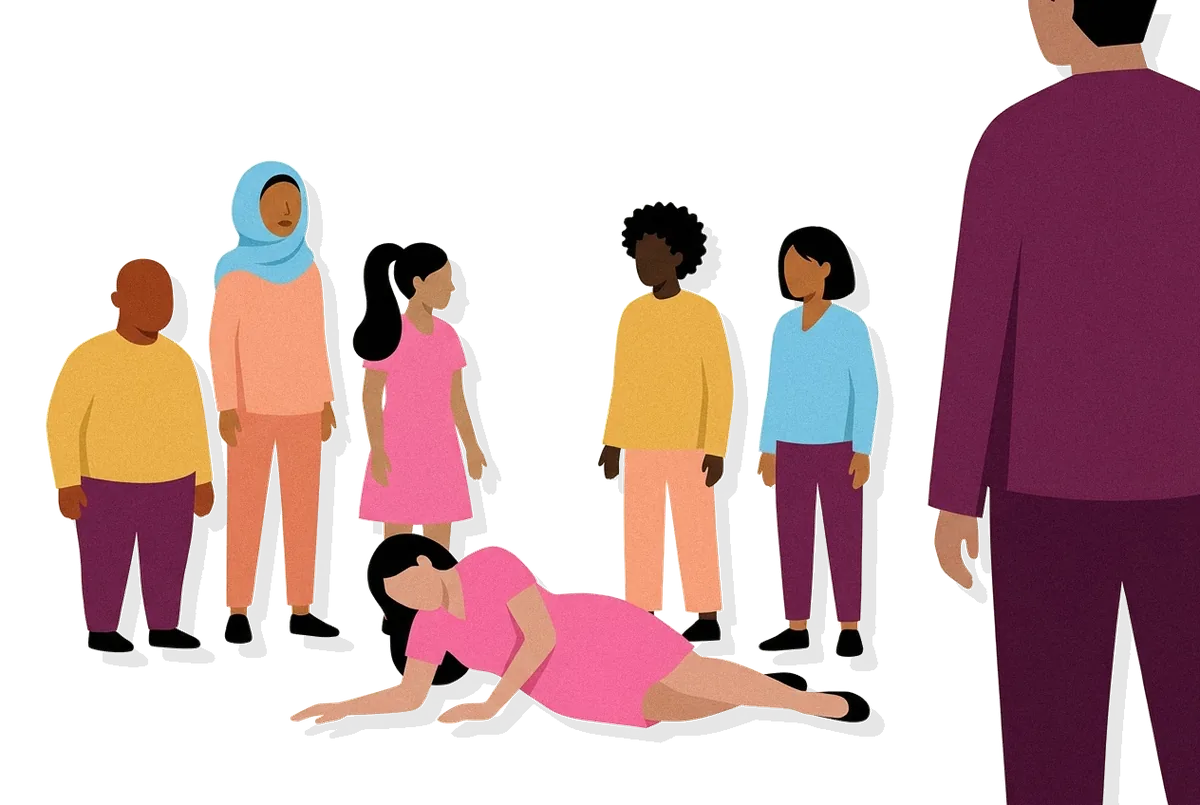
This is the bystander effect: a person who would act instantly if they were alone becomes passive once other people share the same view of the problem. The effect does not require the group to be uncaring. Each person privately notices the problem and privately assumes somebody else, probably someone more qualified or more responsible, will raise it. Run the same meeting with one person in the room instead of a dozen, and the bug gets reported within seconds. The information reaching the room has not changed; only the number of other people who received it at the same time has.
032 min
Why the Bystander Effect happens
Two mechanisms combine to produce the effect. The first is diffusion of responsibility: when several people share the same information about an emergency, each person's sense of personal obligation to act shrinks, because the duty to help feels divided among everyone present rather than resting on one person. Darley and Latané explained the drop as diffusion of responsibility: when other people are believed to be present, each person assumes someone else will act, so responsibility for helping is spread thin enough that no one feels it is squarely theirs.
The second mechanism is pluralistic ignorance. A bystander reads the calm reactions of everyone else as social proof that nothing is actually wrong, and because every other bystander is doing the same thing, the group collectively reads a real crisis as normal. A room full of people not reacting looks like evidence that nothing is wrong, even though every individual in it might be privately alarmed.
The effect is not fixed. A 2011 meta-analysis by Fischer and colleagues, pooling more than 7,000 participants across decades of studies, found the bystander effect was strongest in situations that looked ambiguous or non-dangerous and weakened or disappeared in emergencies that were clearly dangerous. Once a situation is unambiguous — a fire, a visibly bleeding injury — the pluralistic-ignorance half of the mechanism has nothing left to distort, because nobody needs the group's reaction to know that help is needed. Diffusion of responsibility can still slow the response even then, but it no longer suppresses it outright.
041 min
Where the Bystander Effect comes from
John Darley and Bibb Latané designed their first test after the news coverage of Kitty Genovese's murder, to isolate whether the number of witnesses itself changes behaviour. In their 1968 experiment, 72 university students each believed they were having a discussion over an intercom with one, two, or five other students about problems of student life. One participant, a confederate of the researchers, staged a seizure partway through and called for help. Each real participant could not see or hear the others, only speak into the intercom, so the only variable that changed between conditions was how many other people they believed were listening. In Darley and Latané's original experiment, 85% of people reported the emergency when they believed they were the only listener, but only 31% did when they believed four other people could also hear it. The finding has since been replicated across dozens of studies.
051 min
Individual effects
For one person, the bystander effect changes a single decision: whether to be the one who intervenes right now. The direction of the error is always the same, toward waiting, checking, or assuming the situation is already handled, when acting sooner would have helped more. An engineer who notices a production alert firing in a shared channel with a dozen other engineers online may assume someone with better context is already investigating, and say nothing for the ten minutes it takes for someone else to notice the alert is still unacknowledged. The cost is time: the outage runs longer, or in Darley and Latané's seizure study, the response that took a median of under a minute when the participant was alone took close to three times as long once the participant believed four other people were listening too. The person is not indifferent. They are waiting for a signal that never comes, because everyone else is waiting for the same signal.
061 min
Systemic effects
Across a team, the same mechanism compounds through process rather than through one missed moment. When an incident-response channel pages twenty engineers instead of routing to a single on-call owner, the page becomes information everyone has and no one owns. In many organisations, average time-to-acknowledgment gets worse, not better, as the number of people paged grows — the same pattern Darley and Latané found with an intercom, reproduced by a paging system instead. Nobody on the page decides the incident does not matter; each person reads the others' inaction as a signal that someone with more context must already be on it, and the group collectively waits longer than any one of them would have alone.
071 min
Examples
In a 2011 hit-and-run in Foshan, China, more than a dozen people walked or cycled past two-year-old Wang Yue as she lay bleeding in the road, over the seven minutes between the first vehicle striking her and a second truck running over her again. A security camera recorded the entire sequence, and the footage, once broadcast, triggered a national debate in China over why so many individual people, none of whom knew any of the others, all made the same choice to keep walking. No single passerby decided the child did not deserve help. Each one appears to have read the others' inaction as information that the situation must not be as serious as it looked, exactly the pluralistic-ignorance pattern the laboratory studies describe.
An illustrative case shows the same pattern at a smaller scale: a support engineer sees a customer's server returning errors in a monitoring channel that pages an entire on-call rotation rather than one named owner. They assume whoever is officially on call this week is already looking at it, so they keep scrolling. Everyone else on the rotation does the same. The alert sits unacknowledged for twenty minutes, not because anyone decided it was unimportant, but because nobody was the only person who saw it.
081 min
How the Bystander Effect shows up in product, design, and engineering
Meta's own engineering research states that the bystander effect occurs when a task is assigned to a group of people and leads to a lower likelihood of any individual acting than when an individual is explicitly assigned to a task. Meta observed this directly in code review: when a pull request is assigned to an entire team rather than one named reviewer, each team member can assume a teammate will pick it up, and the review sits longer than one sent to a single person. The fix Meta and similar engineering organisations use is the same one the lab studies point to — route the request to one accountable name, not a group.
Designers see a milder version of the same thing in usability testing: when several observers watch the same session behind the glass, each one is less likely to be the one who flags a confusing screen, assuming a more senior observer already caught it. And in AI evaluation, a shared queue of model outputs waiting for human review from any of several labellers is reliably slower to clear than the same queue split into individually owned batches, for the identical reason a diffused emergency is slower to get help.
091 min
How to guard against the Bystander Effect
The technique with the most direct evidence behind it is also the simplest: assign the task to one named person rather than a group, and say their name out loud. Darley and Latané's own follow-up work found that singling out a specific bystander collapses the diffusion effect almost entirely, because there is no longer anyone else to defer to. In practice this means naming an on-call owner instead of paging a channel, tagging one reviewer instead of a team, and in an emergency, pointing at one bystander directly and giving them an instruction ("you, call an ambulance") rather than shouting to the crowd.
A second technique is to remove the ambiguity that pluralistic ignorance feeds on: stating plainly that a situation is a real emergency, or that a bug is confirmed and needs a fix now, denies the group the excuse of reading each other's calm as evidence that nothing is wrong. Awareness of the effect alone does very little; knowing the theory does not make a person more likely to act when they are one of a crowd, so the fix has to change who is responsible, not just what people know.
101 min
Common misunderstandings
The 1964 murder of Kitty Genovese, reported at the time as watched by 38 witnesses who did nothing, became the case study that launched bystander research, but a 2007 re-investigation by Manning, Levine and Collins found no evidence for the presence of 38 witnesses, or that witnesses observed the murder, or that witnesses remained inactive. Some neighbours did hear parts of the attack, at least one called the police, and none had the full, unobstructed view of the crime that the original account implied. The New York Times itself acknowledged decades later that its own reporting had exaggerated the story.
The popular version of the bystander effect treats it as proof that people in cities, or people in general, have become callous. That is a fundamental attribution error: explaining someone's inaction by their character rather than by the situation, when the laboratory evidence points the other way. The 85% helping rate when Darley and Latané's participants believed they were alone shows the same people who fail to act in a crowd will usually act without hesitation once the diffusion is removed.
111 min
Bystander Effect vs. nearby concepts
| Concept | What it names | How it differs |
|---|---|---|
| Bystander Effect | The drop in individual helping caused specifically by the presence of other people | The mechanism, tied to group size |
| Bystander Apathy | The popular label for a bystander's apparent indifference | Describes the visible outcome, not the cause; often used loosely to mean the bystander effect itself |
| Diffusion of Responsibility | One of the two mechanisms behind the bystander effect | A cause, not the effect — pluralistic ignorance is the other cause |
| Groupthink | A group converging on a bad decision because dissent is suppressed | Involves active discussion and consensus-seeking; the bystander effect involves no discussion at all |
The distinction that matters most: Bystander Apathy describes what an inactive crowd looks like from the outside, while the bystander effect names the specific, testable reason it happens.
?6 questions