011 min
Where theory of mind shows up
Picture a backend engineer who has spent two weeks fixing a bug in a payment system. On Friday they write the release note.
Fixed key collision in the payment retry handler.
A customer support agent reads it and cannot tell what to say to a customer who was charged twice. The note is accurate. It is also written for a reader who already knows what the engineer knows.
Now run the same scene again with one change. Before writing, the engineer asks what the support agent knows. The agent knows how customers describe the problem, but not how the code works. The new note says that customers who tapped Pay twice on a slow connection were charged twice, that this is fixed, and that anyone charged twice before the fix can ask for a refund. The agent can now act.
Both notes describe the same fix. The difference was a guess about another person's knowledge. Not imagining what a reader lacks is known as the curse of knowledge. The ability to make the guess in the first place is what psychologists call theory of mind, and they have measured it in children, adults, animals and machines.
021 min
Where theory of mind comes from
The term comes from a question about animals. In 1978 David Premack and Guy Woodruff asked whether a chimpanzee can work out what a person is trying to do. They said an individual has a theory of mind if it attributes mental states to itself and to others. They called it a theory because mental states cannot be seen directly, and because guesses about them can be used to predict what others will do.
Their evidence came from a chimpanzee named Sarah. She watched videos of a person facing a problem, such as bananas out of reach, a person who was locked in, or a heater that did not work. Then she was shown photographs. She kept choosing the photograph that showed a solution, such as a stick, a key or a lit wick. Premack and Woodruff read this as a sign that Sarah understood what the person wanted.
A weakness in the design is easy to see. Sarah may have matched each problem to a familiar solution without any idea of what the person wanted. A cleaner test needs a case where what the subject knows and what the other individual believes are different. That is the idea behind the false-belief task.
031 min
The false-belief task
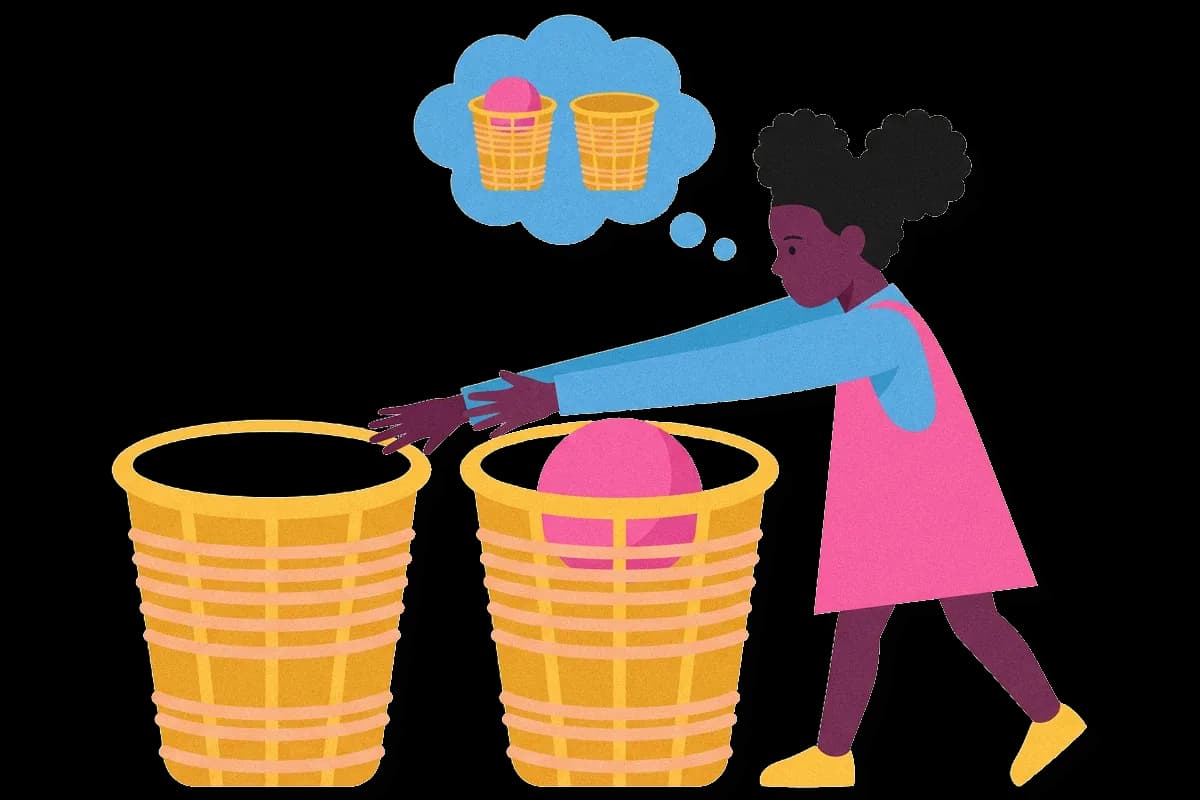
The false-belief task builds a case where what is true and what a person believes come apart. A belief that does not match the facts is called a false belief. In 1983 Heinz Wimmer and Josef Perner built their test around two puppets. In the best-known telling, a boy puppet named Maxi puts a chocolate in a blue cupboard and goes out to play. While Maxi is away, his mother moves the chocolate to a green cupboard. The child watching is asked where Maxi will look when he comes back.
The child knows the chocolate is in the green cupboard. The correct answer is the blue one, because that is where Maxi left it and where he believes it still is. Course notes that describe the study report that children aged three or younger answered wrongly and expected Maxi to search in the green cupboard, where they knew the chocolate was. The same notes say that children aged six or more were quite successful.
Typically developing children begin to pass this kind of task at about age four, while children with autism may fail it, as Baron-Cohen, Leslie and Frith reported in 1985. That finding made the false-belief task the standard measure of theory of mind, a status that has since been questioned.
041 min
How theory of mind works
Passing the task means keeping two things in mind at once: where the chocolate really is, and where Maxi believes it is. A belief about another person's belief is called a metarepresentation. Adults build these in a moment and rarely notice the effort.
Three kinds of input feed the guess. The first is knowledge of the shared situation, such as what both people can see. The second is social cues, such as gaze, tone of voice and facial expression. The third is the meaning of what the person does. From these, a person forms a view of what the other knows and wants, and predicts what they will do next.
Two accounts of how the guess is made
Researchers disagree about how the guess is made. Theory-theory says that people hold a set of everyday rules about minds and apply them to each case. Simulation theory says that people use their own thinking as a model of another person's: they imagine themselves in the other person's position and see what they would conclude. Each name covers a family of accounts, and neither has won.
Beliefs about beliefs
Beliefs can nest. A product manager who thinks that the designer believes the spec is final holds a second-order belief. Children usually manage this nested version some years after the basic one.
051 min
How theory of mind develops
Children do not arrive with the skill fully formed. In the first year, babies begin to follow where an adult looks. Around their first birthday they start to point in order to share attention. Toddlers also begin to pretend, which needs the idea that a thing can be treated as something it is not. These early steps come before the shift on false-belief tasks at about age four, and nested beliefs come later.
Do infants already have it?
Researchers also study babies with looking-time tasks. An infant watches an actor who holds a false belief, and the researcher measures how long the infant looks at each outcome. A longer look at the unexpected outcome has been read as a sign that babies already track beliefs. That reading is contested. A 2018 commentary by a group of infant researchers said the area may be among the most debated in developmental science, because of a replication crisis that was just beginning.
061 min
How adults use theory of mind, and when they do not
Passing a false-belief task at age four does not guarantee that the skill is used well later. Adults know that other people see and know different things, yet they often fail to use that knowledge while a conversation is going on.
The candle experiment
In 2000 Boaz Keysar and colleagues tested this with a game. A person called the director gave instructions to a listener, who moved objects on a set of shelves. The common ground of the game was the set of objects both people could see. The listener could see all three candles, but the director could see only two, because the smallest candle was hidden from the director. When the director asked for the small candle, they meant the smaller of the two candles they could see. Eye tracking showed that listeners did not limit their search for what the speaker meant to objects that both people knew about.
The shortcut behind the errors
Keysar's team called the cause an egocentric heuristic, which means reading an instruction first from your own point of view. The team argued that this usually reduces doubt about what a speaker means, but it can lead to a systematic error. A systematic error is one that repeats in the same direction every time the two points of view differ.
071 min
How theory of mind shows up in product work
The shortcut explains the first release note. The engineer read their own note with their own knowledge in mind, and to them it made sense. Teams make the same error in specs, onboarding screens and error messages. The cost is a reader who cannot act, or a user who stops using the product.
Designers face a parallel problem with users. What a user believes about how a product works is a mental model, and it can differ from what the team believes. A designer who watches users fail at the same step sees the gap directly.
Two checks help. First, name the reader and write down three things that reader does not yet know. Second, ask someone outside the team to say in their own words what the message means before it goes out. If they cannot, the message failed, whatever the author felt when rereading it. Both checks replace a guess about the reader with evidence from the reader. The research on adults above does not show that knowing about the shortcut removes it, so the checks do not depend on awareness.
082 min
Theory of mind in AI systems
Language models are now tested with the same tasks used with children. The results are easy to over-read, so the details matter.
Language models on false-belief tasks
In a study published in 2024, Michal Kosinski gave eleven language models a set of 40 false-belief tasks. Each task had a false-belief scenario, three matched scenarios where the belief was true, and a reversed version of all four. The matched versions test whether a model answers the same way whatever the story says.
The scoring rule
A task counted as solved only when the model answered all 16 prompts across the eight scenarios correctly. This strict rule matters, because a model that guesses well on single prompts still fails the task.
The result
ChatGPT-4 solved 75% of the tasks, while two earlier GPT models solved 20%. The paper compared the 75% with the scores of six-year-old children in earlier studies.
People and models on one battery
In 2024 James Strachan and colleagues compared people and language models on a battery of tests covering false beliefs, indirect requests, irony and faux pas. A faux pas is a remark that hurts someone because the speaker did not know something they needed to know.
A lead that did not hold
LLaMA2, an openly released model, scored above people on the faux pas test, but follow-up tests showed that lead was illusory, possibly because the model leans toward assuming a character did not know something. A score on one test can hide the reason behind it.
Small changes, different answers
In 2023 Tomer Ullman showed that small changes to a task, ones that keep its logic the same, reversed the results of what had looked like a success.
What a passing score does not show
A model that passes a benchmark has not shown that it holds beliefs about beliefs. Ullman argued that the starting assumption should be skeptical, and that failure cases should count for more than average success rates. For a team that builds an assistant, the practical step is to test altered versions of each scenario, not only the textbook one.
091 min
Theory of mind and autism
The 1985 result led to a hypothesis that autism involves a difficulty in understanding other minds. This idea shaped decades of research. It has also been challenged. The double empathy problem says that the difficulty sits between two people who understand the world in different ways, not inside one of them.
A test of the idea
In 2020 Catherine Crompton and colleagues ran an experiment in which a story was passed along chains of people, and they measured how much detail survived at each step. Mixed chains of autistic and non-autistic people lost detail faster than chains made up of one group. If the difficulty sat inside autistic people alone, chains made only of autistic people should have done poorly. They did not.
How far the result goes
One experiment does not settle the question. It used a story-retelling task in a lab, and it measures how much information passes along a chain, not how well anyone reads a mind. The finding does show that where a difficulty appears can depend on who is talking to whom. That matters for any team that mixes people with different ways of communicating.
101 min
Where the evidence is contested
The false-belief task has a critic with a clear case. Paul Bloom and Tim German argued in 2000 that passing the false-belief task takes skills besides theory of mind, and that theory of mind does not require reasoning about false beliefs. If they are right, a child who fails the task may still understand minds in other ways, and a child who passes has shown one skill, not the whole ability.
The same question follows infant looking-time studies and tests of language models: what does a score stand for? For practitioners, the safer course is to treat any single task as one view. Several different tasks give a better picture than any one.
111 min
Theory of mind vs. nearby concepts
Theory of mind is an ability. The concepts below describe feelings, errors or biases that sit next to it.
| Concept | What it is | How it differs from theory of mind |
|---|---|---|
| PsychologyEmpathy | ||
| PsychologyCurse of knowledge | ||
| PsychologyFalse consensus | ||
| PsychologyThe mind-reading fallacy |
The line between them is simple. Theory of mind is the capacity to model another mind. Empathy is a different capacity, and the other three describe ways the first one is misused.
?4 questions
Questions people ask
At what age do children develop theory of mind?
Do animals have theory of mind?
How is theory of mind tested in adults?
Is theory of mind the same as telepathy?
§12 sources
Sources and further reading
Show all 12 sourcesHide sources
Premack, D., & Woodruff, G. (1978). Does the chimpanzee have a theory of mind? Behavioral and Brain Sciences, 1(4), 515-526.
Wimmer, H., & Perner, J. (1983). Beliefs about beliefs: Representation and constraining function of wrong beliefs in young children's understanding of deception. Cognition, 13(1), 103-128. (83)90004-5
Course notes describing the Wimmer and Perner (1983) Maxi study.
Baron-Cohen, S., Leslie, A. M., & Frith, U. (1985). Does the autistic child have a "theory of mind"? Cognition, 21(1), 37-46. (85)90022-8
Byom, L. J., & Mutlu, B. (2013). Theory of mind: Mechanisms, methods, and new directions. Frontiers in Human Neuroscience, 7, 413.
Poulin-Dubois, D., Rakoczy, H., et al. (2018). Do infants understand false beliefs? We don't know yet: A commentary on Baillargeon, Buttelmann and Southgate's commentary. Cognitive Development, 48, 302-315.
Keysar, B., Barr, D. J., Balin, J. A., & Brauner, J. S. (2000). Taking perspective in conversation: The role of mutual knowledge in comprehension. Psychological Science, 11(1), 32-38.
Kosinski, M. (2024). Evaluating large language models in theory of mind tasks. Proceedings of the National Academy of Sciences.
Strachan, J. W. A., Albergo, D., Borghini, G., et al. (2024). Testing theory of mind in large language models and humans. Nature Human Behaviour.
Ullman, T. (2023). Large language models fail on trivial alterations to theory-of-mind tasks. arXiv preprint.
Crompton, C. J., Ropar, D., Evans-Williams, C. V., Flynn, E. G., & Fletcher-Watson, S. (2020). Autistic peer-to-peer information transfer is highly effective. Autism, 24(7), 1704-1712.
Bloom, P., & German, T. P. (2000). Two reasons to abandon the false belief task as a test of theory of mind. Cognition, 77(1), B25-B31.