011 min
Why consumer psychology starts with shoppers who cannot say why
A study published in 1977 by the psychologists Richard Nisbett and Timothy Wilson shows the difficulty well. They invited passersby in shops, under the cover of a consumer survey, to judge four pairs of nylon stockings. The four pairs were identical. The shoppers still did not choose evenly. The pair on the right was picked almost four times as often as the pair on the left.
The researchers then asked the shoppers why they had chosen as they did. No shopper mentioned where the pair had been placed on the table.
That gap is the starting point of the field. What moves a choice and what a buyer can report about it are not always the same thing. A survey that asks people for their reasons collects explanations. It does not always collect causes. Consumer psychology looks for the causes in other ways, mostly by watching what people do when one thing changes.
022 min
What consumer psychology covers
Shoppers could not report what moved them, so consumer psychology follows the buyer through the whole purchase and asks which mental process is at work at each step. The path has three parts: before the purchase (noticing a need, looking at options), the choice itself, and after it (using the product, judging it, then replacing it or throwing it away).
The main processes are these.
- Attention and perception. What a shopper notices at all, and how it looks to them. A price in large type is seen first. A fee in small type may not be seen.
- Memory and learning. Which brands come to mind in the shop, and what earlier purchases taught the buyer to expect.
- Attitudes. A lasting like or dislike of a product, a brand or an advertisement. The theory of reasoned action says an attitude and the views of other people form an intention, and the intention leads to the purchase. Attitudes toward one specific product predict buying that product better than general attitudes do.
- Motivation. The needs that push someone to buy, such as safety, belonging or status.
- Decision rules. The shortcuts people use to compare options, called heuristics. One is satisficing, a term from the economist Herbert Simon: take the first option that is good enough instead of searching for the best one.
- Social and cultural influence. What other people chose, the groups a buyer belongs to, and the meaning a culture gives a product.
- Involvement. How much effort the buyer spends. A person buying salt compares little. A person buying a car compares many options, and searches longer when a bad choice would cost more.
Emotion runs through all of these. A buyer who feels trust or pleasure at the moment of choice often chooses differently from the same buyer who feels worry.
032 min
Where consumer psychology comes from
The idea that buyers respond to things they do not notice is older than the stockings study. In 1903, Walter Dill Scott, a psychologist at Northwestern University, wrote a book on advertising built on psychology. He argued that people are better described as creatures of suggestion than as reasoners.
The field took shape in the middle of the century. Ernest Dichter, working from the 1930s to the 1950s, brought psychoanalysis into marketing and studied the unconscious motives behind purchases. In 1957 the writer Vance Packard published The Hidden Persuaders, which accused advertisers of using psychological research to shape what buyers wanted. From the 1960s the cognitive revolution turned attention to how buyers take in and weigh information, and Simon's work on limited attention and good enough choices became part of that. Researchers also organized: Division 23 of the American Psychological Association was founded in 1962, and it grew into the independent Society for Consumer Psychology by 1988, which launched the Journal of Consumer Psychology in 1992.
Suggestion, as Scott described it
Scott held that every thought carries a pull toward action. The action follows unless a competing idea stops it. On this view an advertisement works by placing an idea in front of a reader at a moment when no competing idea is present. This is an early statement of the claim that a cue can matter without the buyer thinking about it.
Scott's coupon count
Scott also counted. He compared magazines from May 1902 and May 1903 and saw that return coupons were often printed next to the binding, where they are hard to tear out. In every May 1903 magazine he checked, advertisers had moved their coupons away from the binding and from the middle of the page, where many sat before his article came out.
Two journals, two communities
The Journal of Consumer Research started in 1974 and covers topics in consumer research. Its sponsors come from several fields, among them marketing, anthropology and sociology. So the field is shared between psychology and other disciplines, and it is not owned by one department.
042 min
How consumer psychology explains a purchase
Scott's idea leaves a question open: how can a cue change a choice that the buyer never notices? The usual answer has three parts. Buyers have limited time and attention, a limit Herbert Simon called bounded rationality. Because of that limit, they rely on shortcuts and on whatever is easiest to notice. And the surroundings decide which features are easy to notice. So a cue the buyer never mentions can still tip a choice among options that seem equal.
Music and wine
A supermarket study shows the same thing with sound. Researchers played French music at some times and German music at others beside a shelf of French and German wines. When French music played, buyers bought more French wine, and when German music played, German wine outsold the French. In the published results, 76 percent of the wine bought was French under French music, and 73 percent was German under German music. Researchers watched from a distance, and the buyers did not know they were in a study.
Levers that researchers have named
Product teams meet some effects again and again. Each is a tendency, not a law.
- Social proof. People copy what others chose, which is why social proof appears as ratings, review counts and labels that name the most popular choice.
- Loss aversion. Losing something feels worse than gaining the same thing feels good, so a message about what the buyer will lose when a trial ends often works better than one about what they would gain. See loss aversion.
- Price anchoring. The first price a buyer sees becomes the reference for judging the next one. See price anchoring.
- Scarcity. Limited stock or limited time makes an item look more valuable.
- Decision fatigue. After many decisions in a row, people choose worse or avoid choosing.
- Impulse buying. An unplanned purchase set off by a cue at the moment of sale, such as a display near the checkout.
- Cognitive dissonance. The discomfort of acting against a belief. After an expensive purchase, buyers often look for reasons it was a good choice.
- Self-image. People tend to choose brands that fit how they see themselves, so a purchase also says something about the buyer.
None of these works the same way for every buyer or in every setting, and that is why the next sections test one of them closely.
052 min
The jam study: when more choice sells less
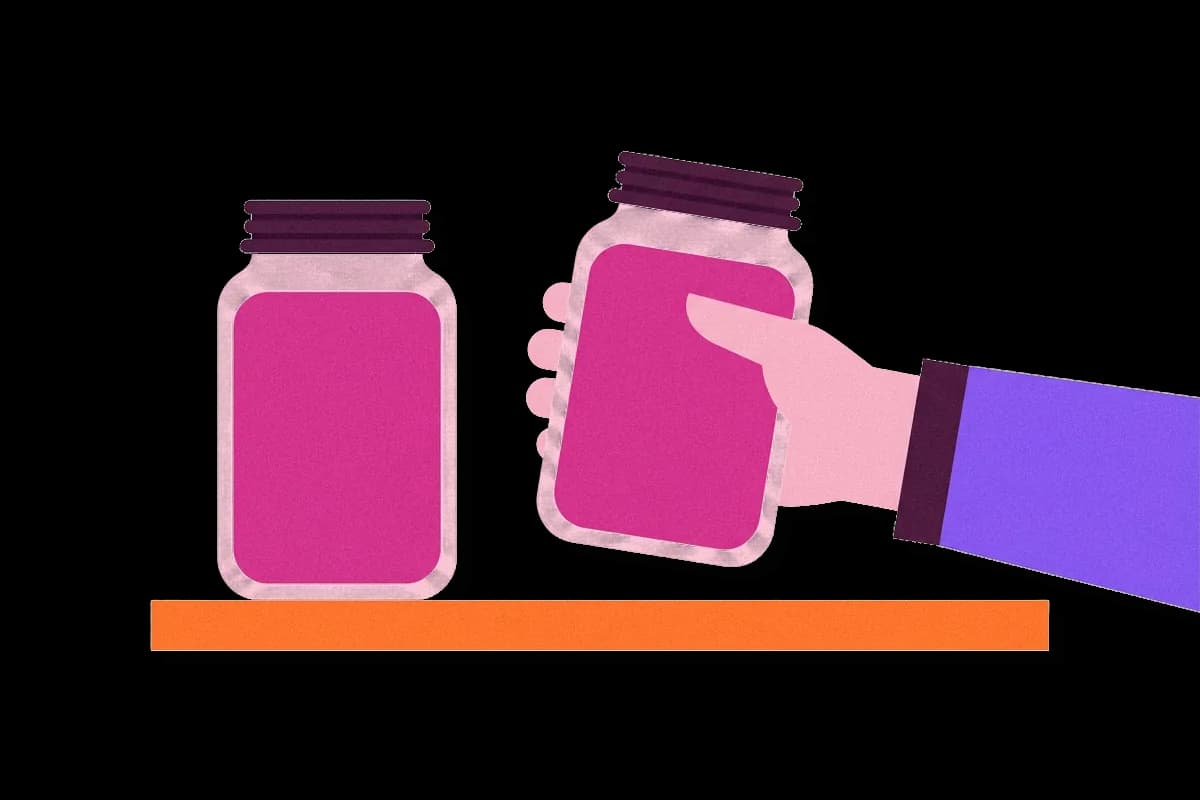
Cues are one cause of a purchase. The number of options is another, and it is the subject of the best-known field experiment in the area, on what is now called choice overload. In 2000 the psychologists Sheena Iyengar and Mark Lepper set up a tasting booth in an upscale grocery store. The booth showed either 6 or 24 flavors of one brand of jam, and everyone who came to it received a coupon for $1 off any jar of that brand. Of the shoppers who stopped at the six-jam booth, about 30 percent later bought a jar, while at the 24-jam booth only about 3 percent did.
More people stopped, fewer bought
The larger display did not fail to attract people. More shoppers were drawn to the 24-jam booth than to the six-jam booth. Variety made shoppers curious, but it did not make them buy. A team that counted only visitors would have drawn the opposite conclusion from the one the sales show.
Why many options lead to quick cuts
A study the paper cites found that people use an elimination strategy more often as the number of options grows. An elimination strategy means dropping options one by one because they fail on a single feature, instead of weighing each option in full. With three options 21 percent used it, with six options 31 percent, and with nine options 77 percent. As that share rose, the share of available information that people used fell. So a large range pushes buyers toward rough cutting instead of careful comparison.
Beyond shopping
The same paper reports two more experiments, one with chocolates and one with optional class essays. In both, people given 6 options were more likely to act than people given 24 or 30. The effect was not limited to jam, and not limited to shopping.
061 min
Where the evidence on choice overload is contested
The jam result spread widely, and later work tested whether it holds. In 2010 Benjamin Scheibehenne, Rainer Greifeneder and Peter Todd pooled 50 experiments on choice overload in a meta-analysis, which is a study that combines the results of many studies. The average effect across the studies was close to zero, older published studies showed larger effects than later or unpublished ones, and buyers with clear existing preferences were not hurt by many options.
Those findings do not erase the jam study. They show that its size depends on conditions. A large range seems to hurt when buyers have no firm preference, and to do little when they do. A single famous result can be smaller or narrower than its retelling, and replication, which means repeating a study to see whether the result returns, is the test any finding needs before it guides a decision. Until the conditions are better understood, a product team should test its own range of options with its own buyers instead of cutting options by rule.
071 min
How consumer psychology shows up in tech
Picture a product manager at a subscription app who sees many people cancel in the first week. The exit survey says the price is too high, but the cancellations come right after a reminder email about the price. The survey records what people say. The email timing records what they did. Consumer psychology starts from the second.
- Product manager. Decides whether to trust the exit survey or the event data, and how many plan tiers to show.
- Designer. Decides where reviews and ratings appear, how many choices a screen offers, and which option is selected by default.
- Engineer. Decides what to log, so that each cue can be tested on its own, and whether a recommendation feature should show fewer, better suggestions. Personalization that misses the buyer's taste can irritate people instead of helping them.
- Founder. Decides how the pricing page orders its plans, and how the end of a free trial is worded.
Each of these is a call about a cue. The work is to find out what the cue does to behavior, and not to assume it.
081 min
How to apply consumer psychology to a product
The steps below depend on each other. Skipping one makes the next one weak.
Record what people do before asking why.
The stockings study shows that stated reasons can leave out the real cause, so behavior comes first.
Write one explanation that predicts a change.
For example: showing the review count next to the buy button will raise sign-ups. This needs step 1, because you can only explain a behavior you have seen.
Test it by changing only that cue.
Show the change to a random half of visitors, an A/B test, and compare purchase rates. This needs step 2, because without a prediction the test has nothing to confirm or reject.
Repeat the test in your own setting.
The record on choice overload shows an effect can be strong in one study and close to zero on average. This needs step 3, because one winning test is one setting.
Ask whether the change also helps the buyer.
This needs a measured effect from step 4, because only then can you tell who gains from it.
Do the last step before shipping, not after the numbers look good.
091 min
How to measure consumer psychology
A team can go and measure consumer psychology today. Most start with one number: the conversion rate, which is purchases divided by visitors, calculated for each version in a test. A second number comes from asking buyers what they intended, and comparing it with what they bought. The difference between the two is called the say-do gap.
| Method | What it records | Blind spot |
|---|---|---|
| Randomized test (A/B test) | What buyers do when one cue changes | It does not say why |
| Survey or interview | What buyers say about reasons and attitudes | Reasons given can differ from the cause |
| Field observation | Behavior in a real place, such as a shelf | Other factors are hard to control |
| Eye tracking | Where the gaze rests on a page or shelf | Shows attention, not liking |
| EEG (neuromarketing) | Electrical brain activity while a person views an ad or a package | Signals are hard to tie to one specific choice |
Neuromarketing means using brain measures such as EEG to study responses to marketing. It adds a second view of the buyer, but it does not replace a behavior test.
101 min
Common mistakes with consumer psychology
Three wrong beliefs cause most of the damage.
- Teams assume buyers can tell them why they chose. Buyers can tell a story. The stockings study shows the story can leave out the cause. Use stated reasons as a lead to test, not as a finding.
- Teams assume a famous result will repeat in their product. The jam study and the meta-analysis of choice overload show the same idea giving a strong effect in one setting and almost none on average. Test it before building on it.
- Teams assume a principle is a guarantee. Social proof, scarcity and the rest are tendencies. They depend on the buyer and the setting, and some stop working once buyers expect them.
A fourth mistake is ethical. Since Packard's 1957 book, critics have asked where the line is between helping buyers decide and getting around their judgment. A cue that works by hiding a cost can raise sales this month and cost trust later. A useful test is whether the buyer would object on seeing exactly how the cue was meant to work. If so, it is closer to pressure than to persuasion.
111 min
Consumer psychology vs. nearby concepts
The deciding axis is the level of explanation. Consumer behavior describes what buyers do and the wider patterns of buying, including social and cultural ones. Consumer psychology explains the mental processes behind one person's choice, such as emotion, motivation and attention.
| Concept | Question it asks | Typical output |
|---|---|---|
| This pageConsumer psychology | ||
| MarketingConsumer behavior | ||
| PsychologyBehavioral economics |
?4 questions
Questions people ask
Is consumer psychology part of psychology or of marketing?
Can a survey alone tell you why customers buy?
Does consumer psychology apply to apps and online stores?
What work do consumer psychologists do?
§11 sources
Sources
Show all 11 sourcesHide sources
Nisbett, R. E. and Wilson, T. D. (1977). Telling more than we can know: Verbal reports on mental processes. Psychological Review, 84(3), 231-259.
Iyengar, S. S. and Lepper, M. R. (2000). When choice is demotivating: Can one desire too much of a good thing? Journal of Personality and Social Psychology, 79(6), 995-1006.
Scott, W. D. (1903). The Theory of Advertising. Boston: Small, Maynard and Company.
Wikipedia, a biography of Walter Dill Scott:
Wikipedia, a biography of Vance Packard that describes The Hidden Persuaders (1957):
Society for Consumer Psychology, its own history page:
Journal of Consumer Research, about the journal:
Psychology Today, a summary of Scheibehenne, Greifeneder and Todd (2010), Can there ever be too many options? A meta-analytic review of choice overload:
The Decision Lab, a summary of North, Hargreaves and McKendrick (1999), The influence of in-store music on wine selections:
The Decision Lab, reference guide to consumer psychology:
EBSCO Research Starters, consumer psychology: