011 min
Confirmshaming in a discount pop-up
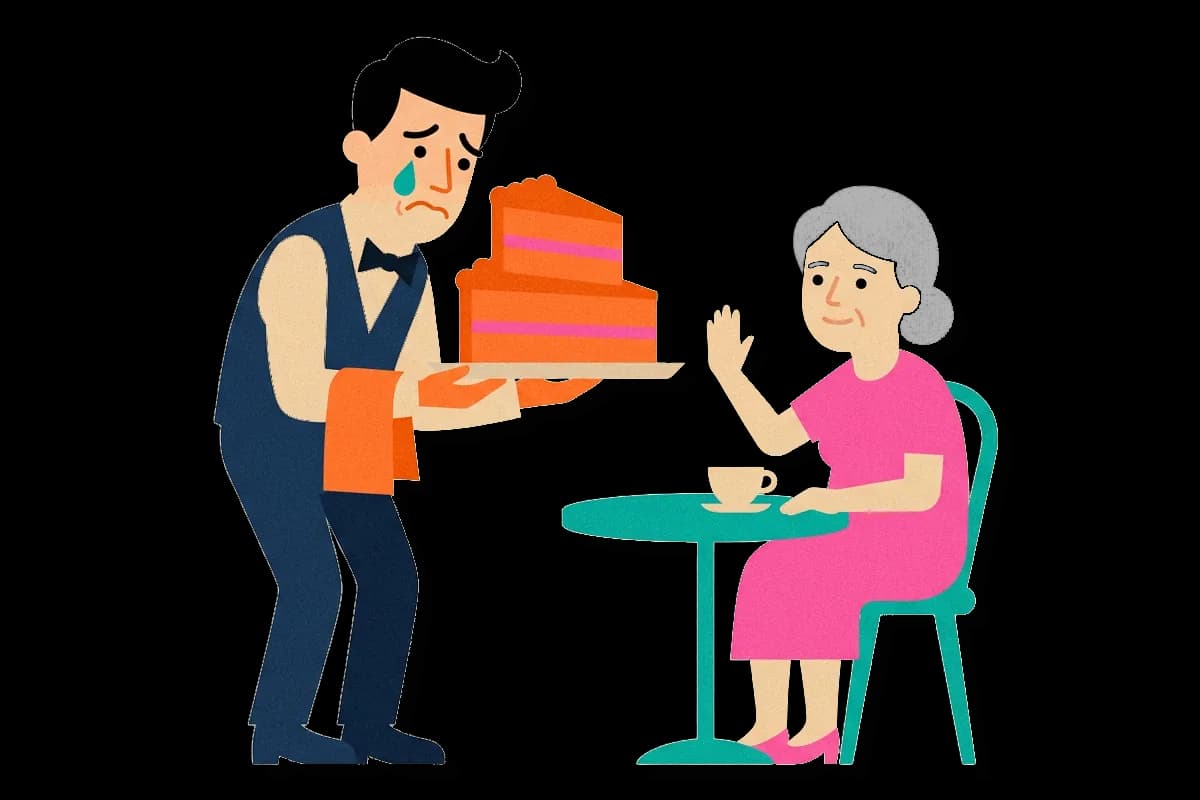
Picture a designer at an online shop who is asked to add a pop-up that collects email addresses in return for a discount. The first draft has two buttons: one offers the discount and the other says No thanks. The growth lead reviews the draft and asks for one change: make the second button say No thanks, I like paying full price.
The change costs nothing to build, and the growth lead expects more people to accept. The designer is uneasy about it, and the unease has a reason. The old label described what the button does. The new label describes the person who clicks it, and describes them as someone who chooses to overpay.
That change is confirmshaming. It is common enough to have a name, a history and a body of measurements. The first question is where the name came from.
021 min
Where the word confirmshaming comes from
The habit had no common name until people began collecting examples of it. By 2016 a Tumblr blog that gathered shaming decline links had reached Hacker News and the press, and the practice became widely known. Arunesh Mathur and colleagues, whose 2019 crawl is described later, credit Harry Brignull, a UX designer in the United Kingdom, with coining it. Brignull's Deceptive Patterns website lists confirmshaming as one type of deceptive design.
The Nielsen Norman Group (NN/g), a UX research firm, wrote about the same practice in April 2017 under another name. Its authors, Kate Moran and Kim Flaherty, called the shaming labels manipulinks, a word they credit to Steve Costello. They also noted that the usual name is slightly off. The shame attaches to the refusal, not to the confirmation, so declineshaming would describe it better.
Confirmshaming is practitioner vocabulary, not the result of one study. Nobody measured it first and named it afterwards. The measurements came later, and they are covered in the evidence sections below.
032 min
How confirmshaming works
A few words can change a decision because the decline label asks the person to say something about themselves. An ordinary decline label names an action: No thanks, Not now, Close. A confirmshaming label names a trait, such as disliking savings, disliking fun or not caring about health. Clicking it feels like agreeing with the description.
Two ideas explain why that works. The first is the framing effect: the same choice feels different depending on how it is described, and a refusal described as a flaw feels worse than a plain no. The second is shame itself. Mathur and colleagues call shame a strong driver of behaviour change. A person who wants to avoid feeling foolish takes the other button.
The labels seen in the wild share this shape. The table lists real ones.
| Label on the decline option | Where it appeared | What it says about the person who clicks it |
|---|---|---|
| No thanks, I like paying full price | Discount pop-ups on shopping sites, found in a 2019 crawl | They choose to overpay |
| No thanks, I hate saving money | Discount pop-ups on shopping sites, found in a 2019 crawl | They dislike something most people like |
| No thanks, I don't like deals | An email pop-up on Sears.com, reported by NN/g in 2017 | They have no interest in a bargain |
| No, I don't want to stay alive | A notification request on MyMedic, a first aid supplier, in 2018 | They do not value their own survival |
The MyMedic case shows how far the wording can go. The shop sells first aid supplies, so its customers include people who meet injury and death at work. In 2018 its request to send notifications offered a decline link saying the visitor did not want to stay alive.
The visitor can see it, and it still works
Mathur and colleagues classify confirmshaming as asymmetric, because only the decline option is worded as shaming. They also note that it is not covert: the visitor can see that the wording is trying to influence them. That separates it from a fee shown late or a box ticked in advance, which work because the person does not notice them. A shaming label does not depend on a hidden detail. It depends on how the choice feels.
041 min
How common confirmshaming is
Teams use this wording often enough that researchers have counted it. In 2019 researchers at Princeton University and the University of Chicago, led by Mathur, crawled about 11,000 shopping websites with software and recorded the dark patterns they found. The crawl found 1,818 in total, of 15 types.
They found 169 instances of confirmshaming. Those instances were spread over 164 websites. Most were pop-ups that asked for an email address in exchange for a discount, which is the setting of the designer's pop-up above.
The count covers only shopping sites that the crawler reached. It says nothing about apps, emails or checkout flows, where the same wording also appears.
053 min
What confirmshaming does to sign-up rates
The designer's next question is whether the new label works. The best measurements come from two online experiments by Jamie Luguri and Lior Strahilevitz of the University of Chicago, published in 2021. Each used a large group of American adults chosen to match the online population by age, gender, race, region and education.
In the first experiment, people were told that their survey answers showed concern about privacy, and that they were being signed up for an identity-theft protection plan with a monthly fee after a free trial. The researchers counted how many accepted. A control group saw plain Accept and Decline choices, and 11.3 percent accepted. A mild group saw a bundle of tactics: acceptance was pre-selected and marked as recommended, the way to decline was placed behind Other options, and on the next screen declining was worded as not wanting to protect one's own data or credit history. In that group 25.8 percent accepted, which is more than twice the control rate. An aggressive group also saw countdown timers, extra screens and a trick question, and 41.9 percent accepted.
The mild bundle contained confirmshaming but also other tactics, so those figures do not show what the shaming label added by itself. The second experiment tested tactics one at a time.
One tactic at a time
In the second experiment, 3,777 people each saw zero to three tactics, so the effect of each could be separated. The confirmshaming version described declining as not caring about protecting data or credit history. About 20 percent of people who saw it accepted (120 of 612), against about 15 percent in the control group (191 of 1,289). The label alone added close to five percentage points.
Where in the flow it matters
The first experiment also recorded the screen on which each person accepted. In the mild group, more than three quarters accepted on the first screen, before any shaming appeared. The second screen, where the decline choice carried the shaming label, produced 35 of the mild group's 155 acceptances, or 23 percent. The last screen listed weak reasons for declining and offered a final chance to accept, and the authors call it confirmshaming too. Almost nobody accepted there. In this test, shame worked as a middle step and did little as a closing step.
Shame outside the button
Shaming does not have to sit on a button. On the last screen, people who had declined were asked to say why. The listed reasons included a credit rating that was already bad, a belief that identity theft could not happen to them or their family, and having nothing to hide. Most of the options made the person who refused sound careless, and the final choice was to sign up after all.
How people felt, and who was affected
The same experiments checked mood. In the second experiment, confirmshaming had no significant effect on mood compared with the control group. In the first experiment, the mild bundle did not upset people either, but the aggressive bundle did. Only 9 people dropped out of the survey in the mild group, against 65 in the aggressive group. Stacking many tactics made people notice and object.
Education also mattered. People who had at most a high school diploma were more susceptible to the mild tactics.
062 min
What confirmshaming costs, and where the evidence is thin
A higher sign-up rate is the effect a team sees within days. The costs, if there are any, arrive later. NN/g's 2017 article argued that the short-term gain comes at the price of disrespecting users, and that this would lead to long-term losses. The article offered one usability session as support. A participant saw a shaming pop-up from Women's Health and a plain newsletter offer from WebMD, and she preferred the plain one. NN/g said itself that this was one person's reaction.
The experiments above point the other way. Mood did not change when the shaming wording was mild. But neither source measured what a shop cares about over months, which is whether a visitor returns, buys, unsubscribes or complains. The experiments recorded mood and willingness to join a follow-up study right after the choice. Built In says other usability studies found dissatisfaction and higher unsubscribe rates with the practice, but it names none of them, so they cannot be weighed here.
NN/g also raised a confound, which is a second cause that can explain the same result. Shaming pop-ups often hide what the person is signing up for, so a lift in sign-ups may come from the unclear offer and not from the shame. Its example was a recipe site that asked for an email address to get recipes without saying the address would also join a newsletter. In the second experiment the confirmshaming condition changed only the decline wording, so the comparison with the control group does not have this problem.
Together the sources support a narrow reading. The shame adds a few percentage points of acceptance, and the cost is unmeasured, not shown to be zero. A team that wants to know has to measure what happens after the sign-up.
073 min
Confirmshaming and the law
If shaming adds sign-ups and no cost has been proven, the next question is whether any law forbids it. The answer depends on the country, and few places name the pattern.
India names it. On 30 November 2023 the Central Consumer Protection Authority published guidelines that list specified dark patterns, and confirm shaming is one of them. The guidelines define it as any phrase, video, audio or other device that creates fear, shame, ridicule or guilt in order to lead users to buy a product or keep a subscription, mainly for commercial gain. Its two illustrations are a flight booking page that says I will stay unsecured when the traveller leaves out insurance, and a shop that adds a charity to the basket without consent and then says charity is for rich, I don't care when the user removes it. The definition is not limited to written labels, because video and audio count.
The European guidance does not use the word, but it covers the same wording. The European Data Protection Board's guidelines on deceptive design in social media interfaces describe emotional steering, which is wording or visuals that make users feel scared, guilty or punished, and they warn that it is likely to lead people against their own data protection interests.
California's privacy regulations say that the path to a more privacy-protective option must not be longer or harder than the path to a less protective one. For selling personal information they give Yes and No as an equal pair, and they say that agreement obtained through a dark pattern is not consent.
The symmetry test
Strahilevitz has proposed extending that symmetry idea to wording, which would cover confirmshaming without banning persuasion. One permissible option may not be presented with more negative emotional language than the other. Under this test, a decline button reading No thanks beside an accept button reading Get the discount passes, and one reading No thanks, I like paying full price fails. He compares the idea to the rules for wording ballot initiatives in elections.
Why the mild version worries researchers
Luguri and Strahilevitz drew an unexpected conclusion from the mood and dropout results. Aggressive tactics caused anger and exits, so customers react against the worst cases themselves. Mild tactics caused neither, so customer behaviour does not discourage them. The authors say this makes the strongest case for regulation the subtle uses. A single shaming label is a subtle use.
Why it is hard to regulate
In the United States, the main limit is free speech. Luguri and Strahilevitz explained in a 2019 working draft that the law accepts penalties on commercial speech mainly when the speech is false, and that shaming wording is not false. They wrote that confirmshaming may be difficult to restrict under current US legal doctrine, because firms have speech interests in their wording. They found no court case in 2019 that decided whether such wording is lawful, and they added that small doses of it may be close to benign. A shaming label is rude, but it states no false fact, and that is why consumer-fraud law fits it poorly.
081 min
Confirmshaming vs. nearby concepts
Confirmshaming is one of a group of related terms. The neighbours differ on one question: what the wording or design does to the person's choice.
| Concept | What it is | What separates it from confirmshaming |
|---|---|---|
| DesignDark patterns | ||
| DesignNudge theory | ||
| DesignSludge | ||
| Not in the library yetHonest persuasion |
A useful test for any label is to read the decline option as a sentence about the person who clicks it. If it describes a trait, it is confirmshaming. If it describes an action, it is not.
091 min
How to write a decline option without confirmshaming
A team that decides to stop has a short job: keep the persuasion on the offer and make the decline neutral.
- State the benefit on the offer and say what the person gives in return. If an email address also joins a newsletter, say so.
- Write the decline as an action, such as No thanks or Not now, with the same weight and length as the accept label.
- Leave a clear way to close the window. Nick Anderson, a designer and instructor quoted by Built In, advises three exits: the empty space around the window, a close icon and a decline option.
- Say the label aloud to another person. Copy that would be rude in a conversation is rude on screen.
- Compare versions with an A/B test that tracks more than the sign-up, such as unsubscribes, complaints and later visits, because sign-ups alone cannot show the cost.
This does not ban warmth or humour. A brand with a playful tone of voice can write a friendly decline such as Maybe later. The line is whether the joke is about the person who refuses.
101 min
How to spot confirmshaming in an audit
An audit can find confirmshaming without analytics, because the evidence is the wording. Check for these signs:
- A decline label that starts with No thanks and continues with I plus a verb, such as I hate, I don't want or I'd rather.
- Two labels in different registers: a plain phrase for accept and a full sentence about the person for decline.
- A pop-up whose only exit is the decline link.
- A cancellation or unsubscribe page that lists what the person will lose in a tone of blame.
- A question after a refusal that asks why and offers answers that make the refuser sound careless.
- Support tickets or social media posts that quote the label back at the company.
?3 questions
Questions people ask
Is a funny decline label still confirmshaming?
Is it confirmshaming to tell people what they will miss?
Does confirmshaming only appear in pop-ups?
§9 sources
Sources
Mathur, A., Acar, G., Friedman, M. J., Lucherini, E., Mayer, J., Chetty, M. and Narayanan, A. (2019). Dark Patterns at Scale: Findings from a Crawl of 11K Shopping Websites. Proceedings of the ACM on Human-Computer Interaction, CSCW.
Luguri, J. and Strahilevitz, L. J. (working draft of 5 August 2019; published 2021 in the Journal of Legal Analysis). Shining a Light on Dark Patterns.
Strahilevitz, L. J. (2022). Shining a Light on Dark Patterns, slides prepared for the California Privacy Protection Agency.
Built In. Confirmshaming: What It Is And Why You Should Avoid It, a magazine summary of the second experiment.
Show all 9 sourcesShow fewer sources
Moran, K. and Flaherty, K. (2017). Stop Shaming Your Users for Micro Conversions. Nielsen Norman Group.
Brignull, H. Confirmshaming. Deceptive Patterns.
Central Consumer Protection Authority, India (2023). Guidelines for Prevention and Regulation of Dark Patterns.
European Data Protection Board (2023). Guidelines 03/2022 on deceptive design patterns in social media platform interfaces, version 2.0.
California Code of Regulations, title 11, section 7004.