012 min
A default effect in a settings screen
This case is illustrative, not a real product. A designer is building the settings for a note-taking app. The team must decide whether a new note is private or visible to the whole workspace.
In the first release, a new note is visible to the workspace unless the author turns sharing off. Few authors open the sharing menu, so most notes end up visible to everyone. After a month, a support ticket arrives: a note with salary data was readable by the whole company.
In the second release, a new note is private unless the author turns sharing on. Authors who want to share do it with one click. Few notes are shared by accident, and the tickets stop.
Nobody was forced to do anything in either release. Both let people change the setting. The outcomes still differ, because most people never change a default.
The same pattern appears wherever a form or a setting starts with a value already chosen:
- A notification setting that starts on or off.
- A plan that is highlighted on a pricing page.
- A box that is already ticked at checkout.
- A retirement plan that enrols new employees unless they decline.
- A privacy or tracking setting.
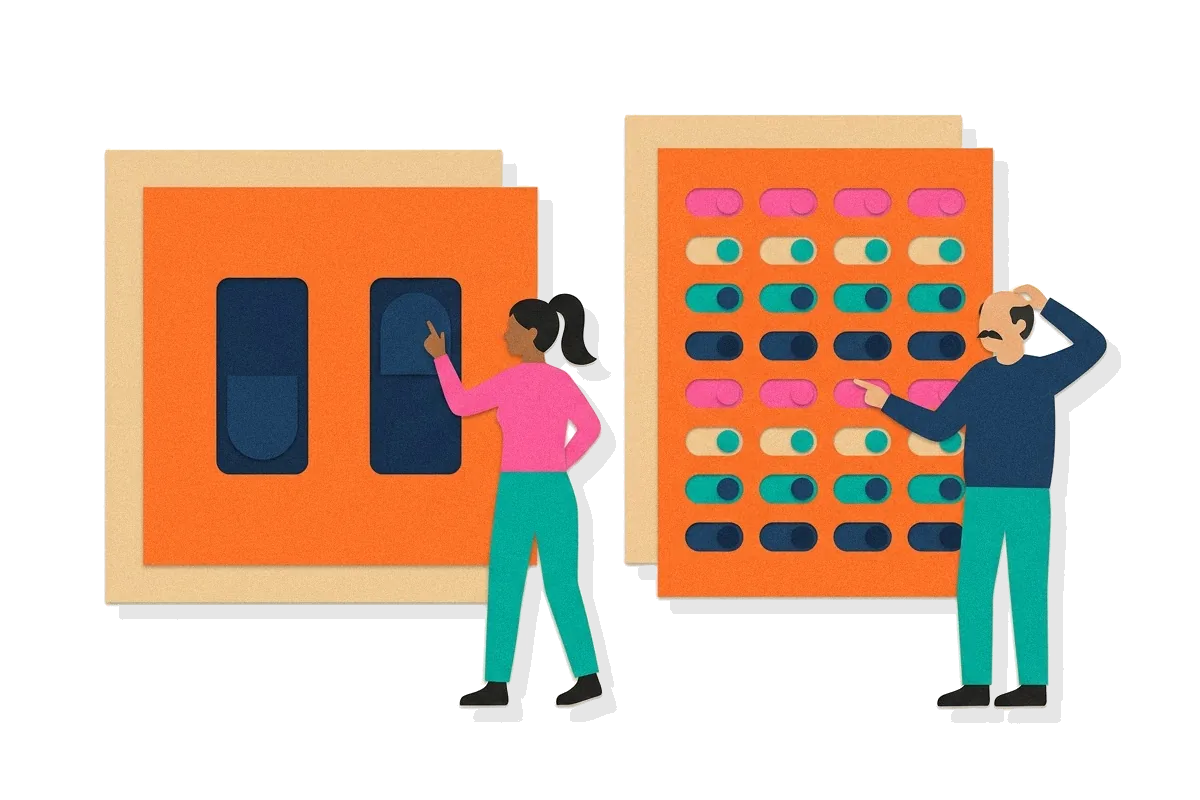
The decision for the designer is not whether to have a default. Every control starts in some state. The decision is which state it starts in, and who that state serves.
022 min
The 401(k) study behind the default effect
The best-known field evidence comes from a retirement-savings plan. A 401(k) is a United States retirement plan in which employees put part of their pay into an investment account. Brigitte Madrian and Dennis Shea studied one large United States company that changed how new employees joined its plan. Their working paper was published by the National Bureau of Economic Research in 2000.
Before the change, employees had to choose to join. After the change, they were enrolled automatically and could opt out. The authors summarise the result in one sentence. Although none of the economic features of the plan changed, this switch to automatic enrollment dramatically changed the savings behavior of employees.
The authors compared groups by how long the employees had worked at the company. At 3 to 15 months of tenure, 37% of the group hired before automatic enrollment took part in the plan, against 86% of the group hired after.
The default also shaped what people did after they joined. Madrian and Shea report that the company chose a contribution rate of 3% of pay and a money market fund as the starting values. Six out of ten employees hired under automatic enrollment did nothing to change the default savings behavior set by the company. Only 1% of the employees in the earlier groups had that same combination.
The authors give two explanations. The authors say this behavior appears to result both from participant inertia and from many employees taking the default as investment advice on the part of the company. Inertia means that people leave things as they are when changing them takes effort.
A second well-known study is Eric Johnson and Daniel Goldstein's article "Do Defaults Save Lives?", published in Science in 2003. It compared organ donation rules across European countries. Countries where people had to opt out of donation had much higher consent rates than countries where people had to opt in. The comparison is between countries, not between randomly assigned groups, so other national differences may also play a part.
031 min
Why the default effect happens
Researchers describe several channels through which a default changes a decision. In a real decision more than one usually operates at once. Johnson and colleagues name three of them: ease, endorsement and endowment.
Ease. Doing nothing costs no effort and changing a default costs some. The effort can be physical, such as finding the right menu. It can be mental, such as comparing options. It can also be emotional. When the effort is larger than the person thinks the difference is worth, they leave the default alone. This is the inertia that Madrian and Shea describe.
Endorsement. A pre-selected option can look like advice. If the designer or the company picked it, people may assume it was picked for a reason. Madrian and Shea report that many employees took the default as investment advice from the company.
Endowment. A default describes the current state, and people often judge a change from the current state as a loss. This links the default effect to the endowment effect and to loss aversion.
The three channels give a way to predict a new case. A default is stronger when changing it is hard, when people trust whoever set it, and when it looks like the current state. A default is weaker when the change takes one click, when the setter is not trusted, and when people already hold a clear preference.
041 min
How large the default effect is, and where it is contested
Jachimowicz, Duncan, Weber and Johnson published a meta-analysis in 2019. A meta-analysis combines the results of many studies into one estimate. They analysed 58 default studies with a combined 73,675 participants.
Opt-out defaults led to greater uptake of the pre-selected option than opt-in defaults. The authors call the pooled result a medium-sized effect.
The average hides a large spread. The majority of those studies found positive effects, but several found no significant effect and two found negative effects. So a default does not always work, and a designer should not assume a fixed size.
Two patterns explain part of the spread:
- Domain. The effect was larger for consumer decisions than for environmental decisions.
- Mechanism. Defaults worked better when people saw them as the choice architect's view of what they should do, or as the status quo.
This matters for practice. A default that is easy to change, set by a source people distrust, and far from their current state can have little effect. The practical advice is to test the default with real users instead of relying on a published average. See choice architecture for the wider practice of arranging options.
052 min
The default effect in real products and laws
Applied: automatic enrolment. The company in the Madrian and Shea study changed one thing, the starting state of the plan. The result was a rise in participation from 37% to 86% at 3 to 15 months of tenure. The change was easy to reverse, because employees could opt out at any time, and the plan terms were otherwise the same.
Violated: pre-ticked consent boxes. On 1 October 2019 the Court of Justice of the European Union decided that a pre-ticked checkbox does not give valid consent to store cookies. The court held that the consent which a website user must give is not validly constituted by way of a prechecked checkbox which that user must deselect to refuse. The case, known as Planet49, concerned a German company that used a pre-ticked box in an online promotional game. The court treated the default as unreliable evidence of what the user wanted.
Violated: extra payments. Article 22 of the European Union Consumer Rights Directive (2011/83/EU) says a trader must seek the express consent of the consumer to any extra payment. If the trader inferred consent by using default options the consumer must reject, the consumer is entitled to reimbursement. Law in this area treats a default as a way to collect agreement that people did not clearly give.
The two laws point the same way. A default is acceptable when it shows what people would choose anyway, and it is regulated when it produces consent or payment that people did not clearly choose.
Role scenarios, illustrative. A product manager choosing a trial plan for a pricing page decides which plan is highlighted at the start. An engineer setting a default for data retention decides how long records are kept for everyone who never opens the setting. A designer of a form decides which shipping method is selected. Each of them is making the choice for every person who does nothing.
062 min
Setting a default on purpose
Every control has a default, so the question is how to choose one deliberately.
Pick the option most users would choose if they thought about it.
Use usage data or interviews. A default that matches careful choices helps people. A default that matches only the company's interest works against them.
Count the cost of a wrong default.
A default that is wrong for 10 out of 100 users is a minor problem for a notification setting. It is a serious problem when the setting exposes private data.
Make the change easy to find and easy to do.
A setting one click away keeps the default honest. Placing it in a deep menu raises the cost of leaving it.
Say what the default is.
A short label such as "Private. Only you can see this note." lets people decide with the facts in front of them.
Measure what people change.
If many users change a default soon after they start, the default is wrong for them. An A/B test of two defaults shows which one people keep for good reasons.
The approach has limits. When people hold strong opinions, as with a plan price, a default has little effect and the time is better spent on the choice itself. When a decision is a major one, such as consent, a pre-selected option does not replace asking. When there are many options, a sensible default also reduces choice overload. A default with no clear best answer can still hide that the person has a choice to make.
071 min
How to spot a harmful default
A default can be audited with data you already have.
- A setting where over 90% of accounts still have the starting value after 30 days. Check that this is because people agree, not because they never found the setting.
- Support tickets that begin with "I did not know this was on".
- A spike in changes to one setting right after an update that changed its starting value.
- Users who change a setting and then change it back.
- A large difference between the share of people who keep a default and the share who say they prefer it in a survey.
One caution applies. A high share of people on a default is not proof of a default effect. People may simply agree with it.
081 min
The default effect compared with nearby concepts
The default effect is often mixed up with two neighbours. They are separate because each one explains a different thing.
| Concept | What changes | What it explains |
|---|---|---|
| Not in the library yetDefault effect | ||
| PsychologyEndowment effect | ||
| PsychologyAnchoring |
A default can use both. An option the person starts with can feel owned, which links it to the endowment effect. A default value, such as a suggested tip, can also work as an anchor. The separating question is what the person does when they act on nothing. If the outcome is whatever was pre-selected, it is the default effect.
?6 questions
Questions people ask
What is the default effect?
What is an example of the default effect?
How do I apply the default effect in design?
Is setting a default manipulative?
Does the default effect always work?
How is the default effect different from the endowment effect?
§5 sources
Sources
Madrian, B. C. and Shea, D. F. (2000). The Power of Suggestion: Inertia in 401(k) Participation and Savings Behavior. NBER Working Paper 7682.
Johnson, E. J. and Goldstein, D. (2003). Do Defaults Save Lives? Science, 302(5649), 1338-1339.
Jachimowicz, J. M., Duncan, S., Weber, E. U. and Johnson, E. J. (2019). When and why defaults influence decisions: a meta-analysis of default effects. Behavioural Public Policy, 3(2), 159-186.
Directive 2011/83/EU of the European Parliament and of the Council, Article 22, Additional payments.
Show all 5 sourcesShow fewer sources
Court of Justice of the European Union (2019). Press release No 125/19: Storing cookies requires internet users' active consent, judgment in Case C-673/17.