011 min
The enrolment form nobody returned
Imagine a company with a retirement savings plan that every new hire may join. Joining is almost always in the employee's interest. Still, many new hires mean to join and never do. The form sits on a desk, and the first weeks of a new job are full of other tasks.
Now imagine the company changes one thing. New hires are enrolled automatically, and anyone who does not want the plan can leave it. Nothing is forbidden. Nobody is paid more or less for any choice. Only the starting position is different.
Economists Brigitte Madrian and Dennis Shea studied a switch like this at a US company in 2001. They looked at its 401(k), a US workplace retirement plan, and found that far more employees took part once enrolment became automatic. That one change is what the rest of this article is about, and it has a name.
022 min
What counts as a nudge in Nudge Theory
Thaler and Sunstein use the word nudge for any feature of the choice architecture that changes behaviour in a predictable way. Choice architecture means the way options are arranged and shown to the person deciding. The change must not ban an option and must not change what the options cost or pay. To count, a nudge must also be easy and cheap to avoid.
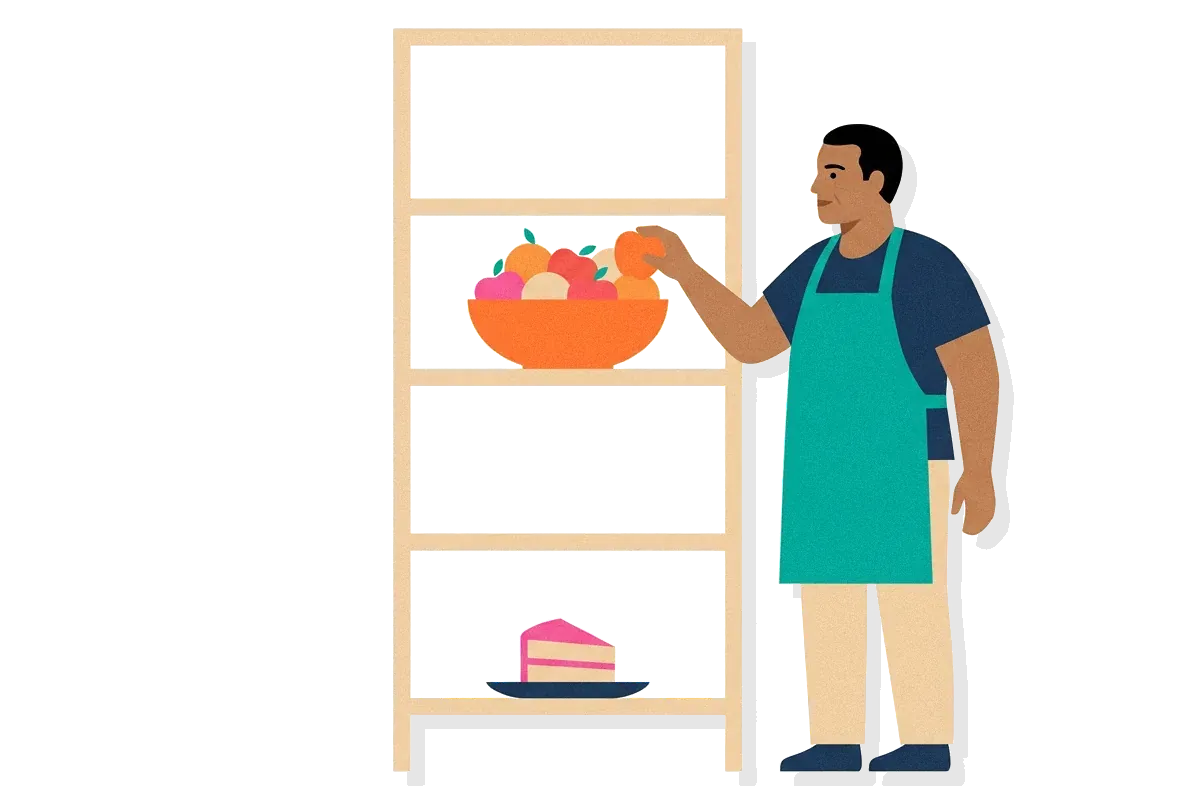
The test is simple. Putting fruit at eye level in a cafeteria is a nudge. Banning junk food is not, because that removes an option. The person who sets up the choice is called a choice architect, and every choice already has one, even when nobody planned it. Read more on choice architecture.
Thaler and Sunstein call the underlying view libertarian paternalism. It is libertarian because people stay free to choose otherwise. It is paternalistic because the designer picks a starting point that they believe will leave people better off.
| Tool | Options left open | Cost of choosing differently | Example |
|---|---|---|---|
| Nudge | All | None added | New hires enrolled unless they leave |
| Ban | Fewer | Not possible | Junk food removed from sale |
| Tax or subsidy | All | Changed | A tax on sugary drinks |
| Information campaign | All | None added | A poster about healthy eating |
Narrow and broad definitions
Not everyone draws the line in the same place. Vincent Berthet and Benjamin Ouvrard point out that Thaler and Sunstein first gave a narrow definition, and Sunstein later gave a broader one. The two disagree on whether giving people information counts as a nudge. The last row of the table is therefore a nudge in one reading and not in the other. When you read a study or a report, check which meaning its authors use.
032 min
Why Nudge Theory works on ordinary decisions
Why would the starting position matter to a person who could simply change it? The usual answer comes from Daniel Kahneman's account of two ways of thinking. System 1 is fast and automatic. System 2 is slow and reflective. When a decision is complex, rushed or one of many, System 1 takes over and relies on rules of thumb.
Nudges work with those rules of thumb. People tend to keep whatever is already set. They dislike a loss more than they like an equal gain, which is loss aversion. They copy what others do, which is social proof. They notice what is prominent and skip what is not.
The designer's tools follow from this:
- Defaults. The option that applies if the person does nothing.
- Social norms. A statement of what most people like them do.
- Salience and order. What is shown first, largest or nearest.
- Simplification. Fewer steps and fewer fields between the person and the action.
- Timely prompts and feedback. A reminder when the person can act, and a result they can see.
A default also reads as advice
Madrian and Shea named two causes for what they saw. One was inertia, which means people leave things as they are. The other was that many employees took the default as investment advice from their company. The second cause matters for design. A default is a message, because the person assumes whoever set it had a reason.
041 min
Where Nudge Theory comes from
The psychology came first. Kahneman and Amos Tversky had shown in the 1970s that people decide with shortcuts that can be predicted, and that the shortcuts sometimes lead to errors. Economists then had to ask what to do about it.
Thaler, an economist, and Sunstein, a legal scholar, both at the University of Chicago, gave their answer in the 2008 book Nudge. They argued that governments and companies already shape choices, so they should do it on purpose and in the person's favour. The Nobel committee gave Thaler the 2017 economics prize for his contributions to behavioural economics.
The idea reached government quickly. In 2010 the UK created the Behavioural Insights Team in the Cabinet Office, often called the Nudge Unit, headed by the psychologist David Halpern. It later became a separate organisation, and other governments set up similar teams.
052 min
Defaults in practice: pensions and organ donation
The company example was not a one-off. In the UK, the government changed workplace pensions from opt-in to opt-out. The Behavioural Insights Team reports that ten million more people were saving into a workplace pension within eight years, and that private-sector coverage rose from 42% to 85%.
Organ donation shows the same effect. In 2003 Eric Johnson and Daniel Goldstein asked 161 people in an online experiment whether they would be donors. Some were told the starting position was to be a donor, and others that it was not. The donation rate was about twice as high when people had to opt out as when they had to opt in.
Defaults have limits, and the next three parts show where they stop helping.
The default amount stays, too
Madrian and Shea found that many employees hired under automatic enrolment kept the contribution rate and the investment fund that the company had set. Very few employees hired before the change had picked that combination themselves. A low default rate can therefore hold down the savings of people who would have chosen more.
Not only a matter of effort
One explanation for the default effect is effort: changing a setting takes work, so people do not. Johnson and Goldstein tested this by letting people change their answer with a mouse click. That largely removes effort as the reason in their experiment, which points to the other causes in this article, such as the default being read as advice.
Asking for an active choice
A default is not the only option. Gabriel Carroll and colleagues made new hires answer an enrolment question before starting. That raised enrolment by 28 percentage points compared with a standard opt-in procedure. They also showed when this beats a default. It is better when people tend to procrastinate and want very different savings levels.
061 min
How Nudge Theory shows up in digital products
The same ideas apply wherever someone designs a choice. Say a designer on a photo-backup app learns that most people never switch backup on. Interviews show that people want it and plan to do it later.
The designer has several moves. Backup can start switched on, with an off switch that is easy to find. The setup screen can say how many people already back up. A prompt can appear right after a person takes a photo, when the benefit is clearest. The number of steps can drop from five to two. Each move changes the setting around the choice. None removes the choice.
A real digital case comes from the Swiss electricity market. The Behavioural Insights Team reports that making renewable energy the default raised uptake from 3% to 80% among households, and that the effect lasted for years.
The EAST checklist
The Behavioural Insights Team packages its method as four prompts: make the action easy, attractive, social and timely. The team says the list is a practical aid and not a full model of behaviour. It suits a design review, because each prompt turns into a question about one screen.
071 min
When a nudge backfires
A nudge can move people the wrong way. Wesley Schultz and colleagues tested household energy messages in a field experiment in 2007. A message gave each household the average usage in its neighbourhood. Households that used more than average cut back. Households that used less than average used more. The researchers called this the boomerang effect.
Adding a second message that showed social approval removed the boomerang effect. The lesson for designers is that a norm tells everyone where the middle is, including people who were already doing better. Test a nudge on the groups it is likely to affect differently.
081 min
Where the evidence on nudging is contested
How large are nudge effects? Stefano DellaVigna and Elizabeth Linos collected 126 randomised trials with 23 million people, run by two US nudge units. Nudges in academic journals raised take-up by 8.7 percentage points on average. Nudges in the unit trials raised it by 1.4 points. They conclude that publication bias in the journals, together with low statistical power, can account for the gap.
A 2021 meta-analysis by Mertens and colleagues found that nudging works on average, with moderate publication bias. Maximilian Maier and colleagues replied in 2022 that, once the bias is corrected for, no evidence for an overall effect remains. They also report that effects differ across nudge types, so some nudges may work even when the average does not.
So the honest summary is that average effects are smaller than early papers claimed, and some kinds of nudge are much stronger than others. The defaults in the pension studies are the best-supported kind. For anything else, run your own test.
091 min
Nudges, manipulation and dark patterns
Critics say nudging is paternalism, and that it can slide into manipulation. Both concerns are fair. A nudge changes a decision without the person weighing reasons, so the designer carries the responsibility for the direction.
One worry is that a nudge only works if it stays hidden. A laboratory experiment by Hendrik Bruns and colleagues tested this with a default contribution to carbon-emission reduction. Telling people about the default's influence, its purpose, or both did not significantly change its effect. One experiment is not a rule, but it suggests that a designer can say what a default is for.
A useful test is whether you would be comfortable telling the user what the setting is and why. If not, the design is probably a dark pattern. A dark pattern shapes a choice against the user's interest, often by making the way out hard. Added friction in a cancellation flow is the usual case. Some writers call this misuse sludge.
101 min
Nudge Theory vs. nearby concepts
Three neighbours are mistaken for a nudge.
| Concept | What it changes | Where the person ends up |
|---|---|---|
| Nudge | The setting of the choice | Free to choose, with a favoured option |
| Boost | The person's own skill | Better able to decide alone |
| Dark pattern | The setting, against the user | Often finds the exit hard |
| Incentive | The cost or reward | Paid or charged for the choice |
Ralph Hertwig and Till Grüne-Yanoff describe boosts as interventions that build people's competence to make their own choices. A nudge works on the setting, so its effect depends on the setting staying in place. A boost, such as teaching a person to read a risk table, leaves a skill behind.
111 min
Using Nudge Theory well
Start from the behaviour you want to see, then ask what stands in the way. If people want the action but do not take it, look at defaults, steps and timing. If they do not want it, a nudge is not the right tool.
- Write down the choice, who makes it and what happens if they do nothing.
- Pick one nudge that makes the helpful option the easy one.
- Check that leaving it takes one clear action.
- Run a randomised test: show half of the people the new design and compare outcomes.
- Look at groups separately, since a nudge can help one group and hurt another.
Stop when the nudge only serves the company. A nudge that cannot be defended to the person it affects has stopped being one.
?3 questions
Questions people ask
Is nudge theory a real theory?
Is nudge theory only for governments?
How do I know a nudge worked?
§12 sources
Sources
Show all 12 sourcesHide sources
Madrian, B. and Shea, D. (2001). The Power of Suggestion: Inertia in 401(k) Participation and Savings Behavior. NBER Working Paper 7682.
Johnson, E. and Goldstein, D. (2003). Do Defaults Save Lives? Science.
Behavioural Insights Team (2024). EAST: Four simple ways to apply behavioural insights, revised and updated edition.
Carroll, G., Choi, J., Laibson, D., Madrian, B. and Metrick, A. Optimal Defaults and Active Decisions. NBER Working Paper 11074.
Schultz, P. W., Nolan, J., Cialdini, R., Goldstein, N. and Griskevicius, V. (2007). The constructive, destructive, and reconstructive power of social norms. Psychological Science.
DellaVigna, S. and Linos, E. (2022). RCTs to Scale: Comprehensive Evidence from Two Nudge Units. Econometrica; working paper version.
Maier, M. et al. (2022). No evidence for nudging after adjusting for publication bias. PNAS.
Bruns, H. et al. (2018). Can nudges be transparent and yet effective? Journal of Economic Psychology.
Berthet, V. and Ouvrard, B. (2019). Nudge: Towards a Consensus View?
Hertwig, R. and Grüne-Yanoff, T. (2017). Nudging and Boosting: Steering or Empowering Good Decisions. Perspectives on Psychological Science.
Nudge theory, overview and definition.
The Nobel Prize in Economic Sciences 2017, press release.