011 min
Change Blindness at a glance
- What it is: noticing a change in a scene is not automatic — the mind carries forward only whatever it was already attending to when the change happened.
- Origin: Ronald Rensink, J. Kevin O'Regan, and James Clark measured it precisely in 1997 with the flicker paradigm.
- Where it bites: live dashboards, video edits, eyewitness accounts, anything compared by eye instead of by a tool.
- Guard against it: give a change its own motion — a highlight, a fade — instead of relying on someone already looking at the right spot.
- Contested: whether the failure means the mind stores almost nothing, or stores plenty that fades before it can be compared.
021 min
Where Change Blindness shows up
A designer is watching a live-updating dashboard during a user test. The dashboard refreshes one of its numbers every few seconds. Most people watching the screen do not notice the refresh unless they happen to be looking directly at that number the instant it changes. The designer assumes the refresh needs a brighter flash, so they ask for one. The flash was never the problem. Without a change pulling attention to the exact spot that moved, a viewer who blinked, glanced away, or was reading a different part of the screen has no way to catch a static before-and-after difference, no matter how large it is.
The same gap shows up whenever a person compares two moments by eye instead of by a tool. A witness who looks away from an argument for a second can fail to notice that a coat has changed color when they look back. A film can swap a background prop between two cuts of the same scene, and most viewers never catch it, because a cut is exactly the kind of interruption that erases the earlier image before the mind can hold it against the next one.
032 min
Why Change Blindness happens
Change blindness happens because the visual system does not keep a complete, continuously updated copy of a scene to check a new view against. What a person is looking at, at any instant, is seen in real detail — but that detail is not kept once attention moves to something else. Catching a difference between an old scene and a new one needs the earlier version of the changed part held in mind at the moment of comparison, and that only happens for whatever attention was on when the change occurred.
Ordinarily, an actual change in the world announces itself: something moving, appearing, or disappearing creates a burst of local motion, and that motion pulls attention to the spot automatically, whether or not a person meant to look there. A blink, an eye movement (a saccade), a video cut, or a flickering display erases that motion signal by interrupting the view at the exact moment of the change. Nothing pulls attention to the changed spot, so the comparison never happens, and the earlier version is simply replaced by whatever appears next, with no sense that a replacement occurred.
What still gets noticed under these conditions is guided by what a viewer already finds meaningful, not by how large the change is. A designer studying a dashboard notices a number change in the panel they are already reading long before one in a panel at the edge of the screen, even if the edge panel's change is the bigger one. Attention, not eyesight, decides what gets compared.
042 min
Where Change Blindness comes from
Ronald Rensink, J. Kevin O'Regan, and James Clark built the flicker paradigm to test this precisely. An original photograph and a modified version of it, each shown for 240 milliseconds, alternated on screen with an 80-millisecond blank gray field between them, repeating until the viewer spotted the difference or 60 seconds passed. Because the blank field erases the motion signal a real change would otherwise produce, a viewer has to compare the two images from memory instead of catching the change automatically.
Before running the main experiment, five independent describers each wrote a short description of every scene; an object mentioned by three or more of them counted as central to the scene's meaning, and an object mentioned by none of them counted as marginal. Changes to objects independently rated as central to a scene's meaning took an average of 7.3 alternations (4.7 seconds) to notice, while changes to objects rated as marginal took an average of 17.1 alternations (10.9 seconds), and some marginal-object changes took more than 80 alternations (50 seconds). The marginal-object changes were, on average, more than 20% larger in area than the central-object changes, so the faster detection of central-object changes cannot be explained by central changes simply being easier to see.
Two follow-up checks confirmed the result was really about attention rather than eyesight. When Rensink, O'Regan, and Clark gave observers a valid verbal cue naming the part of the scene that had changed, identification of both central and marginal changes sped up sharply, showing the changes were not simply too hard to see. And with the blank fields removed, so the flicker paradigm's interruption was gone, people spotted the same changes after an average of only 1.4 alternations, with no difference between central and marginal objects.
052 min
A second case: outside the lab
A year before Rensink, O'Regan, and Clark published the flicker paradigm findings, Daniel Simons and Daniel Levin ran a different kind of test, outside the laboratory entirely. An experimenter stopped a pedestrian on a college campus to ask for directions. Partway through the conversation, two confederates carrying a large door walked directly between the pedestrian and the experimenter, briefly blocking the view. During that interruption, the first experimenter stepped aside and a second person, wearing different clothes, of a different build, with a different voice, took over the conversation. Only half of the pedestrians noticed the change.
The door did the same job as the blank field in the flicker paradigm: it interrupted the pedestrian's view at the exact moment of the change, so no motion signal pulled attention to the switch. What differs between the two studies is the setting — a static photograph on a lab monitor against a moving, three-dimensional conversation — and the fact that the changed object was a person's identity, something most people assume they would never miss.
A related study by the same pair pushed the point further, this time on film. Levin and Simons cut between two shots of a person answering a phone and swapped in a different actor mid-action. Viewers were surprisingly oblivious to the substitution of one actor for another, even though the person portrayed by the actors was the central object in the film. Only 33% of the 40 subjects reported that one actor had changed into another.
062 min
How Change Blindness shows up in product and engineering
A live-updating interface — a stock ticker, a shared document, a multiplayer game board — can update correctly and still be invisible to the person using it, for the same reason the flicker paradigm works: if the update happens without its own motion and the viewer is not already looking at that exact region, the old and new states are never compared. The fix a designer reaches for is not a bigger change; it is a transition — a highlight, a slide, a brief fade — that gives the changed region its own local motion so attention is pulled there automatically.
The same gap affects usability testing. A moderator who looks down to take notes during a screen transition can miss the exact same content a participant missed, for the same reason, which is why a screen recording is a more reliable record of what happened on screen than a moderator's live notes.
It also matters for anyone watching a system for problems. An engineer scanning a log stream or a metrics dashboard for an anomaly is doing, by eye, exactly the kind of before-and-after comparison change blindness defeats: if a concerning value appears and disappears, or the dashboard refreshes, while the engineer's attention is on a different panel, nothing in the interface forces the comparison to happen. Automated diffing and alerting exist because that comparison is unreliable when it is left to a person glancing at a screen from moment to moment.
071 min
How to guard against Change Blindness
Give a change its own motion. A brief highlight, fade, or slide draws the same low-level attention signal a moving or appearing object would draw in the real world, restoring the cue that a static or hard cut removes — the same kind of distinctiveness that makes an item easier to notice and remember, described by the Von Restorff Effect.
Do not assume a bigger change fixes the problem. A change goes unnoticed because nothing pulls attention to it at the right moment, not because it is too small; a large but silent change is still invisible if the viewer is looking elsewhere when it happens.
For anything where a missed change actually matters — a proofreading pass, a contract revision, a before-and-after comparison — replace side-by-side comparison by eye with a tool that marks the difference directly, such as a version-diff view.
Where a visual highlight is not an option, such as a screen reader or a heads-down moment, pair the change with a cue in a different channel, like a short sound or a vibration. The goal stays the same across channels: give the change a signal of its own, instead of leaving detection to whether someone already happened to be looking or listening in the right place.
081 min
Change Blindness vs. nearby concepts
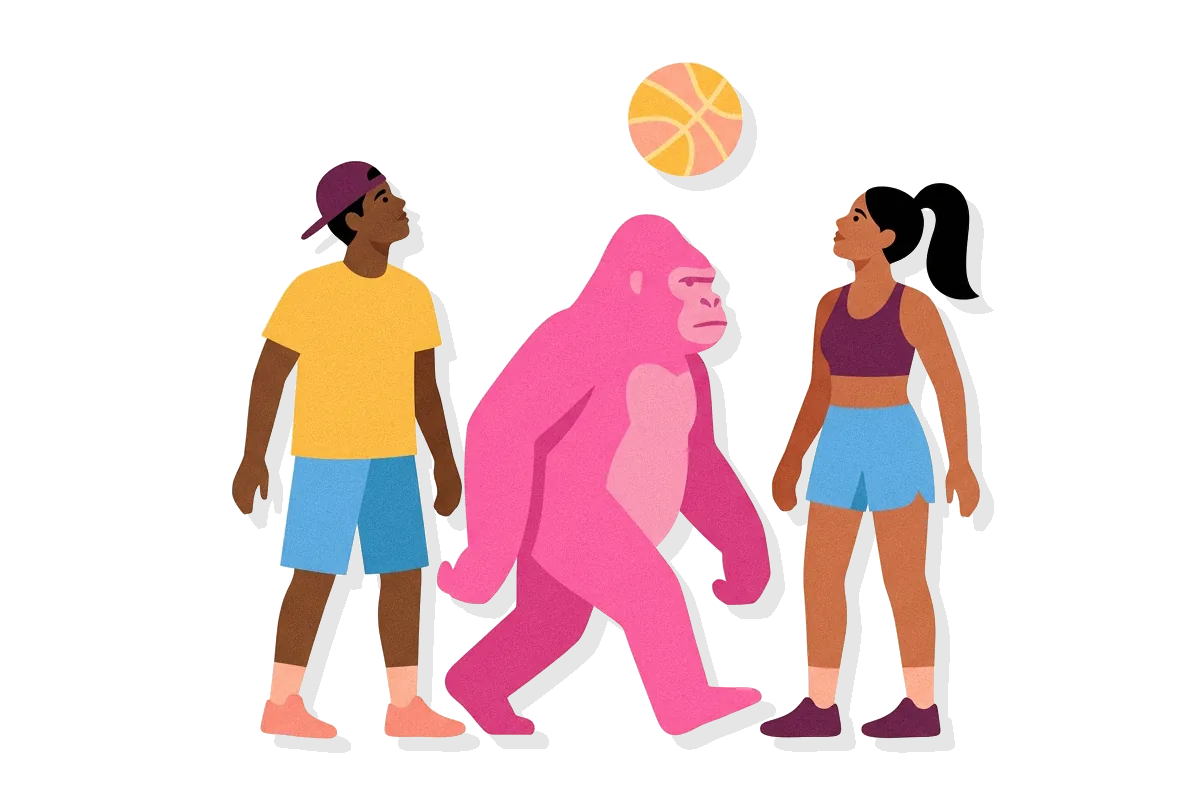
Change blindness is often confused with Inattentional Blindness, and the two are close relatives but not the same failure. Inattentional blindness is failing to notice something that was there the whole time, unchanged, because attention was occupied elsewhere — the well-known case is failing to see a gorilla walk through a group of people passing a basketball, in a video where nothing else changes. Change blindness specifically needs a change between two moments, with an interruption between them; the failure is not noticing the difference, not failing to notice an object that was always present.
It is also distinct from simple forgetting. In change blindness, the earlier scene was seen clearly, in normal viewing conditions, just moments before — the failure sits in the comparison, not in the original perception decaying out of Working Memory over minutes or hours. A witness forgetting a detail from an hour-long conversation is a memory problem on a completely different timescale.
091 min
Common misunderstandings about Change Blindness
The most common error is assuming that paying attention to something guarantees a person would notice it change. The film-actor study shows the opposite: the actor was the obvious focus of the entire scene, and two-thirds of viewers still missed the swap. Attention makes change detection possible; it does not make it automatic.
A second misunderstanding is treating change blindness as proof that people barely see anything at all. The visual system produces a rich, detailed experience of whatever a person is looking at right now — these findings point to a gap in comparing two moments, not a gap in seeing the current one.
A third is assuming the effect only happens to careless or distracted people. Rensink, O'Regan, and Clark's observers were watching closely, expecting a change, and trying hard to find it, and the changes still took several seconds to notice on average. Trying harder does not fix a comparison that has nothing to compare against.
101 min
How research on Change Blindness developed
The flicker paradigm was not the first way researchers produced this failure; it was the first way to produce it on demand, under controlled conditions. In work first reported in 1991, Grimes changed photographs while a person's eyes were moving, and found that half of observers failed to notice when two cowboys sitting on a bench exchanged heads. That earlier method depended on catching a real eye movement at the right moment, which limited how precisely researchers could study the effect; the flicker paradigm produces the same kind of blindness on any monitor, on command, without needing an eye movement at all.
Since then, the same basic failure has been produced with eye blinks, a scattering of dots flashed over the image at the moment of the change, changes stretched gradually across many seconds, and real-world interruptions like the door study. What unites these different methods is that each one blocks the local motion signal an uninterrupted, real change would normally produce.
111 min
Where the evidence is contested
There is a real disagreement about what change blindness proves about vision, not about whether the effect itself is real — it replicates reliably across photographs, film, and real interactions. The open question is what to conclude from it. Some early readings treated change blindness as proof that the visual system holds almost no detailed picture of a scene at all. Simons and Rensink later argued this does not on its own prove that vision stores only a sparse picture of a scene: change blindness would occur even with a detailed, complete representation, if it decayed or was overwritten before the comparison could happen.
Simons and Rensink pointed to research on visual search and iconic memory showing that detailed representations of a scene do form, but last only about half a second before being replaced by whatever is looked at next. The disagreement, then, is not about whether people miss changes — they clearly do, reliably, under precise conditions — but about whether the failure happens at the point of building a picture of a scene, or at the point of holding onto that picture long enough to compare it with what comes next.
?5 questions
Questions people ask
What causes change blindness?
What is an example of change blindness in real life?
How do you reduce change blindness in interface design?
What is the difference between change blindness and inattentional blindness?
Does change blindness mean people barely see anything?
▶3 videos
Watch
Understanding Change Blindness
change blindness, the flicker task, & sensory memory - ok science
ok science
Psychology of Attention Explained | Selective Attention, Inattentional Blindness, & Change Blindness
MindfulThinks
§6 sources
Sources
Rensink, R. A., O'Regan, J. K., & Clark, J. J. (1997). To see or not to see: The need for attention to perceive changes in scenes. Psychological Science, 8(5), 368-373.
Simons, D. J., & Levin, D. T. (1997). Change blindness. Trends in Cognitive Sciences, 1(7), 261-267.
Levin, D. T., & Simons, D. J. (1997). Failure to detect changes to attended objects in motion pictures. Psychonomic Bulletin & Review, 4(4), 501-506. (1997)%20failure%20to%20detect%20changes%20to%20attended%20objects%20in%20motion%20pictures.pdf
Simons, D. J., & Rensink, R. A. (2005). Change blindness: Past, present, and future. Trends in Cognitive Sciences, 9(1), 16-20.
Show all 6 sourcesShow fewer sources
Grimes, J. (1996). On the failure to detect changes in scenes across saccades. In K. Akins (Ed.), Perception (Vancouver Studies in Cognitive Science, Vol. 5). Oxford University Press. Cited via source 4 above; no open copy of the original chapter was found.
Simons, D. J., & Levin, D. T. (1998). Failure to detect changes to people during a real-world interaction. Psychonomic Bulletin & Review, 5(4), 644-649. This is the formal publication of the door study described in source 2; its publisher page requires an institutional login, so it is listed here for the record rather than linked.