011 min
Where the von Restorff effect shows up
A designer at a subscription app is reviewing a settings screen with twelve identical grey menu rows. Nobody on the team can recall which row holds the "delete account" option a week later, because every row looks the same. The designer changes that one row to red text on a white background. In the next usability session, every participant points to it immediately and remembers it days afterward without being asked to. Nothing about the row's wording changed, and no extra copy was added to explain it — only its visual contrast with its neighbors did.
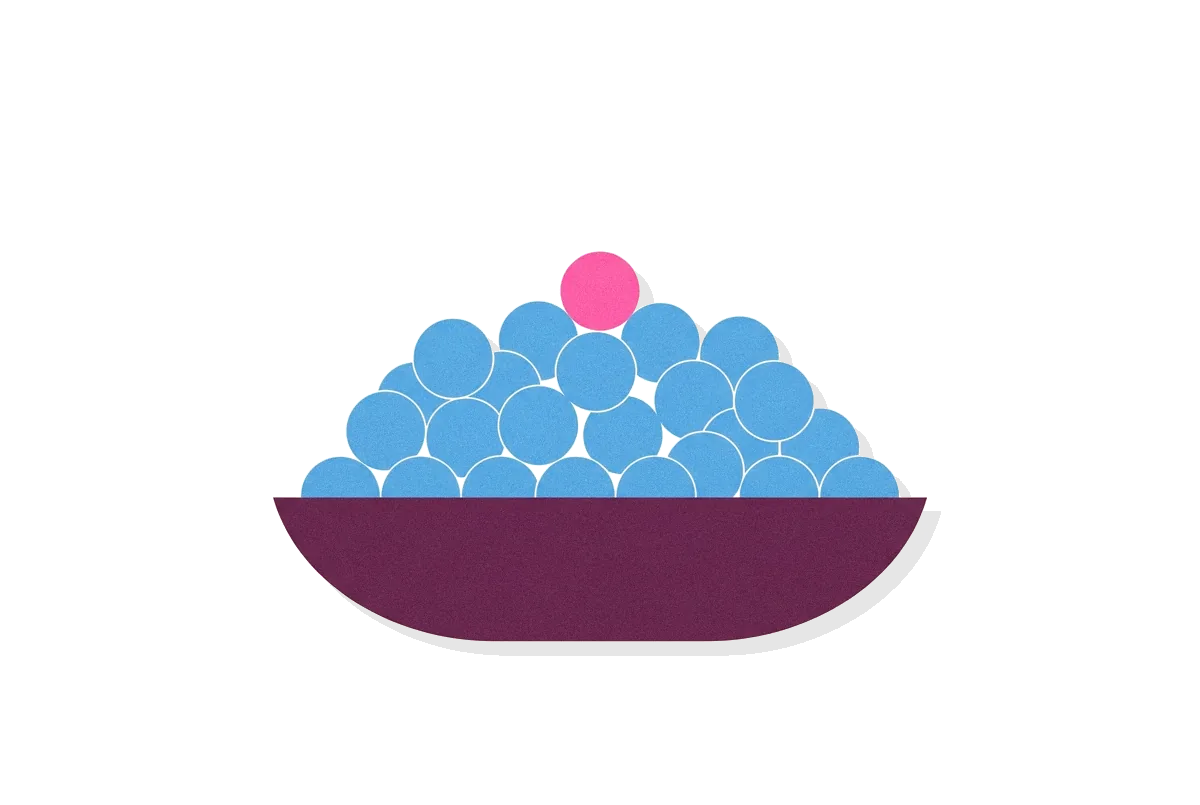
This is the von Restorff effect at work: memory is not just about how much attention something gets in the moment, but about how different it looks from the things surrounding it. An item that breaks the pattern of a list gets encoded as a separate, more memorable event, while items that look like their neighbors blur into one another in memory.
022 min
Why the von Restorff effect happens
Von Restorff's own explanation rests on what later researchers call distinctive processing: memory encodes an event by recording both what it shares with its neighbors and what sets it apart from them. When every item in a list looks alike, there is nothing to set apart, so the mind stores the whole list as one blurred unit. The isolated item gets its own separate memory trace, built from the contrast between it and everything around it.
This is different from simply paying more attention to the odd item, and the distinction matters. Later work by the memory researcher R. Reed Hunt found that isolation still improves memory even when the isolated item does not attract any extra attention at encoding — what changes is how easy the item is to tell apart from the rest at the moment of retrieval. A reader trying to recall "which row was different" has an easy discrimination to make; a reader trying to recall "which of these twelve identical rows" does not.
The effect is also asymmetric in a way that matters for design and writing. It reliably improves recall — being asked to bring an item back to mind unprompted — but it barely helps recognition, being shown the item again and asked "have you seen this." A distinctive item is not simply more memorable in some general sense; it is specifically easier to locate among competing memories, which is exactly the operation recall requires and recognition does not. This makes it a close cousin of how working memory holds a limited set of items, and a contrast to inattentional blindness, where an unexpected item is missed entirely rather than remembered.
031 min
Where the von Restorff effect comes from
Hedwig von Restorff published the effect in 1933, in a paper reporting experiments she ran under the Gestalt psychologist Wolfgang Köhler at the Psychological Institute in Berlin. Over three days, she gave participants lists of eight paired items apiece. Half of each list's pairs were nonsense syllables — deliberately meaningless so that prior familiarity could not explain what got remembered. On the first day every pair type was different from its neighbors; on the following two days, one item was isolated among an otherwise uniform run of nonsense-syllable pairs, placed early in the list.
Participants recalled the isolated item far more often than the equivalent item had been recalled when it was not isolated. Von Restorff also found that the effect held up even when the isolated item was placed where attention would naturally be lower, which she took as evidence against a simple "it stood out so people looked harder" account. The finding held across the different kinds of material she used — numbers, letters, symbols, and words — which is part of why it generalized so far beyond the original memory lab into design, marketing, and interface work decades later.
041 min
Examples of the von Restorff effect
A 2019 study published in a Brazilian neuropsychology journal tested a Portuguese-language version of the Rey Auditory Verbal Learning Test — a standard list-learning memory test — on older adults, including patients with mild cognitive impairment and Alzheimer's disease. The researchers built one isolated item into the test's word lists and found the isolation effect held not only in healthy older adults but in both patient groups too, even though both groups' overall recall was impaired. Distinctiveness kept working as a memory aid even when general recall did not, which is why memory researchers still use isolated-item lists as a diagnostic tool.
A second, illustrative case shows the same principle at product scale. A support engineer scanning a long, uniformly formatted incident log is asked afterward which entries mattered. They can describe the one line that was bolded and colored differently — the deployment rollback — in detail, but only vaguely gesture at the fifteen routine log lines around it. The fix the team made was not to add more text explaining the rollback; it was to make that single line visually unlike its neighbors, so it would be the one thing a tired reader's memory kept.
051 min
How the von Restorff effect shows up in product, design, and AI
For a product designer, the effect argues for restraint rather than decoration: a single call-to-action button in an accent color is remembered because everything else on the page is deliberately plain. The moment a second element competes for the same distinctiveness — a badge, a banner, and a colored button all on one screen — none of them stand out from one another anymore, and the effect collapses back into a uniform list.
For an engineer building a monitoring dashboard, the same logic applies to error states. A dashboard where every metric tile uses the same red-for-bad color scheme trains viewers to stop noticing red at all. A team that reserves a distinct visual treatment for the one metric that actually requires action gets remembered attention on the metric that needs it.
The effect is also exploited deliberately in ways worth naming. A pricing page that renders every plan in identical grey cards except the "recommended" one is using isolation to make that plan the one shoppers remember choosing between, whether or not it is genuinely the best value for a given buyer. The mechanism is the same as the accessible, honest use in a settings screen; only the intent differs.
061 min
How to use the von Restorff effect deliberately
Using the effect well is mostly a matter of counting, not willpower. Before shipping a screen, count how many elements are competing for distinctive treatment — color, size, motion, or position. If more than one item on the same screen is trying to be "the different one," none of them will be, and a reviewer should cut the emphasis back down to one.
The same logic applies in writing and documentation. A page where every paragraph is bolded for emphasis has, in effect, no emphasis left; the only way to make one fact memorable is to leave the rest of the page plainer than it. Writers who want three points to land equally well are better off giving each one a short paragraph of its own than trying to bold all three, because separation does the isolating work that formatting cannot do once it is overused.
Reserve one distinctive treatment per screen for the single item you most want remembered, and keep everything around it uniform so the contrast stays sharp.
One caution: distinctiveness that relies only on color excludes readers with color vision deficiency or low vision, so pair it with a second cue — shape, weight, position, or a label — whenever the memory it creates actually matters.
071 min
Common misunderstandings about the von Restorff effect
The most common misreading is that the effect is simply "things that grab attention are remembered better." That is close, but it misses what von Restorff actually showed: it is the contrast between an item and the established pattern around it that matters, not the item's own loudness. A bright red button on a page of bright red buttons is not distinctive at all, however eye-catching red is in the abstract. Distinctiveness is a relationship between an item and its context, not a property the item carries on its own.
The second misunderstanding is that more emphasis is always better. Because the effect depends on one item breaking a uniform pattern, adding a second and third emphasized element does not multiply the memory boost — it destroys it, by turning the exceptions back into a pattern of their own. Designers who highlight everything important end up highlighting nothing.
A third limit worth naming: the effect is real but modest, and it is not a substitute for the content being worth remembering. Making a bad label distinctive makes people remember a bad label. Isolation decides what gets remembered among competing items; it does not decide whether that item deserved the memory.
081 min
Von Restorff effect vs. nearby concepts
The von Restorff effect is easy to confuse with the primacy effect and recency effect, which describe why the first and last items on a list are remembered best regardless of how they look. Those two effects are about an item's position; the von Restorff effect is about an item's visual or categorical contrast with its neighbors, and it can boost recall for an item in the middle of a list that neither position-based effect would predict.
It is also distinct from the serial position effect more broadly, which is the umbrella term covering primacy and recency together. A list can show a strong serial position curve — good recall at the start and end, weak recall in the middle — and still show a separate von Restorff bump for one isolated item planted in that weak middle section. The two patterns are additive, not competing, so a well-designed memory study — or a well-designed interface — has to account for both a reader's position bias and their distinctiveness bias at once.
091 min
Where the evidence on the von Restorff effect is contested
The live disagreement is about the mechanism, not whether the effect exists. One camp holds that isolation works because a pattern-breaking item involuntarily pulls extra attention during encoding. Karis, Fabiani and Donchin (1984) provided empirical support for this attentional account, finding that participants who showed greater attentional engagement with isolated items also demonstrated better recall for those items. A competing camp, associated with R. Reed Hunt, argues the gain comes later, at retrieval: a distinctive item is simply easier to discriminate from its neighbors when you try to bring it back, whether or not it drew extra attention at the time.
The practical stakes of the debate are small for a designer but real. If the retrieval account is right, an item does not have to be perceptually loud to be memorable — it only has to be genuinely different in kind from what surrounds it, which is why a plainly worded but uniquely placed item can outperform a flashy one. Modern theory has partly reconciled the two views by pointing to contextual incongruity: how much an item violates the pattern its neighbors set, rather than its raw salience, is what drives both the attention it gets and the memory that follows.
?6 questions
Questions people ask
What causes the von Restorff effect?
What is an example of the von Restorff effect in design?
How do you use the von Restorff effect without overdoing it?
What is the difference between the von Restorff effect and the primacy effect?
Is the von Restorff effect real and does it still hold up?
Does the von Restorff effect work for recognition as well as recall?
§6 sources
Sources and further reading
von Restorff, H. (1933). "Über die Wirkung von Bereichsbildung im Spurenfeld." Psychologische Forschung, 18, 299–342. The original paper reporting the isolation experiments.
Hedwig von Restorff — Wikipedia's account of the 1933 experimental setup, the isolation paradigm, and the results.
Von Restorff effect — overview of the effect, the attention-versus-retrieval debate, and ERP evidence.
Hunt, R. R. (1995). "The subtlety of distinctiveness: What von Restorff really did." Psychonomic Bulletin & Review, 2, 105–112. The distinctive-processing account.
Show all 6 sourcesShow fewer sources
Pinto, L. et al. (2019). The von Restorff effect in a Brazilian version of the Rey Auditory Verbal Learning Test in an elderly population (PMC6497024) — the effect in healthy older adults and in MCI and Alzheimer's patients.
Von Restorff Effect — Laws of UX, the design-facing application and its accessibility caveat.