011 min
Where inattentional blindness shows up
An illustrative case, with a role rather than a person. An on-call engineer is paged at night for slow checkouts. They open the service dashboard and start tracking the latency graph, watching for the moment it crossed the alert threshold. For eleven minutes they read that graph, scroll it, compare it against the deploy timeline. Two panels to the right, the error rate has been climbing since before the latency did. They do not see it. In the postmortem they look at a screenshot of the same dashboard and find it immediately.
Change one input and run it again. This time the page says something is wrong with checkout instead of checkout latency above threshold. The engineer opens the same dashboard with no particular graph in mind, scans across it, and notices the error rate within thirty seconds.
Nothing about the screen changed between the two runs. The engineer's eyes covered the same area in both. What changed was what they were looking for, and that turned out to determine what they could see.
That is the pattern, and it is the part people find hardest to accept about themselves. Inattentional blindness is not a failure of effort or of eyesight. The first engineer was concentrating hard. Concentrating hard is what caused it.
022 min
Why inattentional blindness happens
Vision does not deliver a complete picture of a scene to awareness. Attention selects a small part of what reaches the eyes, and what is not selected can fail to reach conscious perception at all, even when it is looked at directly.
The selection is not random. It is governed by what psychologists call an attentional set: the set of features you are currently tuned for. Steven Most, Brian Scholl, Erin Clifford and Daniel Simons made this the centre of their 2005 Psychological Review paper, concluding that the most influential factor in whether an unexpected object is noticed is the observer's own attentional goals.
The number that shows the mechanism
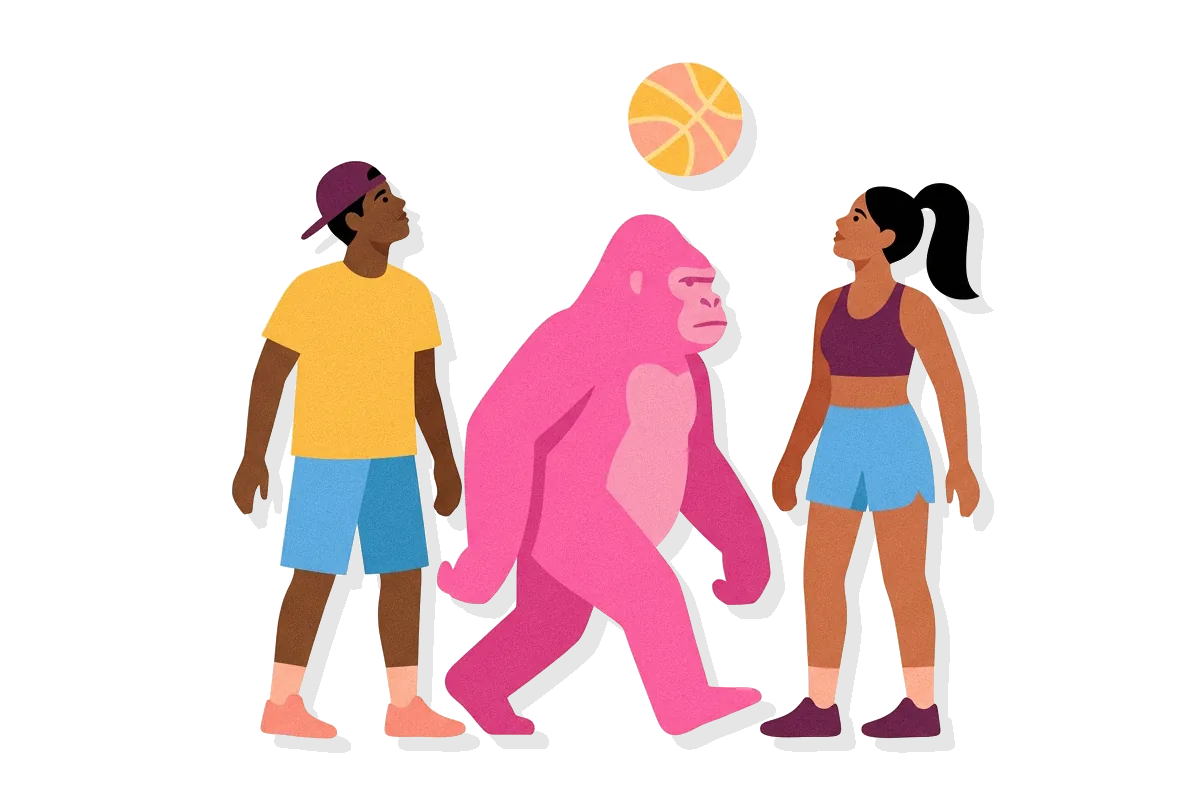
Simons and Chabris built a test of this into the 1999 study without needing a separate experiment. Their video had two teams passing basketballs, one in white shirts and one in black. Observers were asked to count passes made by one team. A person in a gorilla suit then walked through.
In the matched condition, 42 percent of observers noticed the gorilla when they were counting passes by the white team. When they were counting passes by the black team, 83 percent noticed it. Same video, same gorilla, same walk.
The gorilla suit is black. Observers tuned to black shirts were tuned to a feature the gorilla shared; observers tuned to white shirts were not. Noticing roughly doubled on the strength of a feature match. Attention is not a spotlight you point at a location. It is a filter set for particular properties.
Load makes it worse
The second factor is how much the task consumes. Simons and Chabris gave half their observers a harder job: keeping two separate running counts, of aerial passes and bounce passes, rather than one total. Noticing fell from 64 percent to 45 percent.
So two things predict whether you will see the unexpected. Whether it resembles what you are hunting for, and how much capacity your hunt is already using. Neither has anything to do with whether the object is visible.
031 min
Where inattentional blindness comes from
Ulric Neisser ran the ancestor of these studies in the 1970s, overlaying two videos of people playing a game and asking viewers to track one. Most viewers missed striking events in the ignored video. The approach then went quiet for two decades.
Arien Mack and Irvin Rock named the phenomenon in their 1998 book Inattentional Blindness, working with brief static displays rather than video.
The demonstration that carried it out of the laboratory is Daniel Simons and Christopher Chabris, Gorillas in Our Midst, published in Perception in 1999 while both were at Harvard. The design detail that matters is its scale: sixteen conditions, varying the video type, the difficulty of the counting task, which team was attended, and which of two unexpected events occurred.
Across all 192 observers, 54 percent noticed the unexpected event and 46 percent did not. The version now famous is one cell of that grid, not the headline result.
One finding inside it is regularly lost. A woman carrying an umbrella was the other unexpected event, and she was noticed 65 percent of the time against the gorilla's 44 percent. The study was never about gorillas. It was about which unexpected things get through and which do not.
041 min
What inattentional blindness changes
The practical limit is roughly this: a person performing a demanding visual task will miss a large, fully visible, unexpected object somewhere between a third and a half of the time. In the 1999 study, even in the clearest video condition with the easier counting task, 33 percent of observers still missed the event.
Three consequences follow for anyone who designs work or interfaces.
Watching is not covering. Assigning a person to monitor a screen does not mean anomalies on that screen will be noticed. It means anomalies matching what they were told to watch for will be noticed, most of the time.
People cannot report their own misses. The observer who missed the gorilla has no experience of missing anything. This is why self-reports of attention are close to worthless as evidence, and why "I would have seen it" is not information.
Adding a second task is not free. The move from one count to two dropped noticing by nineteen percentage points in the original study. Any interface that asks somebody to hold a second thing in mind is spending from the same budget.
052 min
Examples
Experts in their own speciality. Trafton Drew, Melissa Võ and Jeremy Wolfe published The Invisible Gorilla Strikes Again in Psychological Science in 2013. They gave 24 radiologists a familiar task: search chest CT scans for lung nodules. Into the final case they inserted an image of a gorilla, 48 times the size of an average nodule.
Eighty-three percent of the radiologists did not report it. Eye-tracking recorded where they had looked, and the majority of those who missed it had looked directly at its location.
Two details raise this above a repeat of the 1999 result. These were experts doing their own daily job, not students counting passes in a video, and the eye-tracking removes the obvious objection. They were not failing to look. They were looking and not seeing.
The finding does not say radiologists are careless. It says expertise sharpens an attentional set rather than widening it. A specialist trained to find small round opacities is tuned for small round opacities, and that tuning is exactly what makes them good and what makes the gorilla invisible.
The same shape in a product. A support agent trained to scan tickets for refund requests will process refund requests quickly and reliably. The ticket in the same queue describing a security problem in unfamiliar words is the one that sits unactioned for a day. Nobody was negligent. The queue was searched for a feature that ticket did not have.
062 min
A second case: outside on a street
In 1995, a Boston police officer chasing a suspect ran past a group of officers beating a man. He testified that he had not seen it, and was convicted of perjury and obstruction of justice.
Christopher Chabris, Adam Weinberger, Matthew Fontaine and Daniel Simons tested whether that account was even possible. They published the result in i-Perception in 2011 under the title You do not talk about Fight Club if you do not notice Fight Club. Participants ran along a route following another person, while three confederates staged a fight beside the path. At night, 35 percent noticed the fight. In daylight, 56 percent did. Adding mental tasks to the run cut noticing further, by roughly 15 percentage points per added task.
One variable separates this case from the radiologists: whether the observer is doing a visual search at all. The radiologists were searching a fixed image for a known target. The runners were doing something physical, outdoors, with no search task, in a real three-dimensional space with nothing on a screen.
What the contrast teaches is not available from either alone. If inattentional blindness were a quirk of screens, or of artificial counting tasks, or of laboratory conditions, the running study should have come out differently. It did not. Even in daylight with no counting to do, nearly half of the runners missed a staged assault a few metres away.
That is also why the concept reaches beyond interface design. It is evidence that a sincere eyewitness can be wrong about what was in front of them, which is a claim with consequences in courtrooms as well as in postmortems.
072 min
How inattentional blindness shows up in product, design, and AI
Banner blindness is this effect with a commercial name. Jakob Nielsen of Nielsen Norman Group reported in 2007 that across hundreds of pages of eyetracking sessions, users almost never fixated on anything that looked like an advertisement, whether or not it actually was one. His observation is the important half: the blindness attaches to the appearance, not the content. A genuinely useful notice styled like a banner inherits the same fate. This is eyetracking observation rather than a controlled experiment, so treat it as a strong pattern rather than a measured effect size.
Alert design. A monitoring interface that names the metric to watch has, by that act, narrowed what the responder can see. The stronger pattern is to state the symptom the user reported and let the responder search broadly, then narrow. This costs seconds and buys the whole dashboard.
Design review and QA. A reviewer given a checklist finds checklist items. The regression nobody listed is the one that ships. Two cheap guards: run one pass with no checklist before the checklist pass, and rotate who reviews what, because a fresh attentional set is the only reliable way to catch what another one filters out.
Evaluating model output. This is where the effect bites hardest in AI work, because the evaluation task is itself a visual search. A reviewer scoring answers for factual accuracy is tuned for factual claims. The answer that is factually correct and leaks a customer's name, or ignores the user's actual question, passes. Score one dimension per pass, with separate reviewers, rather than asking one reviewer to hold five criteria at once. The 64-to-45 percent drop from a single to a double counting task is the reason.
082 min
How to guard against inattentional blindness
Start with the honest part. Daniel Simons, who ran the original study, puts it plainly in his own teaching module: there is no magical elixir that will overcome the limits on attention. Awareness of the effect does not confer immunity, and nothing below eliminates it. Each of these reduces exposure by changing the conditions rather than by trying harder.
Widen the set deliberately. Because noticing is driven by feature match, the fix is to change what is being hunted for, not to concentrate more. Ask an incident responder for one unstructured pass across the whole dashboard before naming the metric. Ask a reviewer what stands out before handing them the criteria.
Use a second pair of eyes with a different brief. Two people given the same instructions share an attentional set and will miss the same things. Two people given different briefs will not. This is why an independent reviewer beats a more careful one.
Take tasks away, not add them. Load drives misses. If a role must notice the unexpected, remove the secondary counting, tracking and note-taking from that role rather than training them harder.
Automate the unexpected, and accept the limits. Anomaly detection catches what a tuned human filters out, precisely because it is not tuned. It also produces false alarms, and a responder who has learned to dismiss alerts has formed an attentional set that excludes them.
Stop treating a miss as negligence. An organisation that punishes people for not noticing will get fewer reports, not more noticing. The 1999 result is the argument: roughly half of ordinary observers miss a person in a gorilla suit walking through the middle of the screen.
092 min
Common misunderstandings
"They weren't really looking." This is the belief the eye-tracking was built to test. In the 2013 radiologist study, the majority of those who missed the gorilla had fixated directly on it. Looking and seeing separate cleanly, and only one of them is under the observer's control.
"It shows people are bad at multitasking." The pop version. Multitasking load makes it worse, but the effect appears in single-task conditions too. The primary driver is feature match, and the 42-versus-83 percent split between attending the white and black teams was measured under identical load.
"It's about how visible the object is." Salience matters less than expected. A person in a gorilla suit could hardly be more conspicuous, and 46 percent of observers missed the unexpected event across the 1999 study. The umbrella woman, less dramatic, was noticed more often.
"Training or expertise fixes it." The radiologists were experts performing their own diagnostic task. Expertise appears to narrow the attentional set, which is what makes an expert fast and what makes them miss the thing outside it.
Where the effect is doing useful work. Filtering is not a defect. A radiologist who noticed everything in a scan would never finish one, and a user who attended to every element of a page could not read it. The cost of filtering is paid only when something genuinely important falls outside the filter, which is rarer than these studies make it feel.
101 min
Inattentional blindness vs. nearby concepts
| Compared with | The axis that separates them |
|---|---|
| PsychologyChange blindness | |
| PsychologyBanner blindness | |
| PsychologyAttentional blink | |
| PsychologySelective attention |
If you need one question to tell them apart in conversation: was the thing there all along? If yes, and it was missed, that is inattentional blindness.
?8 questions
Questions people ask
What causes inattentional blindness?
What is the invisible gorilla experiment?
Does inattentional blindness mean people aren't looking?
Are experts immune to inattentional blindness?
What is the difference between inattentional blindness and change blindness?
Can you train yourself to avoid inattentional blindness?
How common is inattentional blindness in real life?
What does inattentional blindness mean for eyewitness testimony?
§7 sources
Sources
Simons, D. J. and Chabris, C. F. (1999). Gorillas in Our Midst: Sustained Inattentional Blindness for Dynamic Events. Perception 28, 1059-1074 (record: )
Drew, T., Võ, M. L.-H. and Wolfe, J. M. (2013). The Invisible Gorilla Strikes Again: Sustained Inattentional Blindness in Expert Observers. Psychological Science 24(9), 1848-1853
Chabris, C. F., Weinberger, A., Fontaine, M. and Simons, D. J. (2011). You do not talk about Fight Club if you do not notice Fight Club: Inattentional blindness for a simulated real-world assault. i-Perception 2(2), 150-153
Most, S. B., Scholl, B. J., Clifford, E. R. and Simons, D. J. (2005). What You See Is What You Set: Sustained Inattentional Blindness and the Capture of Awareness. Psychological Review 112(1), 217-242
Show all 7 sourcesShow fewer sources
Simons, D. J. Failures of Awareness: The Case of Inattentional Blindness. Noba Project
Nielsen, J. (2007). Banner Blindness: Old and New Findings. Nielsen Norman Group
Mack, A. and Rock, I. (1998). Inattentional Blindness, MIT Press, is the book that named the phenomenon. It is cited here through Simons and Chabris (1999), which attributes the term to it directly.