011 min
The Gulf of Execution in a stuck drawer
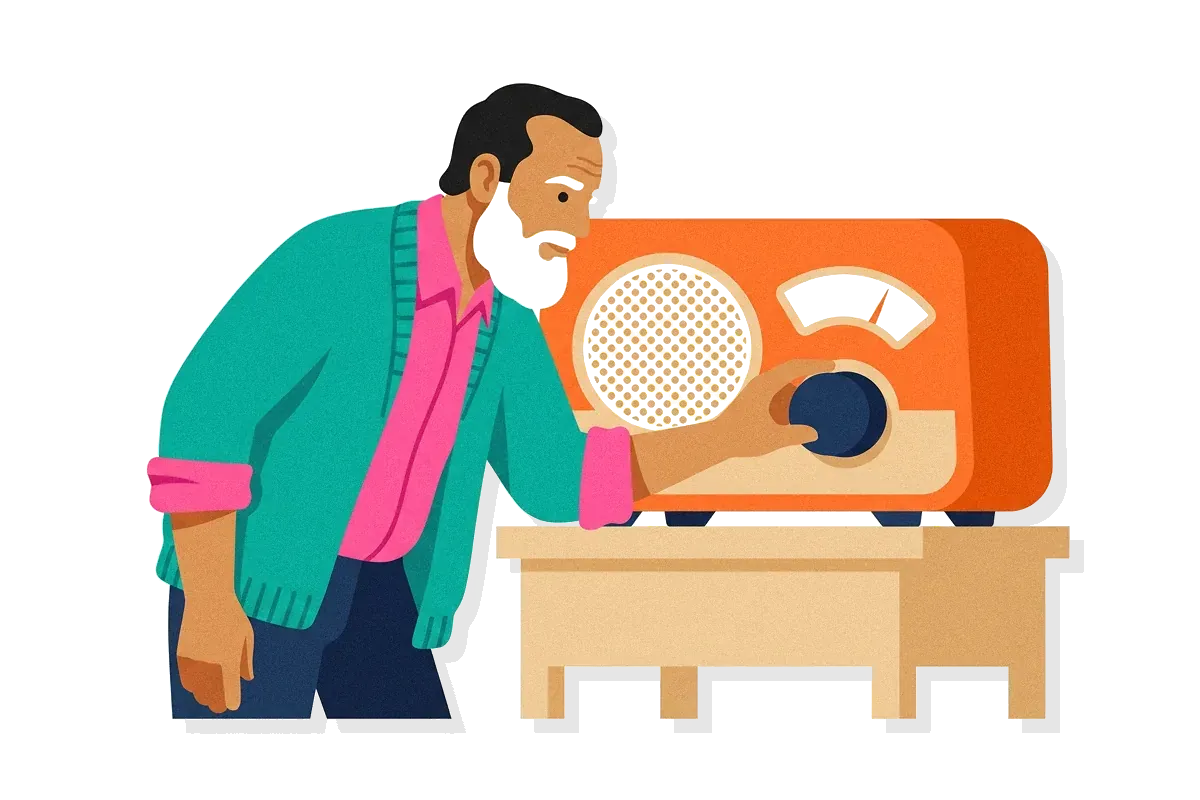
Donald Norman tells a story from a year his family spent in England, in a rented house. One day the landlady came back to the house for some personal papers. She went to the old metal filing cabinet and tried to open the top drawer. It was stuck. She pushed the drawer forward and back, left and right, up and down, and nothing worked.
She had a clear goal, which was to get the papers, and a clear plan, which was to open the top drawer, but when the plan failed she had no idea what to try next. At first the handle did tell her what to do, because it signalled a pull and had a slider that released the catch. Once pulling failed, the cabinet showed her no other action. She then blamed herself and said she was bad at mechanical things.
Norman did not accept her blame. He saw a fault in the cabinet and guessed that its drawer mechanism was out of line. Norman wiggled the drawer, twisted the front panel and banged on the front with the palm of one hand. The drawer slid open.
The landlady knew what she wanted. What she lacked was a way to find the action that would work. That distance, between a goal and the actions an object lets a person discover, is the Gulf of Execution.
022 min
How the Gulf of Execution works
The landlady's trouble fits a simple account of what happens whenever someone uses a thing. Norman describes seven stages of action: one for the goal, three for execution and three for evaluation. The three execution stages are plan, specify and perform. The three evaluation stages are perceive, interpret and compare.
The execution part asks three questions in turn. Which of the possible ways to reach the goal will I try? What exact action do I take now? How do I carry it out? People who meet a device face two gulfs: in the Gulf of Execution they must learn how to operate it, and in the Gulf of Evaluation they must judge its current state and whether their actions reached the goal. The first gulf is the subject here. The Gulf of Evaluation has its own page.
Norman uses the picture of a gulf, a wide stretch of water, and gives the designer the job of building bridges across it. The gulf is narrow when the product shows what can be done and how. It is wide when a person has to guess.
Two jobs inside execution
Kathryn Whitenton of the Nielsen Norman Group explains that execution has two parts: planning an action from an understanding of the controls, and then operating them. Success at one does not guarantee success at the other. A person may know that a small icon is the right control and still miss it with a thumb. Another person may have a steady hand and no idea which control to use. When you find a wide gulf, find out which of the two jobs is failing.
Which way the gulf runs
Hutchins, Hollan and Norman describe each gulf as running in one direction. The Gulf of Execution runs from the person's goals to the state of the system. The Gulf of Evaluation runs back from the state of the system to the goals. The two directions are separate problems, although solving one often depends on solving the other.
Feedforward, the help that comes before the action
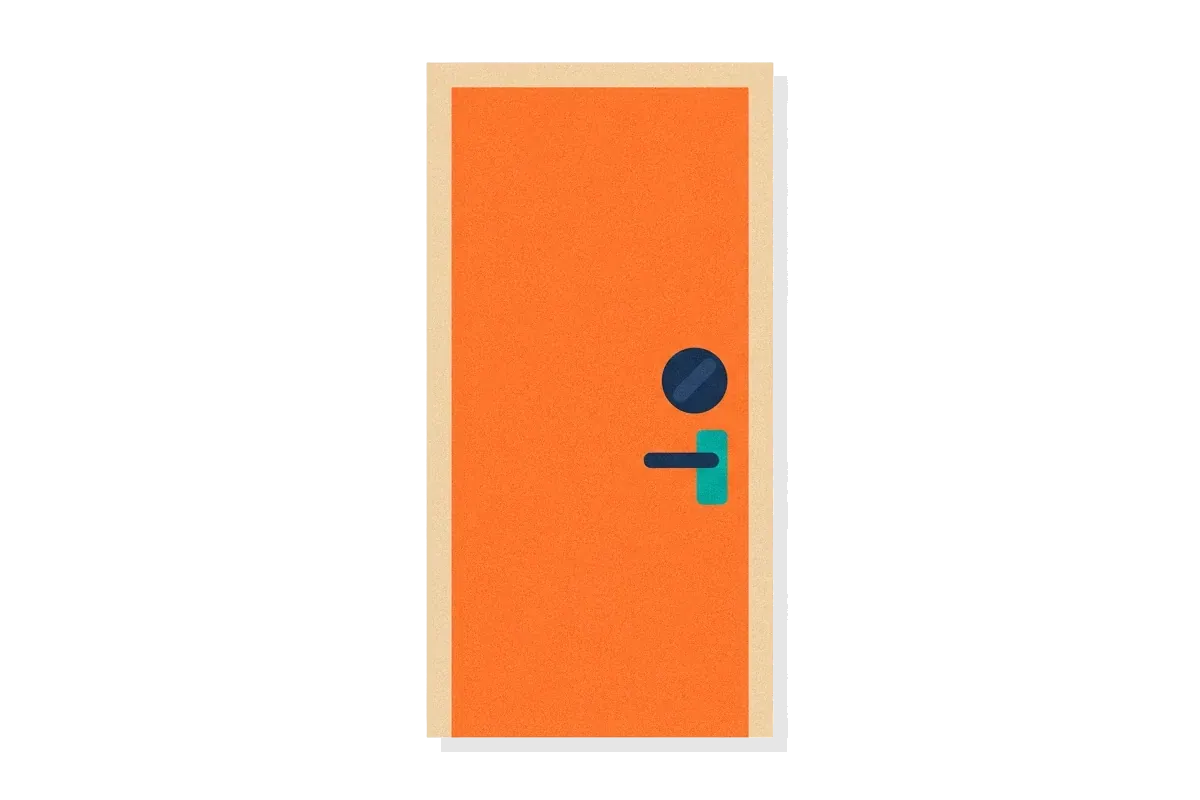
Feedback tells a person what has just happened. Designers also need a word for help that arrives before the action. Norman uses the word feedforward for the information that helps a person answer the questions of execution. Signifiers, constraints and mappings supply it, with help from the person's picture of how the thing works. Norman's own suggestion for a door that must be pushed is a vertical plate on the pushing side, which says where to push before anyone touches the door.
032 min
Where the Gulf of Execution comes from
Norman did not work this out alone. The gulfs came from research at the University of California, San Diego, where Edwin Hutchins, James Hollan and Donald Norman studied why some computer interfaces feel direct to use. Direct manipulation means acting on visible objects, such as dragging a file to a folder, instead of typing commands.
Their paper appeared in the journal Human-Computer Interaction in 1985. They wrote that an interface adds distance to the extent that there are gulfs between what a person wants and knows and how the system describes things. In a paper on direct manipulation interfaces, Hutchins, Hollan and Norman said the Gulf of Execution closes when the commands and mechanisms of the system fit what the user thinks and wants.
Norman later made the idea well known through his 1988 book, first called The Psychology of Everyday Things and later retitled The Design of Everyday Things. In the 2013 revised edition he credits Hutchins and Hollan for the gulfs and notes that they came from a joint research team of a Navy personnel research centre and the University of California, San Diego.
Distance in meaning and distance in form
The same paper splits distance into two kinds. Semantic distance is how far the meaning of what an interface offers sits from what the user wants to say. Articulatory distance is how far the physical form of an action sits from its meaning. Say a person wants to remove a file. A command called delete matches the wish in meaning. Whether the person must type a string of characters or drag an icon to a bin is a matter of form. Either kind can be long or short, so a gulf can be wide for either reason.
042 min
The Gulf of Execution in real products
Distances like these show up in ordinary products. A kitchen stove shows what a bad match between controls and burners costs. A software suite shows what happens when a product gains more features than people can find.
The kitchen stove
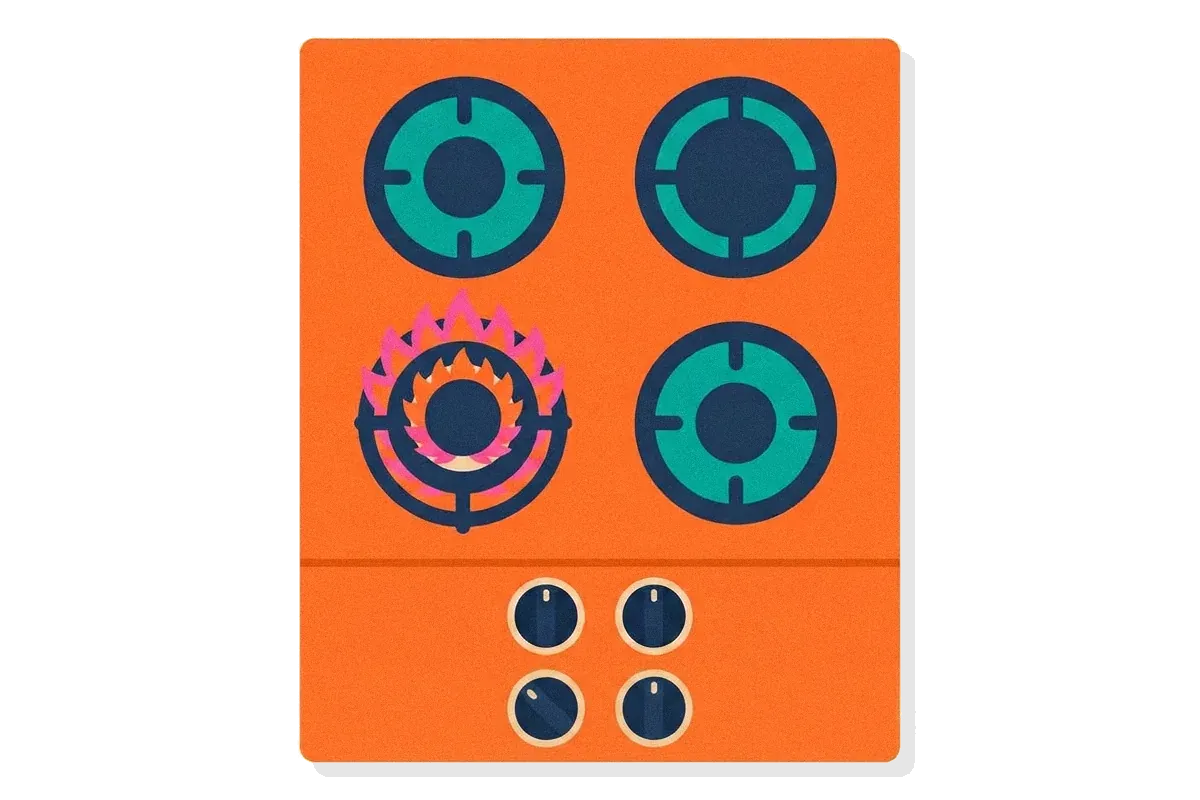
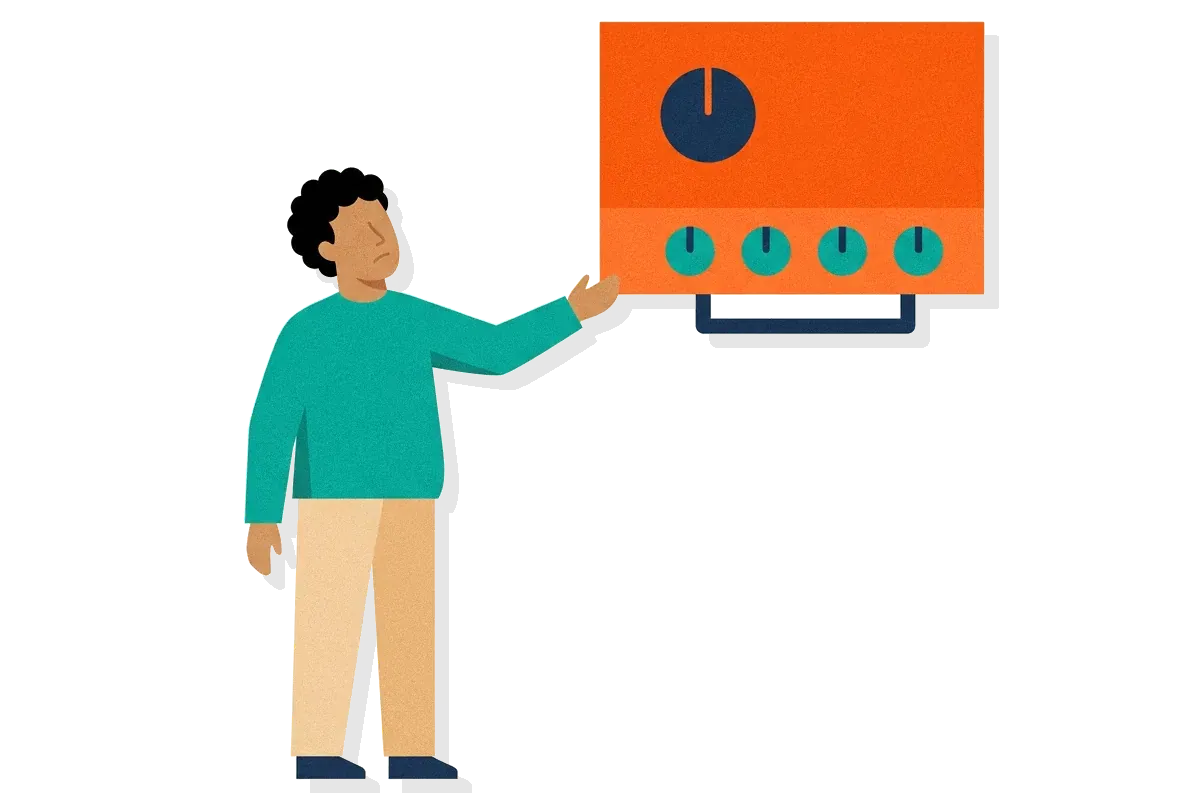
On many stoves the four burners sit in a rectangle and the four knobs sit in a straight line. The knobs do control the burners, but the layout does not say which knob goes with which burner. Norman counts four possible pairings of knobs to burners on a four-burner stove, and all four are sold, so the only way to know which knob heats which burner is to read the labels.
Norman's fix is simple. If the knobs sit in a rectangle like the burners, or the burners are staggered so they line up left to right, no labels are needed. He calls this a natural mapping, a layout where the relationship between a control and the thing it controls is obvious. A person then has nothing to learn or remember.
Microsoft Office before 2007
In software the problem is often volume instead of layout. A Microsoft employee's archived blog post says that most requests for new Office features asked for things the product already had. The same post says Office had gained so many features over the years that people could not find them.
Microsoft's answer was a new interface, the Ribbon, released with Office 2007. The people who asked for existing features were not missing a feature. They had not been able to answer the first question of execution: what can I do here?
052 min
Narrowing the Gulf of Execution
Once the gulf is visible, the fix is to answer the person's questions before they have to ask. Norman says designers narrow the Gulf of Execution with four tools: signifiers, constraints, mappings and a conceptual model. Five moves follow from them, and a designer can start on any of them this week.
- Put a visible hint where the action happens. A signifier is a signal that shows where and how to act, such as a handle, a label or a shape that fits a hand.
- Match the layout of controls to the layout of what they control, as in the stove with knobs in a rectangle.
- Remove actions that cannot work right now, by hiding them or switching them off. A person cannot choose a wrong action that is not offered.
- Give the product a conceptual model people can guess. A conceptual model is a person's picture of how a thing works. Reuse patterns the person already knows, and make the new product behave the way those patterns do.
- Show what an action will do before it happens, with a label that names the result or a preview. This is feedforward.
Norman also gives a checklist. At each stage the person should be able to answer a question: what are the alternatives, what can I do now, and how do I do it. If the product cannot answer one of them without help, that stage is where the gulf is widest.
When showing everything backfires
Visibility has a limit. Norman complains that many products defy understanding because they have too many functions and controls, and he argues that simple home appliances should not carry a bewildering number of them. Putting every control in view replaces one problem with another. The person can see everything and still not know which control matters. Show the common actions first and keep the rare ones one step away.
061 min
How to spot a wide Gulf of Execution
A wide gulf shows up in signs that anyone can check.
- Support tickets or feature requests for something the product already does, as in the Office case.
- People who repeat the same control, or try controls at random, after a first attempt fails. The landlady pushed the drawer in every direction.
- A long pause before the first action in a session recording, with no click, tap or keystroke.
- Wrong-control errors, such as the wrong knob turned on the stove.
- Users who say they are bad at the product. Norman notes that people who struggle with everyday devices often blame themselves, although the difficulty lies in the design and not in the people using it.
Each of these can be counted in a ticket queue or a session recording. None of them needs a guess about what the person was thinking.
072 min
Gulf of Execution vs nearby concepts
Several nearby ideas get mixed up with the Gulf of Execution. The closest is the Gulf of Evaluation, which sits on the other side of the same action.
| Concept | Question it answers | Where it sits |
|---|---|---|
| This pageGulf of Execution | ||
| DesignGulf of Evaluation | ||
| DesignAffordance | ||
| DesignSignifiers | ||
| DesignDiscoverability |
The two gulfs depend on each other. Whitenton describes buying a Bluetooth headset and spending an hour failing to connect it. She had been staring at the Windows 10 settings switch for an hour without realising that it showed Bluetooth was off. Once she saw that, the action she needed was clear. Any plan built on a wrong reading of the state fails, however clear the controls are.
An affordance is an action an object makes possible. It exists whether or not anyone can see it. Discoverability is the quality of a design that lets a person find out which actions exist. The tools do not replace the gulf. Affordances, signifiers and mappings are ways of narrowing it, and the gulf is the measure of how far a given person still has to go.
082 min
Where the Gulf of Execution model stops fitting
The model is a simplification, and Norman says so himself. He calls the seven-stage cycle simplified but still a useful framework for understanding action and guiding design. The Interaction Design Foundation adds that his theories belong to the information-processing view of the mind and share the criticisms made of that view. Four limits matter in practice.
Goals that nobody planned
Norman notes that many everyday actions are opportunistic and not planned: a person who walks past a new cafe may go in without having decided to. In those cases there is no fixed goal to compare the interface with. The gulf is better read as the distance from whatever the person happens to want in that moment.
Experts barely feel the gulf
Not every stage is conscious. A skilled driver thinks "left" and makes the turn, while a learner has to think about brakes, mirrors, pedals and hands one by one. The same product can have a wide gulf for one person and almost none for another. Test with people who are new to the product, because the people on the team already know how to use it.
Users who know more than the interface
Hutchins and colleagues point out that some users hold a view of the task and of the system that is broader and more powerful than the interface provides. In those cases the distance between wish and interface is harder to measure, and you have to look closely at the task being done.
Counting the stages
Sources count the stages differently. Norman's 2013 edition gives seven: the goal, three for execution and three for evaluation. A Michigan Technological University course page lists four steps for execution: establishing the goal, forming the intention, specifying the action sequence and executing the action. Both describe the same idea. Check which count a team means before comparing notes.
?4 questions
Questions people ask
How do you measure the Gulf of Execution?
Does a small Gulf of Execution mean the design is good?
Can a manual or training close the Gulf of Execution?
Does a blank text box have a Gulf of Execution?
§7 sources
Sources for the Gulf of Execution
Show all 7 sourcesHide sources
Norman, D. A. (2013). The Design of Everyday Things, Revised and Expanded Edition. Basic Books. Chapter 2, "The Psychology of Everyday Actions".
Hutchins, E. L., Hollan, J. D. and Norman, D. A. (1985). "Direct Manipulation Interfaces". Human-Computer Interaction, 1(4), 311-338.
Whitenton, K. (2018). "The Two UX Gulfs: Evaluation and Execution". Nielsen Norman Group.
Microsoft Learn archive, "So that's why Office 2007 looks different!", a Microsoft employee's blog post.
Vermeulen, J., Luyten, K., van den Hoven, E. and Coninx, K. (2013). "Crossing the bridge over Norman's Gulf of Execution: Revealing feedforward's true identity". Proceedings of CHI 2013, 1931-1940.
Interaction Design Foundation, "Gulf of Evaluation and Gulf of Execution", The Glossary of Human Computer Interaction.
Michigan Technological University, CS4760 course page, "Norman's Interaction Theory".