011 min
Libertarian paternalism in one company’s retirement plan
In 1998 a large company in the United States changed how new hires joined its 401(k) plan. A 401(k) is a retirement savings plan: the employee sends part of each paycheck into an investment account, and many employers add money of their own. Before the change, a new hire had to fill in a form to join. After it, new hires were joined automatically and had to fill in a form only to leave.
None of the plan's economic features changed. The economists Brigitte Madrian and Dennis Shea studied the company's records. Madrian and Shea compared new hires who were enrolled automatically with a similar group, measured after a similar time at the company. Without automatic enrollment, 37 percent of that group had joined by then, and with it, 86 percent had joined.
Nobody was forced to save. Anyone could still decline, and anyone could still change how much they saved. Yet 49 more employees in every hundred had joined. That raises a fair objection: was the company wrong to pick the starting rule for its employees?
022 min
Why libertarian paternalism says no setup is neutral
The company had to choose some starting rule. It could say that nobody is enrolled until they sign up, or that everybody is enrolled until they decline. Thaler and Sunstein argue that both rules change what employees do, so neither counts as the neutral one. Nothing in nature says an employee who does nothing must save nothing.
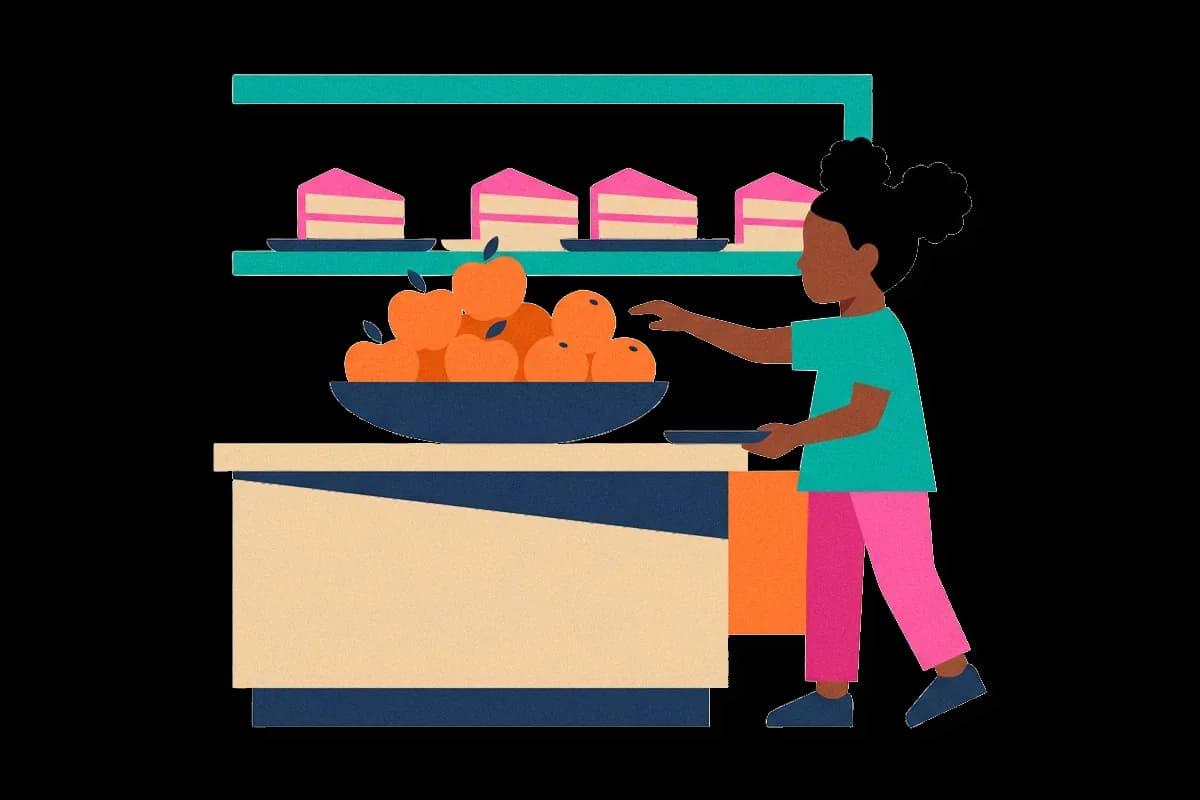
They make the same point with a cafeteria. Say the director of a company cafeteria finds that the order of the food changes what people pick. Putting the fruit first, ahead of the desserts, is the example they use. The director has three options: arrange the food to help diners, arrange it at random, or arrange it to make them as unhealthy as possible. Thaler and Sunstein ask whether anyone would argue for the second or the third.
Their conclusion is that some influence cannot be avoided, so the useful question is not whether to influence choices but how. The first option is paternalistic, because the director picks the order with the diners' good in mind. It is not coercive, because every dish is still on offer.
Asking people to choose is not neutral either
An obvious way out is to remove the default and require every new hire to answer yes or no. Thaler and Sunstein reply that this is also a rule the employer picked. Another study they cite, by James Choi and colleagues, found that required choice raises enrollment, but by less than automatic enrollment does. They add that the rule has a paternalistic side of its own, because many employees would rather not be asked at all.
031 min
The two halves of libertarian paternalism
That conclusion explains the odd name, because libertarian paternalism joins two words that usually oppose each other. Each half has a narrow meaning here.
Paternalistic describes the goal. In Thaler and Sunstein's sense, a policy is paternalistic when it is meant to influence people's choices in a way that makes them better off. They allow that people sometimes decide in ways they would change if they had complete information, unlimited ability to process it, and no lack of willpower.
Libertarian describes the limit. People must stay free to opt out of the arrangement if they want to. In this phrase the word names that one condition, not a wider political position. A rule that blocks a choice, such as a ban, falls outside the idea.
Why would anyone think people need guidance? Thaler and Sunstein point to research on two limits. The first is bounded rationality, the fact that people cannot process every piece of information perfectly. The second is weak self-control, such as valuing spending today far above spending later. They also note that the wording of a question can change the answer people give. One of their examples is a test on retirement portfolios. Employees at a company saw the likely retirement income of their own portfolio and of a portfolio that matched the median choice of their coworkers. Only 20 percent preferred their own.
042 min
Where libertarian paternalism came from
In 2003 Thaler and Sunstein argued that institutions can shape behavior and still respect freedom of choice. Thaler is a behavioral economist and Sunstein is a legal scholar, and both were at the University of Chicago. The short paper appeared in the American Economic Review in May, in a session on behavioral economics and public policy. Its stated goal was modest: to persuade economists, many of whom are libertarians and dislike the word paternalistic, to rethink their view of it. They expected most readers to call the phrase an oxymoron, a pair of words that contradict each other.
In the same year they published a longer defense in the University of Chicago Law Review, titled "Libertarian Paternalism Is Not an Oxymoron". It applied the argument to savings, labor law and consumer protection. Their 2008 book Nudge then turned the idea into a practical set of techniques for a general audience. Those techniques are covered in nudge theory, and the craft of arranging the options is covered in choice architecture.
Their argument rests on three claims. The first is that people do not always choose what is best for them. The second is that there is no neutral alternative to guiding choices, because someone must set the starting arrangement. The third is that guidance does not require force. The paper names the first claim a false assumption in the case against paternalism and the other two misconceptions.
052 min
Why defaults change what people choose
The 401(k) result raises a practical question: why does a starting rule change what people do when nothing else changes? Madrian and Shea conclude that the effect comes from two sources. One is inertia, the tendency to leave things as they are because changing them takes time and effort. The other is that many employees treat the default as investment advice from the company. This is the default effect, and it is closely related to status quo bias.
A default also changes what the act means
A third reason comes from organ donation. In a study published in 2012, Shai Davidai, Thomas Gilovich and Lee Ross asked people to rate how big an act it is to join a donation program. American participants rated joining as a much bigger act when it required opting in than when it required opting out. A follow-up with people in Germany, which uses opt-in, and Austria, which uses opt-out, found the same pattern.
In a third study, people in an opt-in country compared donating to giving away half of one's wealth to charity at death. People in an opt-out country compared it to letting others go ahead in a line or giving a little time to the poor. So the default does more than save effort. It changes how heavy the decision feels.
These three reasons tell a designer when a default is likely to work: when the person has no strong view, when changing it takes effort, and when the default looks like the sensible choice.
061 min
How a planner chooses the default
If a default changes behavior this much, whoever sets it needs a way to pick well. Thaler and Sunstein offer two routes.
The first is cost-benefit analysis: add up who gains and who loses under each rule. For automatic enrollment they expected the gains to be larger, partly because most employees end up joining and few leave once enrolled.
Often the information for that analysis is missing, or gathering it costs too much. In that case they suggest three stand-ins for welfare, which means a person's overall wellbeing:
- Pick what the majority would choose if everyone had to state a choice.
- Require everyone to state a choice.
- Pick the rule that the fewest people opt out of.
Each stand-in has a weakness, and Thaler and Sunstein say so. The majority may be poorly informed. A forced choice may produce poor choices. Few opt-outs may mean people are satisfied, or only that leaving is hard.
The circularity problem
The first test has a built-in trap. What people say they would choose can depend on the default they were handed. If so, the planner is using the effect of the default to justify the default. Thaler and Sunstein accept this limit. They note that the test works only where the majority would go the same way whatever the starting point.
072 min
How far libertarian paternalism can go
A default is the mildest form of libertarian paternalism, because some default has to exist. Thaler and Sunstein ask whether a planner may go further and still respect the opt-out.
Save More Tomorrow
Thaler and Shlomo Benartzi proposed a plan called Save More Tomorrow. Employees agree in advance to raise their savings rate each time they get a pay rise. They stay in until they opt out or reach the plan's maximum. In the first company to use it, employees who joined raised their savings rate from 3.5 percent to 11.6 percent in a little over two years. Very few left the plan.
Making an option harder to reach
Thaler and Sunstein take the cafeteria one step further. Placing the desserts in a separate area means diners must get up to fetch one. A standard economic view says this only adds effort for dessert eaters. Once self-control counts, the picture changes: some diners would eat dessert if it sat in front of them but would skip it with a little help. To keep the step libertarian, the planner can run two lines. One line offers everything, and the other makes unhealthy foods less available. Because people can pick either line, the step passes the test. The line Thaler and Sunstein draw is that a step may raise the cost of an option but may not remove it.
Sweden's pension default
In Sweden, a partial privatization of the pension system named a default portfolio for people who chose nothing. A large publicity campaign urged people to pick their own instead. Thaler and Sunstein cite this as an example of deciding how much choice to offer: many options, and a default that is not pushed.
Penalty defaults in contract law
Contract law has a close relative. A penalty default is a rule that burdens the party best placed to supply clear terms, so that party has a reason to state them. Thaler and Sunstein treat this as another form of libertarian paternalism.
082 min
Libertarian paternalism in product design
Product design meets the same problem every day, because every screen opens with some options already set. Picture a product team building the sign-up screen for a subscription app. They must decide whether the annual plan is selected when the screen opens, whether the renewal reminder is on, and whether the data-sharing box is ticked. Each starting state is a choice the team made, whether or not anyone discussed it.
Applied well, the team sets each default to what most of its users would pick after thinking about it. A renewal reminder that is on is an example. Each setting can be changed in one tap, in a place users can find. The default guides the user and the opt-out costs almost nothing.
A default that serves the designer
On 1 October 2019 the Court of Justice of the European Union decided the Planet49 case. A German company had used a pre-ticked checkbox on a promotional game form to collect consent to advertising cookies. The court ruled that a pre-ticked checkbox that the user must deselect does not give valid consent. Only active behavior by the user counts.
This is the same mechanism used for a different goal. The starting state was set to benefit the company, and the user had to act to refuse. That fails the paternalistic half, because the guidance did not aim at the user's good. Designers call interface designs of this kind dark patterns. Making the exit slow or confusing is called sludge, and it fails the libertarian half.
091 min
When a libertarian paternalism default backfires
A well-chosen default can still leave people worse off, and the 401(k) company showed how. Madrian and Shea looked at what employees did after being enrolled. The company's default sent 3 percent of pay to a money market fund, an investment with low risk and low returns. Of the employees hired under automatic enrollment, 61 percent were still at exactly that setting. They had not raised their rate or moved their money to another fund. Among employees hired before the change, only 1 percent were at the same setting.
So for many employees the default became the savings plan itself, and it was a modest one. More people saved, and many saved little. The lesson for designers is that a default carries a second decision, the value it sets, and that value is the one most people keep.
Who loses under a default
Thaler and Sunstein accept that a default can make some people worse off. They give employees who are short of cash as an example. Their answer is the opt-out: a person who needs the money can leave. That answer works only if leaving is easy in practice. A default fits the typical person and misfits the rest, so the planner has to ask who the rest are.
102 min
Where libertarian paternalism is contested
Not everyone accepts the argument, and the objections come from several directions.
Government planners make mistakes too
The economist Edward Glaeser argued in 2005 that bounded rationality may strengthen the case for limited government, not weaken it. His reasoning is that errors are larger where the people supplying information have strong incentives to persuade and the people receiving it have weak incentives to check. Citizens vote with weaker incentives to learn than they have when they buy something, so officials can make larger errors than consumers do. Thaler and Sunstein answer a related worry, the slippery slope, which is the argument that one small step leads to larger ones. They give three replies: some influence is unavoidable, the opt-out right limits how steep the slope can be, and anyone who fears that planners lack self-control is admitting that people lack it too.
Teach people instead
The psychologist Gerd Gigerenzer argued in 2015 that the evidence for human irrationality is weaker than claimed. He says it relies on narrow logical standards and on selective reporting of research. He proposes teaching people to understand risk as the real alternative to nudging.
Transparency and means
The philosopher Francesco Ferraro takes up the worry that nudges threaten autonomy and dignity. He argues the main problem is transparency, which can be fixed without making nudges less effective. He also argues that paternalistic nudging is means paternalism: it helps people reach their own goals and does not impose goals on them.
Do the effects hold up?
Stefano DellaVigna and Elizabeth Linos studied 126 trials from two nudge units in the United States, teams that run behavioral experiments for government agencies. The trials reached over 23 million people. Their average effect was 1.4 percentage points, against 8.7 points in a sample of published academic papers. They find that publication bias, helped by low statistical power, can explain the whole gap.
Maximilian Maier and colleagues went further in 2022. They reanalyzed a large published review of nudge studies and argued that, once publication bias is corrected, the evidence that nudges work disappears. These studies measure nudges in general, not enrollment defaults alone. For a practitioner, the lesson is to test a default in the setting where it will be used instead of expecting a published effect size.
111 min
Libertarian paternalism vs. nearby concepts
Several nearby terms are used as if they meant the same thing, and the differences matter in design work. The axis that separates them is whose benefit the setup serves, and whether every option stays open.
| Term | Whose benefit | Options stay open |
|---|---|---|
| Not in the library yetLibertarian paternalism | ||
| DesignNudge theory | ||
| DesignChoice architecture | ||
| DesignDark patterns | ||
| Not in the library yetSludge | ||
| Not in the library yetHard paternalism |
Nudge theory is the set of techniques, and libertarian paternalism is the argument for when using them is legitimate. Choice architecture names the work of arranging options, and the work can serve anyone. A helmet requirement is hard paternalism, because it removes the choice. Thaler and Sunstein call rules like this non-libertarian.
121 min
Checking a default against libertarian paternalism
A team that wants to apply libertarian paternalism can test each default with four questions, in this order.
Whose goal does it serve?
If the honest answer is the company's, stop. That is not libertarian paternalism.
Would most people pick it if they were asked and fully informed?
This is the majority test. If you cannot tell, ask a sample of users, or require an active choice for that setting.
How many people leave, and how hard is leaving?
Few opt-outs support the default only when leaving is easy. A hard exit breaks the libertarian half.
Who loses?
Find the group the default fits badly, such as people short of cash or people with an unusual need, and give them a clear way out.
Then measure after launch. The 401(k) company's default raised participation and also anchored many people to a low savings rate. Plans like Save More Tomorrow, which raise the value over time with the person's agreement, show one way to avoid that.
The decision for a team is whether it can defend each starting state to the people it affects. If the team could not explain a default to its users without embarrassment, change the default.
?4 questions
Questions people ask
Does libertarian paternalism apply to companies, or only to governments?
Is libertarian paternalism the same as political libertarianism?
Does libertarian paternalism require a law?
What counts as better off?
§10 sources
Sources
Richard H. Thaler and Cass R. Sunstein, "Libertarian Paternalism", American Economic Review 93(2), May 2003, pp. 175-179.
Cass R. Sunstein and Richard H. Thaler, "Libertarian Paternalism Is Not an Oxymoron", preliminary draft, 3 April 2003, later published in the University of Chicago Law Review.
Brigitte C. Madrian and Dennis F. Shea, "The Power of Suggestion: Inertia in 401(k) Participation and Savings Behavior", NBER Working Paper 7682, 2000.
Shai Davidai, Thomas Gilovich and Lee D. Ross, "The meaning of default options for potential organ donors", Proceedings of the National Academy of Sciences 109(38), 2012.
Show all 10 sourcesShow fewer sources
Court of Justice of the European Union, press release 125/19 on Case C-673/17, Planet49, 1 October 2019.
Edward L. Glaeser, "Paternalism and Psychology", NBER Working Paper 11789, 2005.
Gerd Gigerenzer, "On the Supposed Evidence for Libertarian Paternalism", Review of Philosophy and Psychology, 2015.
Francesco Ferraro, "The Problem With Nudges: Paternalism, Autonomy, and Transparency", e-Publica 8(2), 2021.
Stefano DellaVigna and Elizabeth Linos, "RCTs to Scale: Comprehensive Evidence from Two Nudge Units", Econometrica 90(1), 2022; NBER Working Paper 27594.
Maximilian Maier, Frantisek Bartos, T. D. Stanley, David R. Shanks, Adam J. L. Harris and Eric-Jan Wagenmakers, "No evidence for nudging after adjusting for publication bias", Proceedings of the National Academy of Sciences 119(31), 2022.